-
.jpg)
Egyptian Turquoise Glazed Faience Four Sons of Horus Mount Set
25th Dynasty, circa 747-656 B.C.Sold for (Inc. bp): £5,200
Set of four flat-backed plaques depicting the standing figures of the four sons of Horus (from left to right: Duamutef, Imsety, Hapy, and Qebehsenuef) in profile, each wearing a tripartite wig, broad collars, and holding a long folded cloth; mounted on a stand. 81 grams total, 95 x 80 mm including stand
Gunther Markert collection, Germany/Switzerland, 1954 or 1961. with Robert Bigler, Switzerland. Private collection, London, UK, acquired from the above on 12 October 2001. Accompanied by a copy of the Robert Bigler invoice. This lot has been cleared against the Art Loss Register database, and is accompanied by an illustrated lot declaration signed by the Head of the Antiquities Department, Dr Raffaele D'Amato.
The Four Sons of Horus were deities tasked with protecting the internal organs of the deceased. The human-headed Imsety safeguarded the liver, the baboon-headed Hapy looked after the lungs, the jackal-headed Duamutef defended the stomach, and the falcon-headed Qebehsenuef protected the intestines. Amulets featuring these deities were included within the mummy wrappings. -
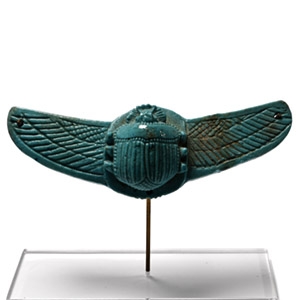
Egyptian Blue Faience Scarab
Late Period, 7th-6th century B.C.Sold for (Inc. bp): £4,550
Comprising a crescentic plaque with central scarab modelled in the half-round, and lateral wings with hatched texturing; scarab with ribbing and other detailing; pierced in four places for attachment; accompanied by a custom-made stand. 22.3 grams, 10 cm wide (44 grams total, 10 cm wide including stand)
Acquired in the 1950-1990s. Mr C., Geneva, Switzerland. Private collection, Europe. This lot has been checked against the Interpol Database of stolen works of art and is accompanied by a search certificate number no.12592-232170. This lot has been cleared against the Art Loss Register database, and is accompanied by an illustrated lot declaration signed by the Head of the Antiquities Department, Dr Raffaele D'Amato.
Winged scarabs were thought to ensure the rebirth and regeneration of the deceased, making them popular funerary amulets. This is a particularly fine example of a rarer one-piece amulet, as they are usually made from three separate elements. -
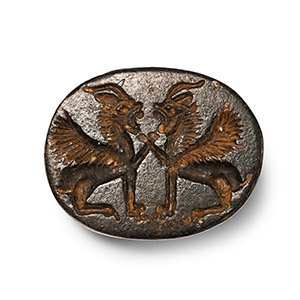
Phoenicio-Egyptian Black Stone Scaraboid with Lions
6th century B.C.Sold for (Inc. bp): £910
With gusset to the sidewall and incuse design to the underside of opposed winged lions each with one forepaw raised. 14.5 grams, 28 mm
Ex collection of the late Mr S. M., London, UK, 1970-1990s. This lot is accompanied by an illustrated lot declaration signed by the Head of the Antiquities Department, Dr Raffaele D'Amato.
Phoenician scarabs with winged lions were often used as guardian figures, much like Mesopotamian lamassu or Egyptian sphinxes. On amulets and seals, they likely served as apotropaic (evil-averting) symbols. In Phoenician and Persian art, hybrid creatures like winged lions reflect a cosmopolitan visual language, blending Egyptian, Assyrian, and Achaemenid motifs. They could symbolise imperial power or transcultural authority. In some cases, winged lions are linked to deities or divine guardianship, especially when shown flanking sacred symbols like trees, thrones, or sun discs. -
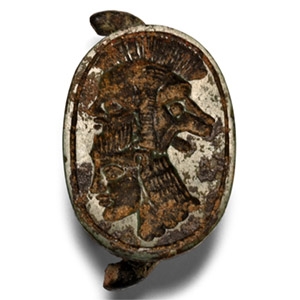
Phoenician Green Stone Scarab with Three-Headed Gryllos
6th-4th century B.C.Sold for (Inc. bp): £2,730
With carapace detailing to the convex face; underside with gryllos of a bearded male, a slender female and a boar. 6.94 grams, 28 mm
Ex collection of the late Mr S. M., London, UK, 1970-1990s. This lot has been checked against the Interpol Database of stolen works of art and is accompanied by a search certificate number no.12635-234910. This lot has been cleared against the Art Loss Register database, and is accompanied by an illustrated lot declaration signed by the Head of the Antiquities Department, Dr Raffaele D'Amato.
Grylli motifs usually combine various human and animal heads, sometimes including animal legs. -
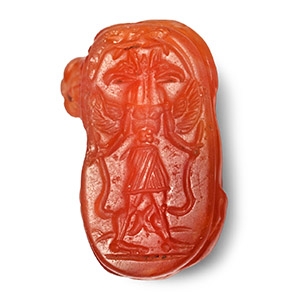
Phoenician Carnelian Scaraboid with Lion
6th-4th century B.C.Sold for (Inc. bp): £2,600
Carved in the half-round as a recumbent lion with head turned, underside with incuse image of a gryphon-headed man holding snakes in his hands. 2.55 grams, 18.65 mm
From the collection of a deceased London gentleman, UK, 1970-1990s. This lot has been checked against the Interpol Database of stolen works of art and is accompanied by a search certificate number no.12636-234419. This lot has been cleared against the Art Loss Register database, and is accompanied by an illustrated lot declaration signed by the Head of the Antiquities Department, Dr Raffaele D'Amato. -
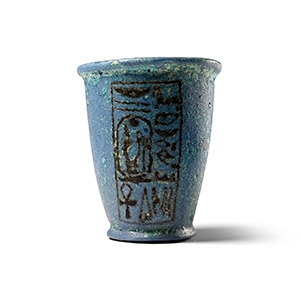
Egyptian Cobalt Blue Glazed Faience Libation Cup of Ramesses II
New Kingdom, 19th Dynasty, circa 1279-1212 B.C.Sold for (Inc. bp): £2,470
Conical in profile with flared base and rim, black glazed inscription panel bearing the dedication: 'Lord of the Two Lands, User-Maat-Re (Ramesses II) given life, beloved of Osiris, Lord of Rosetau'. 46.5 grams, 48 mm
With Jean-Phillipe Mariaud de Serres, Paris. Private collection, London, acquired from the above in 1992. This lot has been cleared against the Art Loss Register database, and is accompanied by an illustrated lot declaration signed by the Head of the Antiquities Department, Dr Raffaele D'Amato. -
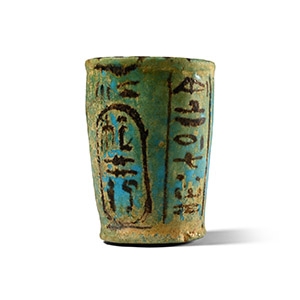
Egyptian Blue Glazed Libation Cup of Ramesses III
New Kingdom, 20th Dynasty, circa 1183-1152 B.C.Sold for (Inc. bp): £1,235
Ritual cup with sides tapering towards the base; the black glazed rectangular panel containing two columns of text: 'Lord of Appearances, Ramesses ruler of Heliopolis (Ramses heqa Iwnw) given life, beloved of Osiris, Lord of Rosetau'. 50 grams, 53 mm
with Hoshigaoka Gallery Co. Ltd, Japan. Private collection, London, acquired from the above on the 26th September 1981. This lot has been checked against the Interpol Database of stolen works of art and is accompanied by a search certificate number no.12637-235085. This lot is accompanied by an illustrated lot declaration signed by the Head of the Antiquities Department, Dr Raffaele D'Amato. -
.jpg)
Egyptian Copper Ring with the Name of Akhenaten
New Kingdom, 18th Dynasty, 1353-1336 B.C.Sold for (Inc. bp): £7,150
A 'stirrup' type ring with a substantial oval-shaped bezel bearing the name of Pharaoh Akhenaten - Nefer-kheperu-re Wah-en-re; supplied with a museum-quality impression. 7.28 grams, 19.03 mm overall, 12.08 mm internal diameter
Acquired in the mid 1980s-1990s. Private collection, Switzerland, thence by descent. Private collection, since the late 1990s. This lot is accompanied by an illustrated lot declaration signed by the Head of the Antiquities Department, Dr Raffaele D'Amato.
Akhenaten, an 18th Dynasty pharaoh (c. 1353-1336 BCE), introduced a major religious shift by promoting the Aten, the sun disc, as the sole god. Rejecting the traditional polytheistic religion of ancient Egypt, Akhenaten elevated the Aten above all other gods and even changed his name from Amenhotep (IV) to Akhenaten, meaning ‘Effective for the Aten’. He founded a new short-lived capital in Middle Egypt called Akhetaten. However, traditional polytheism was restored after his death, and his reforms were largely reversed. -
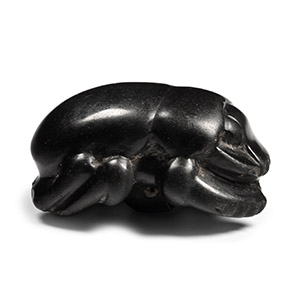
Egyptian Glass Heart Scarab
Late Period, 664-332 B.C. or laterSold for (Inc. bp): £910
Modelled in the round with ribbed loop to the underside, carapace and leg detailing. 6.49 grams, 24.6 mm
Ex London and Home Counties collection, UK, 1920-1940. This lot is accompanied by an illustrated lot declaration signed by the Head of the Antiquities Department, Dr Raffaele D'Amato. -
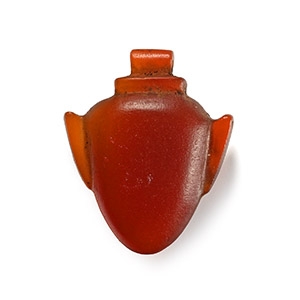
Egyptian Carnelian Heart Amulet
New Kingdom, 1550-1070 B.C.Sold for (Inc. bp): £780
A large heart, ib, amulet of classic egg-form with shallow lugs on either side with short flared top and tubular suspension loop. 5.27 grams, 26 mm
From an early 20th century collection London and Home Counties, UK. This lot is accompanied by an illustrated lot declaration signed by the Head of the Antiquities Department, Dr Raffaele D'Amato.
According to ancient Egyptian beliefs, the heart (ib) was considered to be the centre of intelligence, emotions, and behaviour. The heart was also believed to store an individual's memories. During the Weighing of the Heart ceremony in the afterlife, the heart could speak up for the deceased and account for their lifetime of actions before Osiris. For this reason, heart amulets were placed on the mummy to safeguard the organ and ensure a favourable outcome during judgment. -
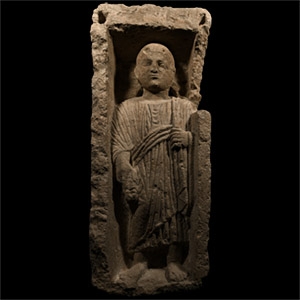
Romano-Egyptian Limestone Stele of a Nobleman Holding an Offering to the Gods
3rd-4th century A.D.Sold for (Inc. bp): £3,640
Modelled in the half-round as a man standing on an integral plinth, round face with short curly hair, wide eyes, a slender nose and a small mouth; wearing a Greek himation wrapped around his body and feet enclosed in Romano-Egyptian sandals; the left arm lowered and holding a cluster of grapes; his right arm bent at the elbow and holding a roll; remains of red and dark brown pigment on the face and clothing. 50 kg, 81.5 cm
Property of a Surrey lady; acquired by her father Christopher Terry circa 1980. Accompanied by an academic report by Dr Raffaele D'Amato. This lot has been checked against the Interpol Database of stolen works of art and is accompanied by search certificate number no.12603-233353. This lot has been cleared against the Art Loss Register database, and is accompanied by an illustrated lot declaration signed by the Head of the Antiquities Department, Dr Raffaele D'Amato.
Limestone niches with polychrome representations of the deceased were common in Roman Egypt, and lasted until the time of the Arab conquest. The man depicted on this stele certainly belonged to the high contemporary nobility as is evidenced by his well-pleated clothing, which identifies him as a member of local Graeco-Roman aristocracy. -
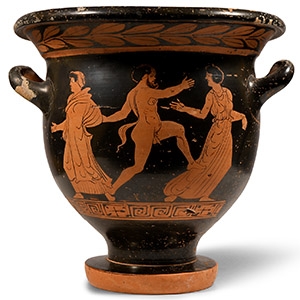
Greek Lucanian Red-Figure Bell-Krater with Nude Dancing Satyr
Circa 380-370 B.C.Sold for (Inc. bp): £8,190
Decorated with a meander with saltire squares below the figural scenes, and a laurel below the rim; Side A: a nude gesticulating satyr with short curly hair and long beard, running to the right with his left leg raised and his arms outstretched, characteristic pointed ears and pug nose, towards a maenad moving right and looking back at him, her hair short and curly, her body draped in a chiton, with another maenad standing behind him, facing left, draped in a himation over a chiton; Side B: three youths in draped cloaks with hoods thrown back; professionally restored. 2.1 kg, 29 cm wide
Fine condition, professionally restored.
Belgian private collection, 1950s. with Christie's, New York, 4 June 2008, no.190. Private central European collection. Accompanied by a copy of the relevant Christie's catalogue pages. Accompanied by an academic report by Dr Raffaele D’Amato. This lot has been checked against the Interpol Database of stolen works of art and is accompanied by a search certificate number no.12067-218141. This lot has been cleared against the Art Loss Register database, and is accompanied by an illustrated lot declaration signed by the Head of the Antiquities Department, Dr Raffaele D'Amato.
The style allows us to attribute this vase to an unknown artist of Lucanian origin: it is in ancient Lucania (a region which is located between present-day Calabria and Basilicata, in Southern Italy and between the Tyrrhenian Sea and the Ionian Sea, with Metaponto as a well-known city) that the first Italic style of red-figure painting developed.

