-
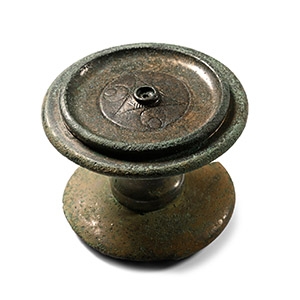
Celtic Iceni Decorated Bronze Horn Cap
Iron Age, 2nd century B.C.-early 1st century A.D.Sold for (Inc. bp): £1,820
Sceptre head or other fitting with biconvex flange, possibly a finial from the yoke of a chariot. 314 grams total, 45-75 mm
Found Colchester, Essex, UK, 1990s. This lot is accompanied by an illustrated lot declaration signed by the Head of the Antiquities Department, Dr Raffaele D'Amato.
Twenty or so 'horn caps' are known in museums and private collections, all have been found in Britain and mostly in Southern England. This type of decorative cap is from the end of a curved wooden handle which projected from the back of an Iron Age chariot, by which a warrior could pull himself back into the chariot. The chariot to which this would have been attached would have belonged to a chief or wealthy warrior from the Icenic tribe. -
.jpg)
'The Middle Aston' Large Anglo-Saxon Gilt Bronze Saucer Brooch with Bird Motif and Composite Boss
Late 5th-6th century A.D.Sold for (Inc. bp): £2,080
With a deep flange, chamfered inner ridge and eye-shaped motifs, second chamfered edge with a wide inner band of Style I bird motif decoration surrounding a central rivetted boss, catchplate and pin-lug to verso; signs of an academically interesting ancient rivetted repair to the outer flange; rare. 36 grams, 59 mm
Found whilst searching with a metal detector in Middle Aston, Cherwell, Oxfordshire, UK, on Wednesday 1st May 2024. Accompanied by a copy of the British Museum's Portable Antiquities Scheme (PAS) report no.OXON-B4DF83. This lot has been cleared against the Art Loss Register database, and is accompanied by an illustrated lot declaration signed by the Head of the Antiquities Department, Dr Raffaele D'Amato.
Saucer brooches are a female Saxon fashion, contemporary with the Anglian penannular and cruciform types, normally worn at the shoulders to secure a tubular dress. -
.jpg)
Frankish Silver-Gilt S-Shaped Bird Brooch with Garnets
5th-6th century A.D.Sold for (Inc. bp): £3,120
S-shaped plate brooch formed with a profile bird-head finial at each end with inset garnet cabochon eye, hatched panels and inlaid garnet cloisons; pin-lugs and catch to reverse. 7.58 grams, 30 mm
Private collection formed in Europe in the 1980s. Westminster collection, central London, UK. This lot has been cleared against the Art Loss Register database, and is accompanied by an illustrated lot declaration signed by the Head of the Antiquities Department, Dr Raffaele D'Amato.
During the mid-sixth century the S-brooch, along with the disc brooch, became popular. These were made primarily of gilded silver embellished with garnet inlays or in garnet cloisonné. Early forms of S-shaped brooches appear in graves in Scandinavia throughout the fifth century and in Europe during the first decades of the sixth century, and reached the height of their popularity during the latter half of that time. They were widespread across Europe and are found in central and western Europe, Italy, Scandinavia and Anglo-Saxon England. They generally take the form of an S-shaped body with heads at either end facing in opposite directions. The heads are generally depicted as birds but examples are known of unidentified animals with splayed open jaws, possibly dragons or wolves. The use of the head imagery is consistent with the aesthetic tendencies associated with the northern, Pagan Germanic world. -
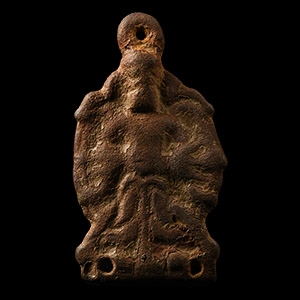
Anglo-Scandinavian Viking Bronze Stirrup Apex Mount with Odin Bound by Serpents
11th century A.D.Sold for (Inc. bp): £624
An excessively rare example of Williams Class A, Type 3 showing a standing nude man with beard and long moustache, an animal-like form around the man's waist extending towards the flanking serpents on each side, the serpents' tails wrapped around the man's legs and their open jaws gape on either side of the man's head. 26.6 grams, 54 mm
Found Sutton Fields, Sutton on the Forest, Yorkshire, UK, on 21 November 1999. From the private collection of Robin Sykes, Yorkshire, UK, formed since the late 1990s. Accompanied by an illustrated record sheet by Jim Halliday dated 22 November 1999, and various off-prints. This lot is accompanied by an illustrated lot declaration signed by the Head of the Antiquities Department, Dr Raffaele D'Amato. -
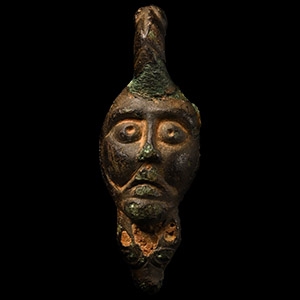
Irish Bronze Hanging Bowl Mount
7th-8th century A.D.Sold for (Inc. bp): £1,170
Comprising: ellipsoid central domed panel forming a bearded mask with impressed points to the pellet eyes, trumpet-shaped nose and deltoid moustache above a broad lower lip; above, curved suspension hook with horse-head detailing to the end and segmented mane; below, a triangular beast-head with narrow muzzle and ovoid ears, almond-shaped eyes. 8.47 grams, 45 mm
Found Sutton Fields, Sutton on the Forest, Yorkshire, UK, on 27 May 2005. From the private collection of Robin Sykes, Yorkshire, UK, formed since the late 1990s. Accompanied by an illustrated record card by Jim Halliday incorrectly identified as Romano-Celtic. This lot is accompanied by an illustrated lot declaration signed by the Head of the Antiquities Department, Dr Raffaele D'Amato. -
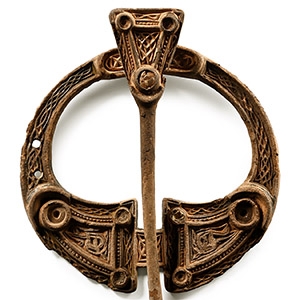
'The Powys' Hiberno-Norse Viking Gilt Bronze Pseudo-Penannular Brooch
8th century A.D.Sold for (Inc. bp): £12,350
Comprising: hoop formed from two convergent crescentic flat-section arms with panels of Insular Style interlace to the obverse, the left arm with two later holes (to accept a securing chain or thong); at each wide end, a trapezoidal panel with regardant beast motif and three discoid cells; at the upper junction, a panel of two-strand interlace; between the wide ends, a narrow rectangular panel with interlace motif; the pin slightly hipped and with round-section shank, triangular headplate with three disc cells (one with amber fill) and central interlace panel; some gilding remaining. 74.4 grams, 13.2 cm
Found by Mr Steven Thomas whilst searching with a metal detector in Powys, Wales, UK, on 28th July 2023. Accompanied by a copy of the Cymru Portable Antiquities Scheme (PAS) report no.SN 91399 13122; NMGW-67571D. Accompanied by a condition report and analysis, no.012501 by the Nation Museum of Cardiff. This lot has been checked against the Interpol Database of stolen works of art and is accompanied by a search certificate number no.12730-236283. This lot has been cleared against the Art Loss Register database, and is accompanied by an illustrated lot declaration signed by the Head of the Antiquities Department, Dr Raffaele D'Amato.
The brooch is 'pseudo-penannular' because of the apparent gap between the flared terminals is blocked by the small rectangular panel; thus the pin cannot pass between the flared ends in the normal manner of a penannular brooch, where one of the curved arms is passed behind the pin to lock it in place. The findspot lies close to a major highway running from the kingdom of Brycheiniog to the southern part of Wales, not far from the Maen Madoc inscribed stone. -
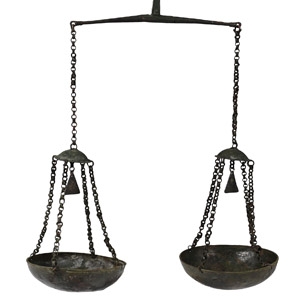
Viking Bronze Scales Set
9th-11th century A.D.Sold for (Inc. bp): £3,380
Comprising: articulated arms for a scale balance with spike gnomon and loop handle; two hemispherical bowls each with suspension holes at the rim, four short chains connected to a hemispherical distributor with triangular dangle below. 53.5 grams, 45 cm
Private collection formed in Europe in the 1980s. Westminster collection, central London, UK. This lot has been cleared against the Art Loss Register database, and is accompanied by an illustrated lot declaration signed by the Head of the Antiquities Department, Dr Raffaele D'Amato. -
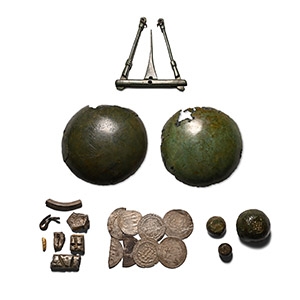
Scandinavian Viking 'Hoard' of Hacked Gold and Silver with Weights, Scales and Pans
9th-10th century A.D.Sold for (Inc. bp): £1,105
Comprising: articulated arms for a scale balance with spike gnomon; two hemispherical bowls each with suspension holes at the rim; three trade weights each with a struck motif to one faces; group of complete and cut-half silver dirham coins; six cut fragments of silver ingot; small gold ingot fragment. 284 grams total, 1-20 cm
From the private collection of a London gentleman, from his grandfather's collection formed before the early 1970s. This lot is accompanied by an illustrated lot declaration signed by the Head of the Antiquities Department, Dr Raffaele D'Amato. -
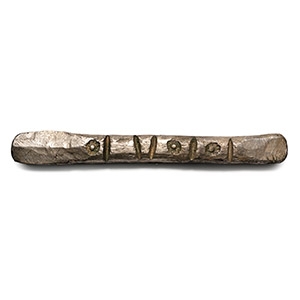
Scandinavian Viking Decorated Silver Currency Bar
11th-12th century A.D.Sold for (Inc. bp): £1,040
D-section ingot with one flattened end, punched rosettes and multiple test nicks. 117 grams, 12.5 cm
From the private collection of a London gentleman, from his grandfather's collection formed before the early 1970s. This lot is accompanied by an illustrated lot declaration signed by the Head of the Antiquities Department, Dr Raffaele D'Amato. -
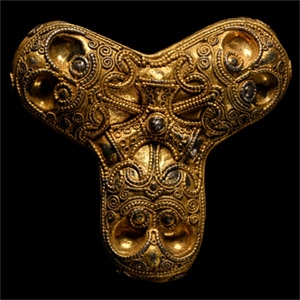
Scandinavian Viking Silver-Gilt Trefoil Brooch with Beasts
9th century A.D.Sold for (Inc. bp): £3,900
Hollow-formed Y-shaped body with applied filigree and granulation forming three radiating beast-heads, central granule in beaded-wire collar; each end with two holes each with a beaded collar, to accept the strings; straps to the reverse with bow, with beaded-wire links, and central dished circle. 21.85 grams, 57 mm
Private collection formed in Europe in the 1980s. Westminster collection, central London, UK. This lot has been checked against the Interpol Database of stolen works of art and is accompanied by a search certificate number no.12734-235601. This lot has been cleared against the Art Loss Register database, and is accompanied by an illustrated lot declaration signed by the Head of the Antiquities Department, Dr Raffaele D'Amato.
The trefoil type is based on a three-armed strap distributor for a sword-belt used by the Carolingian Franks, copied and re-modelled to Scandinavian taste and finally re-purposed as a female dress-ornament or brooch. -
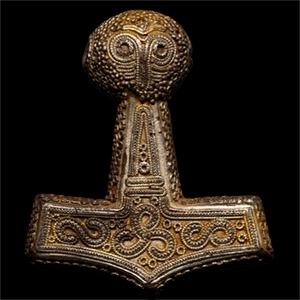
Scandinavian Viking Silver-Gilt Filigree Thor's Hammer Pendant
9th century A.D.Sold for (Inc. bp): £19,500
Hollow-formed and flat-section with applied facial detailing to the suspension lobe, filigree and granule detailing. 12.5 grams, 47 mm
Private collection formed in Europe in the 1980s. Westminster collection, central London, UK. This lot has been checked against the Interpol Database of stolen works of art and is accompanied by a search certificate number no.12735-235602. This lot has been cleared against the Art Loss Register database, and is accompanied by an illustrated lot declaration signed by the Head of the Antiquities Department, Dr Raffaele D'Amato. -
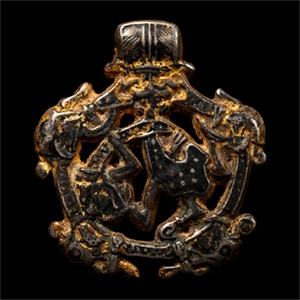
Scandinavian Viking Silver-Gilt Oseberg Style Gripping Beast Pendant
Late 10th-early 11th century A.D.Sold for (Inc. bp): £1,560
Borre-style beast and integral suspension loop with linear detailing; the openwork plaque with pelletted border and scrolled florid niello-filled panels, beast with pelletted band to the body and gripping hands on the border, facing mask below the loop. 21.1 grams, 40 mm
Private collection formed in Europe in the 1980s. Westminster collection, central London, UK. This lot has been cleared against the Art Loss Register database, and is accompanied by an illustrated lot declaration signed by the Head of the Antiquities Department, Dr Raffaele D'Amato.
There is a class of discoid pendants with banded borders and contorted figures found in the hinterland of the Baltic region, associated with the influence of Scandinavian settlers. The design of these items recalls specific elements of Scandinavian art - for example, the 'gripping hands' motif is a feature of the Oseberg Style named after the famous Norwegian ship-burial. Oseberg Style is associated with the beginnings of the Viking age, and was current in the 9th century when Scandinavian settlers began to establish centres of trade and political control in the area of the rivers Dnieper and Volga. The motif has been interpreted as a horse and linked with various legends and mythic figures.

