-
.jpg)
Viking Iron Sword with Bronze Hilt of Petersen Type L
11th-13th century A.D.Sold for (Inc. bp): £6,240
A 'Curonian' sword comprising a straight blade with a narrow and long tang, showing signs of employment on the edges; boat-shaped bronze cross guard with Jellinge style decoration of circles and crosses; rivetted seven-lobed pommel with an upper guard showing similar ornament. 689 grams, 81.5 cm
Private collection formed in Europe in the 1980s. Westminster collection, central London, UK. This lot has been checked against the Interpol Database of stolen works of art and is accompanied by search certificate number no.12618-235588. This lot has been cleared against the Art Loss Register database, and is accompanied by an illustrated lot declaration signed by the Head of the Antiquities Department, Dr Raffaele D'Amato.
The sword, with its seven-lobed pommel and its guards finds good parallels with Baltic swords used by Prussian, Curonians, Estonian and Lithuanian pagan warriors; clear parallels can be seen in Kazakevičius 1996, figs.62-63 (fig.2) and Tomsons, 2012, fig.2 (Fig.3),3,7. The Curonian swords of this type, sometimes with animal head decoration on the lower guard, were widespread and used in the Eastern Baltic lands from 10th to 13th century. -
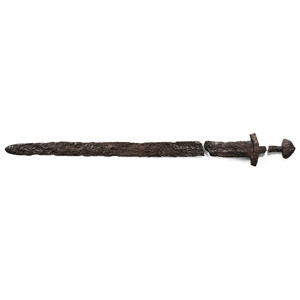
Scandinavian Viking Sacrificed Iron Sword
10th-11th century A.D.Sold for (Inc. bp): £4,160
Deliberately broken up on deposition, Petersen's Type L variant, comprising: D-shaped pommel with peened tang above and upper portion of tang forming the grip; lower section of tang with separate lower guard, scaphoid in plan and gently drooping in profile with convergent ends; upper portion of double-edged lentoid-section blade; lower section of parallel-sided blade with rounded tip. 1.15 kg total, 9-66 cm
From the private collection of a London gentleman, from his grandfather's collection formed before the early 1970s. This lot has been checked against the Interpol Database of stolen works of art and is accompanied by a search certificate number no.12726-234732. This lot has been cleared against the Art Loss Register database, and is accompanied by an illustrated lot declaration signed by the Head of the Antiquities Department, Dr Raffaele D'Amato. -
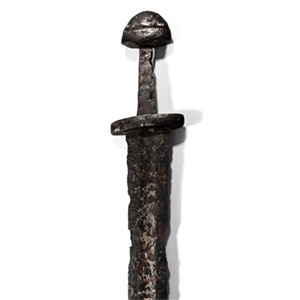
Viking Iron 'ULFBERH+T' Silver and Laten Inlaid Sword
9th-11th century A.D.Sold for (Inc. bp): £16,900
A double-edged Petersen Type X sword, tapering blade with shallow fullers and wide cutting edges, the fuller bearing an inlaid inscription of 'ULFBERH+T' to one side and remains of 'II IXI' (or an interlace pattern) to the other side; the lower and upper-guards, as well as the pommel inlaid with vertical lines of silver and copper, the pommel of tea-cosy type divided into section with well-marked lines. 1.1 kg, 98 cm
Private collection formed in Europe in the 1980s. Westminster collection, central London, UK. Accompanied by an academic report by Dr Raffaele D’Amato. This lot has been checked against the Interpol Database of stolen works of art and is accompanied by search certificate number no. 12617-235587. This lot has been cleared against the Art Loss Register database, and is accompanied by an illustrated lot declaration signed by the Head of the Antiquities Department, Dr Raffaele D'Amato. -
.jpg)
Viking Age Iron Sword of Petersen Type X
Early 10th-mid 11th century A.D.Sold for (Inc. bp): £3,901
A single-handed double-edged cutting sword with wide cutting edges showing usage wear, short boat-shaped cross-guard and a flat tang, pommel of solid tea-cosy type divided into two sections by a shallow groove, traces of wooden scabbard on the blade; cleaned and conserved. 1.24 kg, 90.2 cm
From the private family collection of a lady, UK; acquired in Germany mid 20th century. Accompanied by an academic report by Dr Raffaele D'Amato. This lot has been checked against the Interpol Database of stolen works of art and is accompanied by search certificate number no.12622-236127. This lot has been cleared against the Art Loss Register database, and is accompanied by an illustrated lot declaration signed by the Head of the Antiquities Department, Dr Raffaele D'Amato. -
.jpg)
Large Medieval Silver Inlaid Iron Spearhead
15th-16th century A.D.Sold for (Inc. bp): £1,300
Comprising: a hexagonal-section tapering socket, lentoid-section neck and leaf-shaped blade; inlaid silver-wire scrolled tendril detailing to the socket and neck. 693 grams, 42 cm
Private collection formed in Europe in the 1980s. Westminster collection, central London, UK. This lot has been cleared against the Art Loss Register database, and is accompanied by an illustrated lot declaration signed by the Head of the Antiquities Department, Dr Raffaele D'Amato.
The spearhead likely belonged to a family fighting in the Balkanic wars among Christian and Ottomans in the late 15th century A.D. Spears with such shape are dated to the 16th century and are defined by specialists as ‘schefflin’ type. The ornament of the blade imitates Ottoman decorative models. -
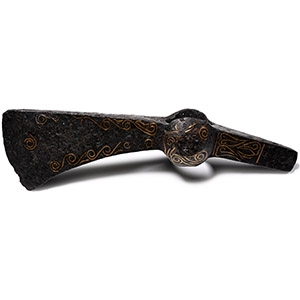
Eastern Viking Period Laten Inlaid Iron Axehead
9th century A.D.Sold for (Inc. bp): £5,200
With narrow straight blade, shank to the rear with square hammer-face, inlaid geometric and vegetal ornaments. 275 grams, 17.7 cm
Private collection formed in Europe in the 1980s. Westminster collection, central London, UK. This lot has been cleared against the Art Loss Register database, and is accompanied by an illustrated lot declaration signed by the Head of the Antiquities Department, Dr Raffaele D'Amato.
Battle-axes came into use in Scandinavia, especially in the Eastern parts of Sweden, Gotland and Denmark. Among the types, there were narrow-bladed types described to be very light in the sources. They could weigh as little as 200-250 grams, making them suitable for single-handed use. Some of them were decorated according to the Slavic taste. -
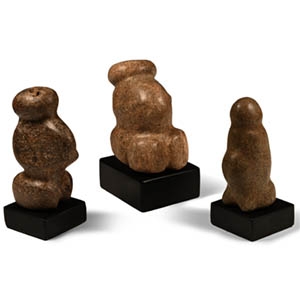
Stone Age Pregnant Mother Goddess Idol Collection
Neolithic Period, circa 6th-4th millennium B.C. or laterSold for (Inc. bp): £598
Comprising two pregnant female figures with emphasised rounded stomach, and a male with vestigial limbs; each mounted on a custom-made stand. 1.75 kg total, 11.3-12.1 cm
From a collection acquired on the UK art market from various auction houses and collections mostly before 2000. From an important Cambridgeshire estate; thence by descent. Accompanied by an academic report by Dr Raffaele D’Amato. This lot has been checked against the Interpol Database of stolen works of art and is accompanied by search certificate number no.12332-224210.
Most scholars consider these as symbols of the fertility cult and as evidence of the existence of a matriarchal society as a form of organisation of the earliest human society. The people of the Stone Age may have considered figures such as this to represent women and mothers with their life-giving powers, or as depictions of the ancestors. -
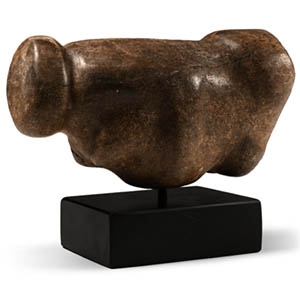
Large Stone Age Pregnant Animal Idol
Neolithic Period, circa 6th-4th millennium B.C. or laterSold for (Inc. bp): £845
Carved in the round with sturdy body, swollen belly and ovoid-section head; mounted on a custom-made stand. 1.66 kg total, 15.5 cm including stand
From a collection acquired on the UK art market from various auction houses and collections mostly before 2000. From an important Cambridgeshire estate; thence by descent. Accompanied by an academic report by Dr Raffaele D’Amato. This lot has been checked against the Interpol Database of stolen works of art and is accompanied by search certificate number no.12337-224209. This lot is accompanied by an illustrated lot declaration signed by the Head of the Antiquities Department, Dr Raffaele D'Amato.
Most scholars consider these as symbols of the fertility cult and as evidence of the existence of a matriarchal society as a form of organisation of the earliest human society. The people of the Stone Age may have considered figures such as this to represent women and mothers with their life-giving powers, or as depictions of the ancestors. -
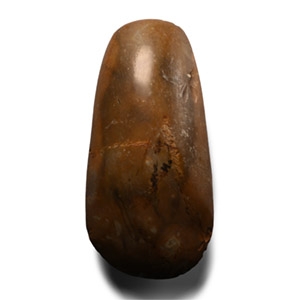
'The Greenstead Green' Stone Age Polished Brown Patinated Flint Axehead
Circa 4000-2350 B.C.Sold for (Inc. bp): £572
Sub-oval in plan, tapering towards the square butt, crescentic blade with the pointed edge extending around the entire object. 534 grams, 14.8 cm
Found whilst fieldwalking in Greenstead Green, Braintree, Essex, UK, on Sunday 18 September 2022. Accompanied by a copy of the British Museum's Portable Antiquities Scheme (PAS) report no.ESS-B342ED. This lot is accompanied by an illustrated lot declaration signed by the Head of the Antiquities Department, Dr Raffaele D'Amato. -
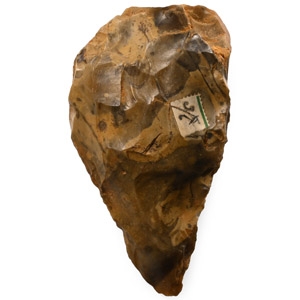
Stone Age Flint Bifacial 'Ficron' Handaxe from Swanscombe
Lower Palaeolithic Period, circa 450,000-300,000 B.PSold for (Inc. bp): £1,040
Flint ficron in form with still-sharp cutting edges and the famous mottled patina from Barnfield Pit; old collector's label with '3/6'` legend. 227 grams, 10.4 cm
Found at Barnfield Pit, Swanscombe, Kent, UK. From the collection of John Sharp, a former well known archaeologist. Acquired on the UK art market. From the private collection of an East Anglian, UK, specialist collector. This lot is accompanied by an illustrated lot declaration signed by the Head of the Antiquities Department, Dr Raffaele D'Amato. -
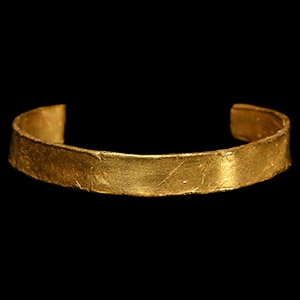
'The Kelvedon' Bronze Age Gold Strip Bracelet
Middle Bronze Age, 2100-1150 B.C.Sold for (Inc. bp): £2,340
Flat in section with slightly dished outer face, some scarring and one clubbed end; repaired. 16.81 grams, 53 mm
Found whilst searching with a metal detector in Kelvedon, near Braintree, Essex, in 2017, declared as treasure under the Treasure Act with reference no.2017 T181, and subsequently disclaimed. Accompanied by a copy of the curator's report for Treasure dated 31 August 2017, where the item is identified as probable Bronze Age. Accompanied by a copy of the DCMS Treasure receipt. Accompanied by a copy of the British Museum’s Portable Antiquities Scheme (PAS) report no.ESS-A74FF3. This lot has been checked against the Interpol Database of stolen works of art and is accompanied by a search certificate number no.12728-234223. This lot has been cleared against the Art Loss Register database, and is accompanied by an illustrated lot declaration signed by the Head of the Antiquities Department, Dr Raffaele D'Amato.
The undecorated surface and the slight burring to the rims are consistent with this being a Bronze Age strip bracelet. A larger but less robust example of the type is in the National Museum of Wales's collection under reference 76.7H/4 from Capel Isaf House, Manordeilo. -
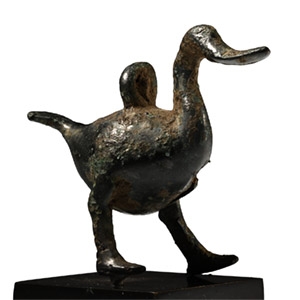
Celtic Bronze Statuette of a Duck
Iron Age, 1st century B.C.-1st century A.D.Sold for (Inc. bp): £780
Modelled in the round with splayed legs, scooped beak, T-shaped tail with serrated edge and loop to the back; mounted on a custom-made stand. 52 grams total, duck: 43 mm high
Ex Cambridge, UK, collection, 1990-2010. This lot is accompanied by an illustrated lot declaration signed by the Head of the Antiquities Department, Dr Raffaele D'Amato.

