-
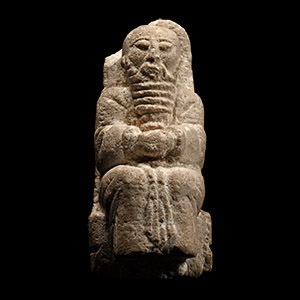
Sumerian Calcite Figure of a Priest
Uruk, 3rd millennium B.C.Sold for (Inc. bp): £1,105
Carved in the round robed figure seated on a chair; the figure with carefully dressed beard and cropped hair, wearing a long-sleeved robe reaching to his ankles with sash-cords at the front draped from his knees; the high-backed chair with D-shaped seat and reserved saltire to the rear with column and rectangular panel above; the figure with hands cupped in his lap; one foot absent. 37.8 grams, 50 mm
Ex collection of the late Mr S.M., London, UK, 1970-1990s. This lot has been cleared against the Art Loss Register database, and is accompanied by an illustrated lot declaration signed by the Head of the Antiquities Department, Dr Raffaele D'Amato. -
.jpg)
Bactrian Stone 'Hand Bag' Ceremonial Weight
Late 3rd-early 2nd millennium B.C.Sold for (Inc. bp): £1,950
Rectangular block with round-section loop handle. 9.95 kg, 27.5 cm
Ex West London, UK, collection, 1990s. This lot has been cleared against the Art Loss Register database, and is accompanied by an illustrated lot declaration signed by the Head of the Antiquities Department, Dr Raffaele D'Amato.
Among the most iconic intercultural style objects are the so-called 'lock' or 'hand bag' weights. These were probably not weights at all, but were likely badges of high office, carried to indicate authority. Similar objects have been found throughout Mesopotamia, the islands of the Persian Gulf, on the Iranian steppe, as well as the Indus Valley. -
.jpg)
Monumental Sasanian Cut Glass Goblet
6th-7th century A.D.Sold for (Inc. bp): £5,200
Comprising a trumpet-shaped base with baluster and conical stem, gently flared body with wheel-cut facetting to the sidewall; restored. 567 grams, 26.4 cm
Private collection, Switzerland, since the 1960s. Accompanied by a copy of a previous two page illustrated cataloguing note. Accompanied by a copy of an Art Loss Register certificate no.DAA0105.687.LL. This lot has been checked against the Interpol Database of stolen works of art and is accompanied by a search certificate number no.12720-235460. This lot has been cleared against the Art Loss Register database, and is accompanied by an illustrated lot declaration signed by the Head of the Antiquities Department, Dr Raffaele D'Amato. -
.jpg)
Fatimid Rock Crystal 'Knight' Gaming Piece
9th-10th century A.D.Sold for (Inc. bp): £4,550
Hexagonal in plan with low-relief stylised horse to the upper face, the lateral facets with stylised perching bird, advancing leopard and other motifs; repaired. 62.47 grams, 32 mm
Ex Mayfair, London, UK, collection, 1980s. This lot has been checked against the Interpol Database of stolen works of art and is accompanied by a search certificate number no.12721-234904. This lot has been cleared against the Art Loss Register database, and is accompanied by an illustrated lot declaration signed by the Head of the Antiquities Department, Dr Raffaele D'Amato. -
.jpg)
Kashan Lustre Pottery Tile with Standing Male Figure
12th-13th century A.D.Sold for (Inc. bp): £624
Rectangular in plan with lateral spurs, reserved figure of a robed male in three-quarter view with hands clutching a purse (?) to the chest; mounted in a fabric-covered base with recessed opening displaying the reverse with impressed Kufic text. 269 grams total, 17 x 13.5 cm
with Christie's, New York, Interiors Sale, 14 January 2009, no.778. Private collection, UK. This lot has been cleared against the Art Loss Register database, and is accompanied by an illustrated lot declaration signed by the Head of the Antiquities Department, Dr Raffaele D'Amato. -
.jpg)
Samanid Terracotta Ewer
9th-10th century A.D.Sold for (Inc. bp): £1,560
Piriform in profile with flared foot, ropework collar to base of flared neck, high-looped strap handle; shoulder with frieze of fleeing deer and pouncing lions among tendrils and foliage. 505 grams, 21.7 cm
Richard Ettinghausen (1906–1979), Princeton, New Jersey; acquired between the 1930s and 1960s. Thence by descent to his son, Thomas A.D. Ettinghausen, and retained in the family residence, Princeton, New Jersey, until 2024. Accompanied by a signed statement of provenance. Accompanied by a copy of an IADAA Interpol search certificate. Accompanied by a copy of a previous three page illustrated cataloguing note. This lot has been cleared against the Art Loss Register database, and is accompanied by an illustrated lot declaration signed by the Head of the Antiquities Department, Dr Raffaele D'Amato. -
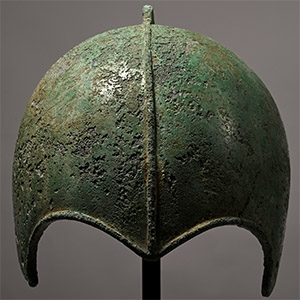
Scythian Bronze 'Kuban' Type Helmet
7th-6th century B.C.Sold for (Inc. bp): £18,200
Raised from a single sheet with rounded skull and semi-circular cut-outs for the eyes with raised rims, raised bar to the front extending to the top with a loop; ten circular perforations to the lower edge; accompanied by a custom-made display stand. 1.47 kg, 23.5 cm wide
Private collection formed in Europe in the 1980s. Westminster collection, central London, UK. Accompanied by an academic report by Dr Raffaele D’Amato. This lot has been checked against the Interpol Database of stolen works of art and is accompanied by search certificate number no.12616-235608. This lot has been cleared against the Art Loss Register database, and is accompanied by an illustrated lot declaration signed by the Head of the Antiquities Department, Dr Raffaele D'Amato.
This war helmet, typical of the Caucasian Scythians, belongs to the so-called Kuban type according to B. Z. Rabinovich, named after the north Caucasian region where the majority of this type of helmets were found. The helmet is almost identical to the helmet found in the 6th century barrow at Kelermes (Stanitsa Kelermeskaya), and in fact many of such helmets have been found in the Northern Caucasus. The helmets were typical of the noblemen fighting on horseback with spear, javelins and especially with bow and arrows. -
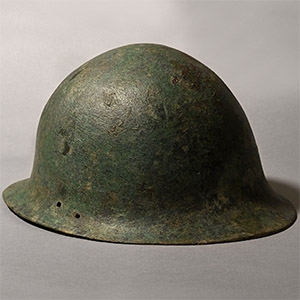
Villanovan Bronze Helmet
8th century B.C.Sold for (Inc. bp): £11,700
With rounded bowl and flared rim; three sets of paired piercings for attachment of leather cheek-flaps; cracked; accompanied by a custom-made display stand. 1.7 kg, 30.5 cm wide
Bowl pierced and cracked.
Acquired early 1990s. Ex private American collection; thence by descent. Private European collection since 1998. Accompanied by an academic report by Dr Raffaele D'Amato. This lot has been checked against the Interpol Database of stolen works of art and is accompanied by search certificate no.11573-199009. This lot has been cleared against the Art Loss Register database, and is accompanied by an illustrated lot declaration signed by the Head of the Antiquities Department, Dr Raffaele D'Amato.
The ‘pot’ or ‘bell’ helmet, found in contexts as early as the 8th century coffer grave (ad arca) from the Esquiline (Rome) and other graves (Coussin, 1926, p.88, fig.23; Sekunda, Northwood,1995, p.6, grave 94) was made from a single piece of bronze, while later Italic variants were fashioned from jointed plates (Connolly, 1981, p.102, figs.2-2a; Egg, 1988, p.223, variant Vetulonia). The skull was somewhat spherical, with a flared rim: in some Etruscan and Italic specimens, this was rivetted for strength. -
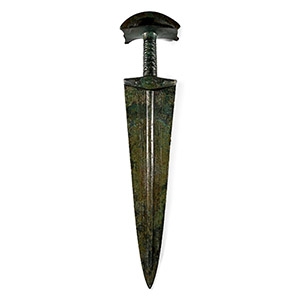
Luristan Bronze Short Sword with Blood Channels
14th-10th century B.C.Sold for (Inc. bp): £9,750
Triangular blade with raised midrib flanked by shallow grooves extending from the integral lower-guard to the tip; the lower guard with raised coffee bean-shaped bosses to both sides; grooved handle with raised ribs and a large openwork crescentic pommel bearing a similar decoration to the blade at the top; accompanied by a custom-made display stand. 1.31 kg total, sword: 47 cm long
Ex Rabi Gallery, London, UK, 1980s. From a private Surrey, UK, collection. Accompanied by an academic report by Dr Raffaele D’Amato. This lot has been checked against the Interpol Database of stolen works of art and is accompanied by search certificate number no.12606-234422. This lot has been cleared against the Art Loss Register database, and is accompanied by an illustrated lot declaration signed by the Head of the Antiquities Department, Dr Raffaele D'Amato.
The now empty cavities of the handle were once filled with organic material. -
.jpg)
Large Levantine Crescentic 'Anchor' Axehead
Middle Bronze Age, late 3rd-early 2nd millennium B.C.Sold for (Inc. bp): £1,560
An anchor-shaped semi-circular blade, semi-elliptical in section, narrow socket with a long extension to the rear. 557 grams, 11.1 cm
Previously in a London, UK, collection, 1970s. Ex Rabi Gallery 1991. This lot is accompanied by an illustrated lot declaration signed by the Head of the Antiquities Department, Dr Raffaele D'Amato.
The ‘anchor’ axes belonged to a homogeneous type of axe, similar to the fenestrated axes, but displaying a different hafting method. The handle was inserted into a short cylindrical collar except at the back, where it extended to a width roughly equivalent to that of the blade. The two ends of the blade widened to form a concave face resting against the handle, thus ensuring a firm support. The edges of the fenestrelles were prominent and sometimes have decoration. At the back of the collar, there was always a spherical or flattened knob. The function of this knob can only be conjectured: it seems too small to serve as a counterweight, hence it was probably an element used to wind the handle's attachment cord. -
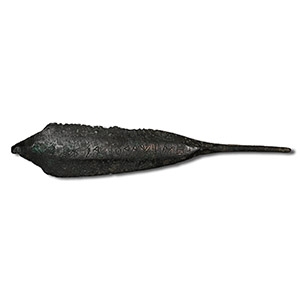
Phoenician Bronze Inscribed Arrowhead
12th-11th century B.C.Sold for (Inc. bp): £1,820
Broad trapezoidal form with cutting edges, fifteen inscribed characters to one face. 12.6 grams, 10.1 cm
From the collection of a gentleman, acquired on the London art market in the 1990s. This lot is accompanied by an illustrated lot declaration signed by the Head of the Antiquities Department, Dr Raffaele D'Amato. -
.jpg)
Achaemenid Akinakes with Horse-Head Hilt and Gold Chain
6th-4th century B.C.Sold for (Inc. bp): £9,100
The upper part of the hilt shaped as a horse-head with an applied sheet-gold mane, wearing a gold bridle of Greek typology adorned with rosettes, mouthpiece formed of wire with garnet beads, and a large garnet cabochon set at the front of the bridle; the upper hilt connected to the straight blade with a restored grip; accompanied by a perspex scabbard with original gold sheet attached; possibly a marriage; mounted on a custom-made display stand. 392 grams, 36.5 cm (473 grams total, 37.6 cm high including stand)
Private collection of a London gentleman, acquired between 1965–2020. This lot has been checked against the Interpol Database of stolen works of art and is accompanied by search certificate number no.12619-235454. This lot has been cleared against the Art Loss Register database, and is accompanied by an illustrated lot declaration signed by the Head of the Antiquities Department, Dr Raffaele D'Amato.
The akinakes was the short dagger of the Scythians and the Achaemenid Persians. Many examples of this characteristic weapon have been found in every corner of the Persian Empire. The hilt was often made of bronze, gold or gilded. It is visible in the hands of the Medes and Persians in the reliefs of Persepolis. These weapons, straight and double-edged, were about 35 cm long. The scabbards could be covered with gold, hung from the belt at the waist and, according to Herodotus, attached to the right thigh with a thong.

