-
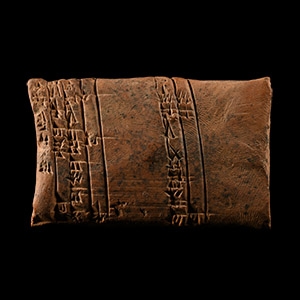
Old Babylonian Administrative Terracotta Tablet Noting a Fall from the City Wall of Isin
19th-16th century B.C.Sold for (Inc. bp): £1,170
Pillow-shaped with band of impressed cuneiform text to upper edge and partial band to the middle. 124 grams, 72 mm
Specialised collection of cuneiform texts, the property of a London gentleman and housed in London before 1988. Thence by descent to family members. Examined by Professor Wilfrid George Lambert FBA (1926-2011), historian, archaeologist, and specialist in Assyriology and Near Eastern archaeology, in the late 1980s and early 1990s. The collection is exceptional for the variety of types, including some very rare and well preserved examples. This lot has been cleared against the Art Loss Register database, and is accompanied by an illustrated lot declaration signed by the Head of the Antiquities Department, Dr Raffaele D'Amato. -
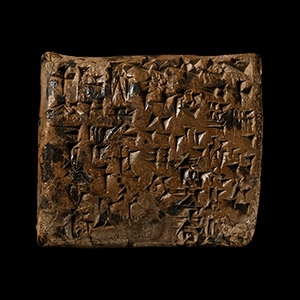
Old Babylonian Cuneiform Tablet with Original Envelope, Recording a Contract for 1½ Shekels of Silver
Circa 2000-1800 B.C.Sold for (Inc. bp): £1,690
Pillow-shaped sealed clay envelope with bands of cuneiform text to the broad faces; with 12 lines in Sumerian and a seal impression. 117 grams, 59 mm
From the important collection of the late Dr Gerrard. This lot has been cleared against the Art Loss Register database, and is accompanied by an illustrated lot declaration signed by the Head of the Antiquities Department, Dr Raffaele D'Amato. -
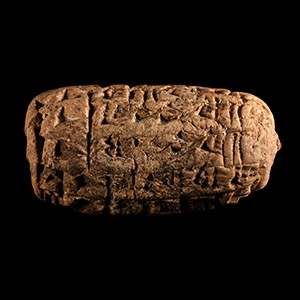
Old Babylonian Terracotta Bulla Recording the Rations of Vegetable Oil to Named Individuals
1900-1800 B.C.Sold for (Inc. bp): £780
Barrel-shaped with vertical perforation, columns of cuneiform text to the sidewall. 20 grams, 40 mm
Acquired in 1997. Private collection, Switzerland, thence by descent. Private collection, since the late 1990s. This lot has been cleared against the Art Loss Register database, and is accompanied by an illustrated lot declaration signed by the Head of the Antiquities Department, Dr Raffaele D'Amato. -
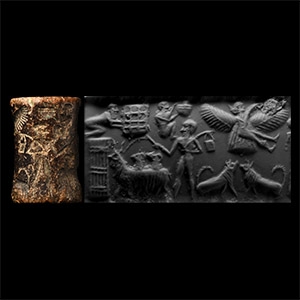
Large Akkadian Cylinder Seal with Figures
3rd-2nd millennium B.C.Sold for (Inc. bp): £4,680
Cotton-reel type seal with incuse frieze including standing figure with whip, water-bearer, opposed bulls and other motifs; supplied with a museum-quality impression. 33.1 grams, 35 mm
Acquired in the mid 1980s-1990s. Private collection, Switzerland, thence by descent. Private collection, since the late 1990s. This lot has been cleared against the Art Loss Register database, and is accompanied by an illustrated lot declaration signed by the Head of the Antiquities Department, Dr Raffaele D'Amato. -
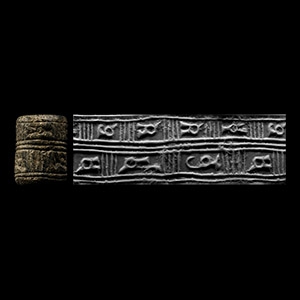
Early Syrian Black Stone Cylinder Seal with Animals
Circa 3000 B.C.Sold for (Inc. bp): £169
Cylinder with cord and bead handles; accompanied by a copy of an old scholarly note, typed and signed by W.G. Lambert, late Professor of Assyriology, University of Birmingham, 1970-1993, which states: 'Description of Cylinder Seal of black stone, 34.5 x 26 mm. The sides are decorated with a design consisting of two registers enclosed within lines, and each register divided into compartments, four in one, three in the other, by bands of four parallel lines. Each compartment contains the head of an animal or bird. The upper and lower surfaces of the cylinder are engraved with rosettes centering on the drill hole. This is an early Syrian seal, c. 3000 B.C., of a very unusual and interesting type. Though it is worn, the design still leaves a clear impression when the seal is rolled.'; supplied with a museum-quality impression. 44.7 grams, 34 mm
UK private collection, acquired 1980-1983. Accompanied by a copy of a scholarly note, typed and signed by Professor Wilfrid George Lambert in November 1987. This lot has been cleared against the Art Loss Register database, and is accompanied by an illustrated lot declaration signed by the Head of the Antiquities Department, Dr Raffaele D'Amato. -
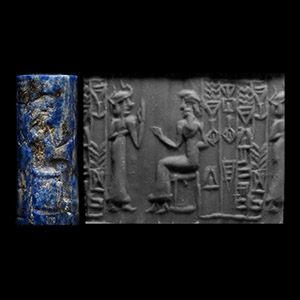
Ur II Period Lapis Lazuli Cylinder Seal with Dedicatory 'Gutua to Inka' Inscription
2200-2000 B.C.Sold for (Inc. bp): £1,820
With frieze depicting a standing figure addressing a seated figure and four columns of cuneiform text, reading 'Gutua to Inka, his Sister / Lady, He Gave (This Seal)'; supplied with a museum-quality impression. 2.96 grams, 20 mm
Acquired in 1995. Private collection, Switzerland, thence by descent. Private collection, since the late 1990s. This lot has been cleared against the Art Loss Register database, and is accompanied by an illustrated lot declaration signed by the Head of the Antiquities Department, Dr Raffaele D'Amato. -
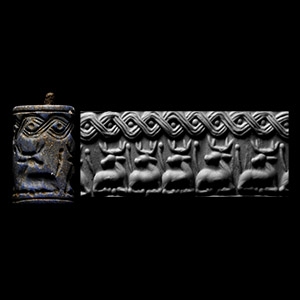
Mesopotamian Lapis Lazuli Cylinder Seal with Animal Frieze
Early 2nd millennium B.C.Sold for (Inc. bp): £1,430
Above: guilloche of two bands with 'eye' motifs in the voids; below: zebu and other animals on a baseline; supplied with a museum-quality impression. 14 grams, 31 mm
From the 'S' collection, acquired 1970-1990s. The collection was seen and studied by W.G. Lambert, late Professor of Assyriology at the University of Birmingham, 1970-1993. This lot has been cleared against the Art Loss Register database, and is accompanied by an illustrated lot declaration signed by the Head of the Antiquities Department, Dr Raffaele D'Amato. -
.jpg)
Neo-Assyrian Chalcedony Cylinder Seal for the God Samnuha from Samsanu
9th-7th century B.C.Sold for (Inc. bp): £9,100
Carved with five columns of cuneiform inscription: 'To the god Samnuha, great lord, Samsanu, eunuch, for the life of [the king) Samnuha-shar-ilani, his Lord, he made and gave (this seal)'; accompanied by a museum-quality impression. 16.8 grams, 40 mm
Acquired in the mid 1980s-1990s. Private collection, Switzerland, thence by descent. Private collection, since the late 1990s. This lot has been checked against the Interpol Database of stolen works of art and is accompanied by search certificate number no.12586-232162. This lot has been cleared against the Art Loss Register database, and is accompanied by an illustrated lot declaration signed by the Head of the Antiquities Department, Dr Raffaele D'Amato. -
.jpg)
Anatolian Black Stone Cylinder Seal with Figures Holding Clubs
Circa 2600-2300 B.C.Sold for (Inc. bp): £234
Cylinder with cord and bead handles; accompanied by a copy of an old scholarly note, typed and signed by W.G. Lambert, late Professor of Assyriology, University of Birmingham, 1970-1993, which states: 'Description of Cylinder Seal of Soft Black Stone, 19.5 x 13 mm. Two standing human figures are striking with big clubs, the one at a seated (fallen?) human, the other at an uncertain depiction. A third standing human (inactive) and two quadrupeds make up the scene. From Syria or Anatolia, c. 2600-2300 B.C. Condition: edges worn, but the design still sharp.'; supplied with a museum-quality impression. 6.76 grams, 19 mm
UK private collection, acquired 1980-1983. Accompanied by a copy of a scholarly note, typed and signed by Professor Wilfrid George Lambert in October 1987. This lot has been cleared against the Art Loss Register database, and is accompanied by an illustrated lot declaration signed by the Head of the Antiquities Department, Dr Raffaele D'Amato. -
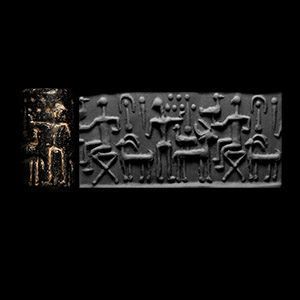
Anatolian Black Stone Cylinder Seal with Seated Deity
Circa 1200-1000 B.C.Sold for (Inc. bp): £442
Cylinder with cord and bead handles; accompanied by a copy of an old scholarly note, typed and signed by W.G. Lambert, late Professor of Assyriology, University of Birmingham, 1970-1993, which states: 'Cylinder seal of soft black stone, 29 x 16 mm. Condition fine. Seated deity with bird on wrist, facing horned quadruped with bird on hind quarters, standing human figure behind horned quadruped; fillers: seven dots, two swords(?), unidentified item. From North Syria or Anatolia, c. 1200-1000 B.C. The god holding the bird is probably the storm god, Teshub, though he could be known at this period by another name.'; supplied with a museum-quality impression. 14.7 grams, 28 mm
UK private collection, acquired 1980-1983. Accompanied by a copy of a scholarly note, typed and signed by Professor Wilfrid George Lambert in January 1989. This lot has been cleared against the Art Loss Register database, and is accompanied by an illustrated lot declaration signed by the Head of the Antiquities Department, Dr Raffaele D'Amato. -
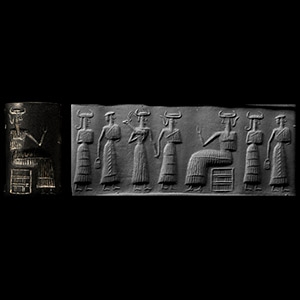
Large Akkadian Black Stone Cylinder Seal with Figures
Circa 2300-2200 B.C.Sold for (Inc. bp): £4,160
Accompanied by a copy of an old scholarly note, typed and signed by W.G. Lambert, late Professor of Assyriology, University of Birmingham, 1970-1993, which states: 'Cylinder Seal of Black Stone, 40 mm. high. The scene shows a seated god with four standing figures in front of him. He is seated on an angular seat, wears a long flounced robe and a horned tiara, and raises one hand in greeting. Immediately before him standing is a god with similar clothes and headdress, gripping the wrist of a second god who standing behind him and holds a kid as an offering to the seated god. This third god has a robe which falls in creases to the ankles. Behind the god with goat stands a human figure with bare head and clothing distinct from all the other figures. He or she (there is no beard) holds a bucket in one hand. The final figure of the row is a god with dress similar to that of the one immediately in front of the seated god, though he holds both hands at the waist. This is a Akkadian seal, c. 2300-2200 B.C., from southern Mesopotamia or a nearby area. It is a large one and in fine condition.'; supplied with a museum-quality impression. 49.5 grams, 41 mm
From the private collection of a North American lady, formed 1970s-early 1990s, with collection reference no.P26. Accompanied by a copy of a scholarly note, typed and signed by Professor Wilfrid George Lambert dated November 1991. This lot has been cleared against the Art Loss Register database, and is accompanied by an illustrated lot declaration signed by the Head of the Antiquities Department, Dr Raffaele D'Amato. -
.jpg)
Mitanni Brown Hematite Cylinder Seal with Winged Birds
Circa 1500-1250 B.C.Sold for (Inc. bp): £390
Cylinder with cord and bead handles; accompanied by a copy of an old scholarly note, typed by W.G. Lambert, late Professor of Assyriology, University of Birmingham, 1970-1993, which states: 'Description of Cylinder Seal of brown Hematitite (sic), 29 x 15.5 mm. Standing composite figure with human legs and body, but a bird's wings and head, is placed between a large recumbent horned quadruped with long neck and a smaller horned quadruped with short neck; other items; scorpion, hand, fish, star. The whole of the design in enclosed within upper and lower rules. This is a good example of the Mitanni "Elaborate Style", from anywhere between north-western Iran and the eastern Mediterranean. As is normal for such Mitanni seals, the cutting was done entirely with three semi-mechanical tools: the drill, the tubular drill and the cutting wheel. The date will be c. 1500-1250 B.C. The ancient name of the composite figure is not so far known. Save for a gash on the standing figure, the condition is fine.'; supplied with a museum-quality impression. 14.4 grams, 23 mm
UK private collection, acquired 1980-1983. Accompanied by a copy of a scholarly note typed by Professor Wilfrid George Lambert in October 1987. This lot has been cleared against the Art Loss Register database, and is accompanied by an illustrated lot declaration signed by the Head of the Antiquities Department, Dr Raffaele D'Amato.

