-
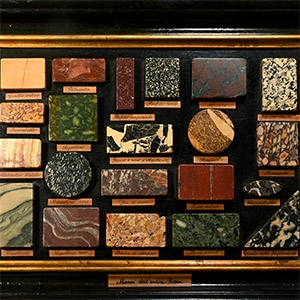
Cut Ancient Roman Stone Collection
1st-4th century A.D.Sold for (Inc. bp): £4,420
Group of cut and polished stone fragment specimens mounted in on a wooden board with frame; manuscript titled label 'Marmi dell' antica Roma' (marbles of ancient Rome) and small manuscript label beneath each block. 5.45 kg, 46.5 x 62.5 cm
From a 19th century European collection, Paris, France. This lot is accompanied by an illustrated lot declaration signed by the Head of the Antiquities Department, Dr Raffaele D’Amato. -
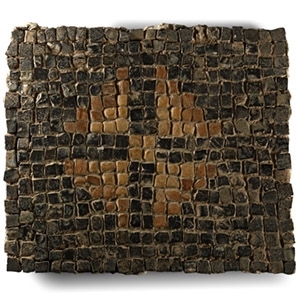
Roman Floor Mosaic Section with Geometric Design
2nd-4th century A.D.Sold for (Inc. bp): £1,950
Cuboid tesserae in matrix with a plaster base; field in dark grey and brown with central lozenge in cream and beige with reserved cross and central square. 1.76 kg, 26 x 23 cm
Found Tunisia, North Africa. Brought to the UK before 1945. From a private old collection formed in the mid 20th century. Ian Wilkinson collection, Nottinghamshire, UK, formed since 1985. This lot is accompanied by an illustrated lot declaration signed by the Head of the Antiquities Department, Dr Raffaele D’Amato. -
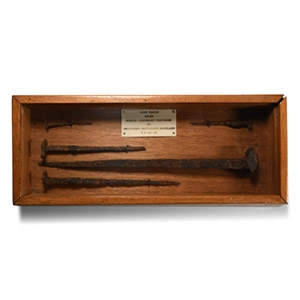
Romano-Scottish Legion XX Valeria Victrix 'Inchtuthil Fort' Boxed Educational Iron Nail Hoard Set
Circa 83-87 A.D.Sold for (Inc. bp): £845
Group of five iron clout-nails permanently mounted in a wooden display case with sloping sides and sliding glazed lid; with information panel 'Iron Nails / From / Roman Legionary Fortress / at / Inchtuthil, Perthshire, Scotland / A.D.83-87'; supplied with a printout on the subject of the Inchtuthil fortress. 589 grams total, 35.7 x 15 cm
From excavations started by Richmond in Perthshire, Scotland, from the 1950s, and discovered in the summer of 1960. Selected and boxed by David Colville & Sons by 1963. Acquired from a private Scottish collection in the early 2000s. Ian Wilkinson collection, Nottinghamshire, UK, formed since 1985. Accompanied by a copy of an online information sheet. This lot is accompanied by an illustrated lot declaration signed by the Head of the Antiquities Department, Dr Raffaele D’Amato.
The fortress at Inchtuthil was a fortified headquarters and forward supply depot for the forces led by the Roman governor, Gnaeus Julius Agricola, when he undertook a lengthy campaign against the Caledonian tribes in the north of Britain. The campaign is mentioned in the biographical work written by his son-in-law, the historian Tacitus, which has been studied in order to understand the Roman plan for the subjugation of the island. The troops chosen for the campaign were drawn from the 20th Legion (Legio XX Valeria Victrix). While the construction of Inchtuthil and other strongholds took place, the troops lived in temporary encampments which were also fortified and formed a chain of defensive sites from which domination of the surrounding territory could be achieved. Subsequently once the site was abandoned late in the 1st century A.D., (around 86 A.D.) no further building took place there or in the area. Excavation in the 20th century by Sir Ian Richmond (begun in 1952) revealed a pristine site with its complete plan recoverable - unique in the Roman Empire. The defences were a broad ditch and turf wall with stone facing, with watchtowers and gatehouses. The site was thought to have been abandoned due to relocation of troops to counter an invasion from eastern Europe into the province of Dacia, although this is no longer certain. A huge quantity of iron nails (more than 875,000) was recovered from a pit in the fort as well as other ironware; the goods had been buried in order not to let them fall into the hands of the Caledonians. The excavated nails and other items were sorted and sold in small parcels, which was completed by 1963.The nails range in size from small nails between thirty-eight and seventy millimetres long, up to the massive spikes three hundred and seventy-two millimetres long. These kind of long nails were also used for crucifixions. -
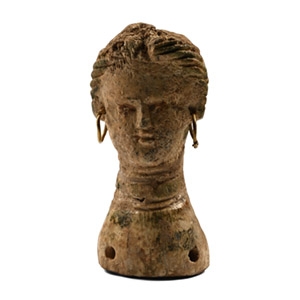
Roman Bone Doll's Head with Earrings
2nd-4th century A.D.Sold for (Inc. bp): £521
Carved in the round with tiered collars to the neck, hair swept back from the face and coloured with green pigment, low-relief facial features, pierced at lower edge for attachment; ears pierced and gold wire earring inserted. 56 grams, 86 mm
Acquired 1980-2015. Ex Abelita family collection. This lot is accompanied by an illustrated lot declaration signed by the Head of the Antiquities Department, Dr Raffaele D’Amato. -
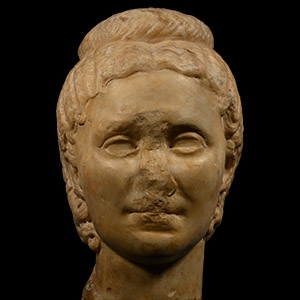
Life-Size Roman Portrait Head of a Roman Lady, Possibly The Empress Salonina
Late 3rd century A.D.Sold for (Inc. bp): £7,800
Portrait head of a woman with an elaborate coiffure, with the hair at the back parted in the middle and the two strands folded over each other and then pulled to the front to form a looped horizontal layer, then parted in the middle of the forehead and drawn to the back of the head, thereby forming ripples; individual curls represented along the hairline up to the completely exposed ears; some modern infills to the forehead area above the left eye, both upper eyelids, both cheeks in the middle area, left nostril and the chin up to the lower lip; heavily cleaned. 16 kg, 34.5 cm
Acquired on the Parisian art market. with Bernard Tinivella, Saint-Ouen. Accompanied by an academic report by Dr Raffaele D’Amato. This lot has been checked against the Interpol Database of stolen works of art and is accompanied by a search certificate number no.12464-228803. This lot has been cleared against the Art Loss Register database, and is accompanied by an illustrated lot declaration signed by the Head of the Antiquities Department, Dr Raffaele D’Amato.
The coiffure is known as 'Scheitelzopf hairstyle' or 'reverse plait'. The closest parallel for this hairstyle is a portrait bust in the Palazzo dei Conservatori (inv. no. 2767), which corresponds in every detail, including the various decorative curls. The same type of hairstyle, albeit with variations in the details (decorative curls and position of the hair loop), is found on a few other portraits of women that were dated to the Period of Gallienus by Marianne Bergmann. Some of the portraits in this typologically related group are likely to be private portraits. Nonetheless, the question must be raised as to whether the portrait shows a member of the imperial family. Hereby physiognomic features and especially imperial coin portraits need to be taken into account. In this context, it is important to note that both eyeballs were reworked, whereby the iris was completely erased. Furthermore, there are pick marks on the eyebrows, eyelids, nose, cheeks, mouth and chin (partly filled in modern times). If these were intentional changes made in the context of the practice of Damnatio memoriae, they would indicate that a lady from the imperial family was represented. The neck has been prepared for insertion into a sculpture. -
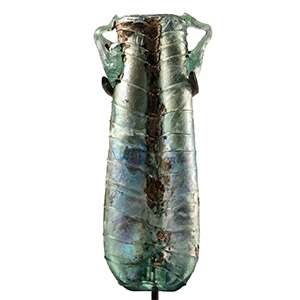
Roman Glass Double Unguentarium
3rd-5th century A.D.Sold for (Inc. bp): £624
Comprising two conjoined tapering tubular cells, with applied handles at the shoulder, decorated with applied trails; mounted on a custom-made stand. 78 grams total, 13 cm including stand
From an important London, UK, collection, 1970-1990s. This lot is accompanied by an illustrated lot declaration signed by the Head of the Antiquities Department, Dr Raffaele D’Amato. -
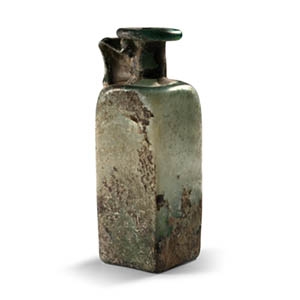
Roman Square Glass Jug
1st-3rd century A.D.Sold for (Inc. bp): £1,170
Square in section with dimple base, flat shoulder and short neck, folded rim; broad strap handle to the rear; mould-blown. 188 grams, 16.2 cm
From a London, UK, collection, 1990s. This lot is accompanied by an illustrated lot declaration signed by the Head of the Antiquities Department, Dr Raffaele D’Amato. -
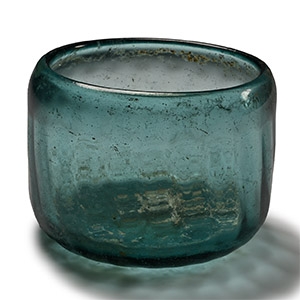
Roman Blue Glass Beaker
3rd-4th century A.D. or laterSold for (Inc. bp): £715
Thick-walled, cylindrical beaker with inwardly curved mouth, rolled rim; shallow dimples to exterior; mold-blown type with slight iridescence; old label to base 'N14075'. 152 grams, 79 mm
Dr K. and W.Z., Rheinland-Pfalz, Germany; acquired 1977 on the German art market. This lot is accompanied by an illustrated lot declaration signed by the Head of the Antiquities Department, Dr Raffaele D’Amato. -
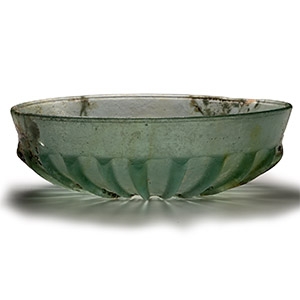
Roman Glass Ribbed Vessel
Eastern Mediterranean, 1st century B.C.-1st century A.D.Sold for (Inc. bp): £572
Flat, thick-walled bowl, mould-made with 22 large ribs to the outer face below the rim extending to the middle of the base; reassembled from fragments. 140 grams, 11.1 cm wide
Ex Martin Wunsch, New York 1980s-1990s. Accompanied by a copy of an Art Loss Register certificate no.S00098335. This lot is accompanied by an illustrated lot declaration signed by the Head of the Antiquities Department, Dr Raffaele D’Amato. -
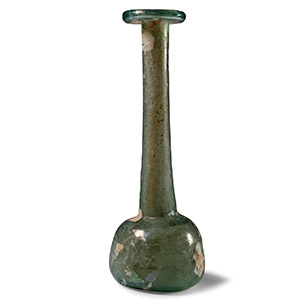
Roman Tall Glass Bottle
1st-2nd century A.D.Sold for (Inc. bp): £572
With plano-convex body and flat base, tapering neck and everted rim; some iridescence to surface. 140 grams, 17.5 cm
Private collection, Luxembourg, 2002. Swiss private collection, 2003. Ex Vittorio Rizzi, Basel, prior 2005. Accompanied by a copy of an Art Loss Register certificate no.S00035605. This lot is accompanied by an illustrated lot declaration signed by the Head of the Antiquities Department, Dr Raffaele D’Amato. -
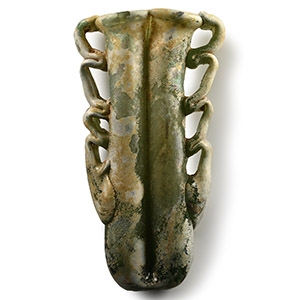
Roman Glass Double Balsamarium with Iridescence
4th century A.D.Sold for (Inc. bp): £410
Comprising two parallel tubes joined at the base and sides, each with flared rim and applied lateral loops; iridescent aqua glass. 73 grams, 11.2 cm
Ex North American collection, 1990s. This lot is accompanied by an illustrated lot declaration signed by the Head of the Antiquities Department, Dr Raffaele D’Amato. -
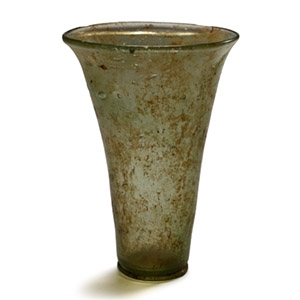
Roman Flared Glass Beaker
1st-2nd century A.D.Sold for (Inc. bp): £468
A 'lotus bud' style beaker with tapering cylindrical body, everted rim and shallow pontil with applied rim to base (partly absent). 117 grams, 11.5 cm
From an important glass collection, London, UK, 1980-1990. This lot is accompanied by an illustrated lot declaration signed by the Head of the Antiquities Department, Dr Raffaele D’Amato.

