-
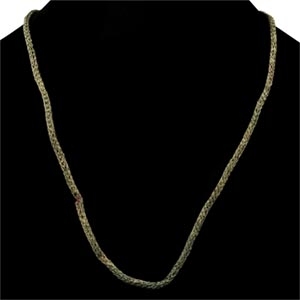
Byzantine Bronze Pendant Chain Necklace
6th-8th century A.D.Sold for (Inc. bp): £156
Trichinopoly cord with coiled wire finials, hook-and-eye fastening. 18.3 grams, 57.2 cm
Acquired on the London art market in the late 1980s-1990s. From the family collection of an East London, UK, gentleman. This lot is accompanied by an illustrated lot declaration signed by the Head of the Antiquities Department, Dr Raffaele D’Amato.
The chain is a multiple 'loop-in-loop' type, a general type of necklace, especially in use in the Romano-Egyptian Jewellery of 3rd-7th century A.D. The early examples were done in Alexandria and the production lasted until the Arab conquest of 641 A.D. -
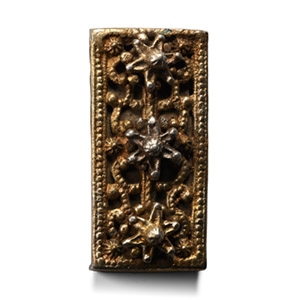
Byzantine Silver-Gilt Ornamented Sword Belt Slide
Circa 12th-15th century A.D.Sold for (Inc. bp): £65
Rectangular in plan with openwork strap to the reverse, three silver-gilt rosettes on a field of granulated strapwork. 33.7 grams, 54 mm
Acquired Brigantia Antiques, York, UK, circa 2006. Ian Wilkinson collection, Nottinghamshire, UK, formed since 1985. This lot is accompanied by an illustrated lot declaration signed by the Head of the Antiquities Department, Dr Raffaele D’Amato. -
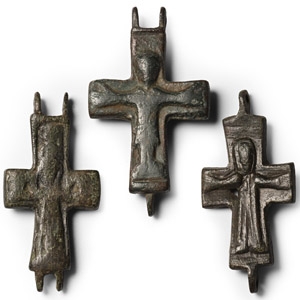
Byzantine Bronze Reliquary Cross Pendant Plate Group
10th-12th century A.D.Sold for (Inc. bp): £117
Each with low-relief figure to the outer face, hinge-knuckles to each end. 20.5 grams total, 42-44 mm
Ex German art market, 2000s. Acquired from an EU collector living in London. From the collection of Surrey, UK, gentleman. This lot is accompanied by an illustrated lot declaration signed by the Head of the Antiquities Department, Dr Raffaele D’Amato. -
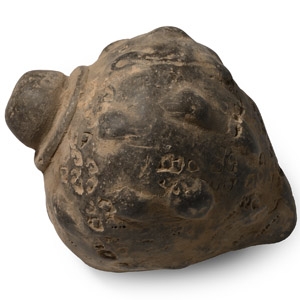
Byzantine 'Greek Fire' Ceramic Fire Bomb or Hand Grenade
9th-11th century A.D.Sold for (Inc. bp): £169
A piriform missile with domed filler-hole, raised lugs and impressed annulets to the body, intended to be filled with explosive liquid and wick, used as a hand grenade. 518 grams, 11.5 cm
From an important specialist collection, London, UK, 1990s onwards. Accompanied by an academic paper by military specialist Dr Raffaele D'Amato, dated 15 July 2019 and titled 'Eastern Roman Empire - Greek Fire Bomb or Hand Grenade (μεσαίον kακάβιον) 9th-11th century AD'. This lot is accompanied by an illustrated lot declaration signed by the Head of the Antiquities Department, Dr Raffaele D’Amato.
Cf. Arendt, W. I., Granaten des 13-14. Jahrhunderts, die an der Wolga gefunden sind, Zeitschrift fur Historische Waffen-und Kostumkunde, 11 (1926-8), p.42; cf. Arendt, W., Die Spharisch-konischen Gefäße aus Gebranntem Ton, ibid; cf. Ayalon, D., Gunpowder and Firearms in the Mamluk Kingdom, London, 1956, p.16. Apart from the use of siphons or manual flame-throwers called cheirosiphona, special corps of Roman soldiers employed terracotta grenades, in the form of small jars, abundantly evidenced in archaeological excavations. They were called μεσαία kακαβιά or κυτροκακάβια where the former had a bulbous shape and the latter a more cylindrical form. -
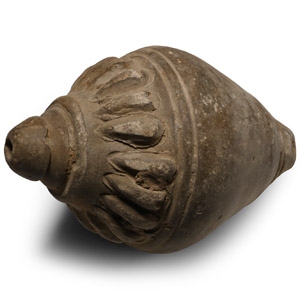
Byzantine 'Greek Fire' Ceramic Fire Bomb or Hand Grenade
9th-11th century A.D.Sold for (Inc. bp): £169
Comprising a piriform body with raised lugs to the upper body, intended to be filled with explosive liquid and wick, used as a hand grenade. 513 grams, 13.7 cm
From an important specialist collection, London, UK, 1990s onwards. Accompanied by an academic paper by military specialist Dr Raffaele D'Amato, dated 15 July 2019 and titled 'Eastern Roman Empire - Greek Fire Bomb or Hand Grenade (μεσαίον kακάβιον) 9th-11th century AD'. This lot is accompanied by an illustrated lot declaration signed by the Head of the Antiquities Department, Dr Raffaele D’Amato. -
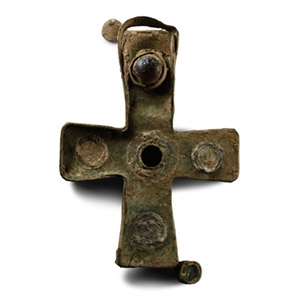
Byzantine Bronze Reliquary Cross Pendant
Circa 8th-10th century A.D.Sold for (Inc. bp): £13
Hollow-formed sheet-bronze enkolpion with cells to the angles (two remaining), five large cells to the obverse with inset cabochon (one remaining). 42 grams, 94 mm
Acquired on the German art market pre 1998. This lot is accompanied by an illustrated lot declaration signed by the Head of the Antiquities Department, Dr Raffaele D’Amato. -
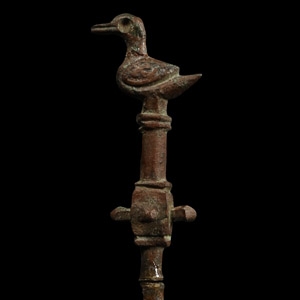
Byzantine Bronze Pin with Duck
6th-8th century A.D.Sold for (Inc. bp): £163
Round-section shank with cuboid panel and four radiating lugs, topped with a perching duck figure. 11.7 grams, 11.7 cm
with a London, UK gallery 1971-early 2000s. Private collection, London. This lot is accompanied by an illustrated lot declaration signed by the Head of the Antiquities Department, Dr Raffaele D’Amato. -
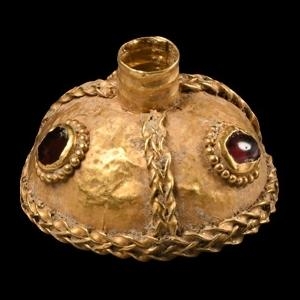
Byzantine Gold Dagger Pommel Cap with Garnets
Circa 8th century A.D.Sold for (Inc. bp): £780
Sheet gold dome with braided filigree band to the rim, three vertical bands and three cells each set with a garnet cabochon, collar to the apex. 2.13 grams, 22 mm
From a continental collection prior to 2000. Acquired on the UK art market in 2010. Ex property of a UK gentleman. This lot is accompanied by an illustrated lot declaration signed by the Head of the Antiquities Department, Dr Raffaele D’Amato.
Eastern Roman daggers of 7th-8th centuries typically displayed gold ornaments embellished with garnets and filigree, visible on the specimens gifted by the Empire to foreign rulers, such as the famous Bulgarian leader Kuvrat. -
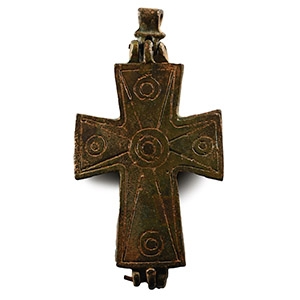
Large Byzantine Bronze Reliquary Cross Pendant
8th-12th century A.D.Sold for (Inc. bp): £130
Formed from two hinged plates with a recess to the inner face of each, cast suspension loop to the upper hinge; one face with ring-and-dot motifs and radiating lines forming a Maltese cross; the reverse with central ring-and-dot on a ropework field. 147 grams, 11.2 cm
Acquired London art market, 1960s-1980s. Property of an Essex, UK collector. Property of a Californian, USA, collector. This lot is accompanied by an illustrated lot declaration signed by the Head of the Antiquities Department, Dr Raffaele D’Amato. -
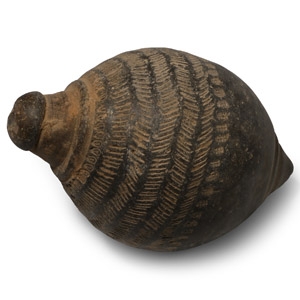
Byzantine 'Greek Fire' Ceramic Fire Bomb or Hand Grenade
9th-11th century A.D.Sold for (Inc. bp): £156
A piriform missile with domed filler-hole, bands of hatched lines to the upper body, intended to be filled with explosive liquid and wick, used as a hand grenade. 725 grams, 14.1 cm
From an important specialist collection, London, UK, 1990s onwards. Accompanied by an academic paper by military specialist Dr Raffaele D'Amato, dated 15 July 2019 and titled 'Eastern Roman Empire - Greek Fire Bomb or Hand Grenade (μεσαίον kακάβιον) 9th-11th century AD'. This lot is accompanied by an illustrated lot declaration signed by the Head of the Antiquities Department, Dr Raffaele D’Amato. -
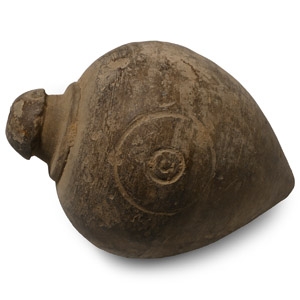
Byzantine 'Greek Fire' Ceramic Fire Bomb or Hand Grenade
9th-11th century A.D.Sold for (Inc. bp): £111
A piriform missile with domed filler-hole, impressed concentric circles to the body, intended to be filled with explosive liquid and wick, used as a hand grenade. 442 grams, 11.7 cm
From an important specialist collection, London, UK, 1990s onwards. Accompanied by an academic paper by military specialist Dr Raffaele D'Amato, dated 15 July 2019 and titled 'Eastern Roman Empire - Greek Fire Bomb or Hand Grenade (μεσαίον kακάβιον) 9th-11th century AD'. This lot is accompanied by an illustrated lot declaration signed by the Head of the Antiquities Department, Dr Raffaele D’Amato. -
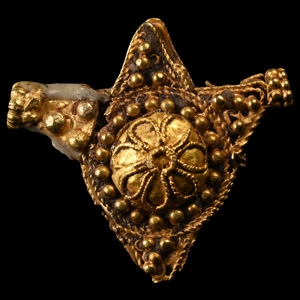
Byzantine Gold Filigree Bead
Circa 11th century A.D.Sold for (Inc. bp): £98
Comprising a central dome with applied filigree rosette, six radiating triangular arms with dense granulation within braided filigree borders (two absent). 1.80 grams, 19 mm
From the collection of a London antiquarian, formed since the 1980s. This lot is accompanied by an illustrated lot declaration signed by the Head of the Antiquities Department, Dr Raffaele D’Amato.

