-
.jpg)
Roman Bronze Traveller Statuette
2nd-3rd century A.D.Sold for (Inc. bp): £104
Hollow-formed figure wearing a paenula and with hands extended to support a patera or salver; mounted on a custom-made stand. 35.8 grams total, 64 mm including stand
From a collection acquired on the UK art market from various auction houses and collections mostly before 2000. From an important Cambridgeshire estate; thence by descent. This lot is accompanied by an illustrated lot declaration signed by the Head of the Antiquities Department, Dr Raffaele D’Amato. -
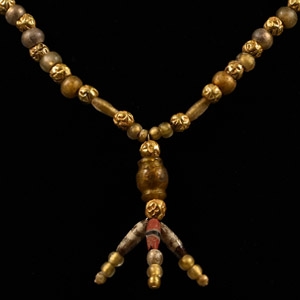
Roman Gold-in-Glass Bead Necklace
4th-5th century A.D.Sold for (Inc. bp): £390
Restrung group of hollow gold-in-glass oblate beads with glass oblate beads, fusiform and other types. 23.5 grams, 51 cm
Acquired on the UK art market 1979-1983. This lot is accompanied by an illustrated lot declaration signed by the Head of the Antiquities Department, Dr Raffaele D’Amato. -
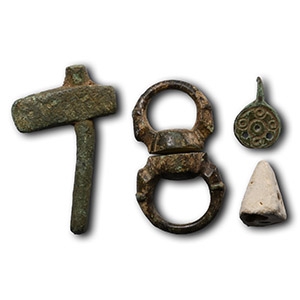
Roman to Norman Artefact Group
4th-12th century A.D.Sold for (Inc. bp): £65
Comprising: a Roman bronze votive hammer; a 6th century Anglo-Saxon bronze hooked clasp; a Viking lead gaming piece; a Norman bronze hunting dog leash swivel. 40 grams total, 17-44 mm
Found Cambridgeshire, UK. This lot is accompanied by an illustrated lot declaration signed by the Head of the Antiquities Department, Dr Raffaele D’Amato. -
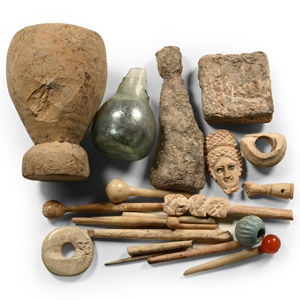
Roman Bone and Other Artefact Collection
1st-4th century A.D.Sold for (Inc. bp): £124
Including discoid spindle whorl, glass bead, bone pins, glass flask and other items. 420 grams total, 8-76 mm
From an old collection formed after WWII and believed to have been from Paestum. Ian Wilkinson collection, Nottinghamshire, UK, formed since 1985. This lot is accompanied by an illustrated lot declaration signed by the Head of the Antiquities Department, Dr Raffaele D’Amato. -
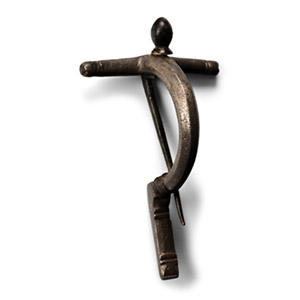
Roman Silver Crossbow Brooch
3rd century A.D.Sold for (Inc. bp): £182
Of early type with lemon-shaped knop above the round-section crossbar, facetted bow with filigree coils to the lower end, D-section footplate with lateral chamfered edges and catchplate to reverse, hinged pin behind the crossbar. 13.9 grams, 60 mm
From an old English collection. Acquired from Spinks, Shambles, York, circa 2010. Ian Wilkinson collection, Nottinghamshire, UK, formed since 1985. This lot is accompanied by an illustrated lot declaration signed by the Head of the Antiquities Department, Dr Raffaele D’Amato. -
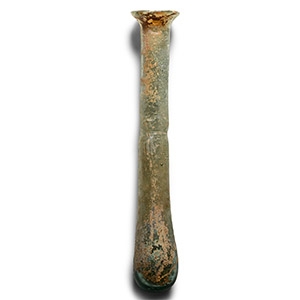
Roman Glass Lachrymatory
1st-2nd century A.D.Sold for (Inc. bp): £98
With long, narrow neck separated from the body by a constriction; funicular mouth. 19 grams, 12.3 cm
Ex W.Kern, Zurich, 1950s-1970s (d.1980s). Accompanied by a copy of an Art Loss Register certificate no.S00086748. This lot is accompanied by an illustrated lot declaration signed by the Head of the Antiquities Department, Dr Raffaele D’Amato.
A lachrymatory (from Latin lacrima, tear) is a type of earthenware or, more commonly, glass container found in Roman and Greek tombs, thought to be bottles into which the relatives of the deceased had dropped their tears. They most likely contained ointments, and the discovery of so many of these containers (unguentaria) in tombs is due to the use of ointments in funeral ceremonies. These lachrymatories are usually shaped like a spindle or flask with a long neck and a bulb-shaped body. -
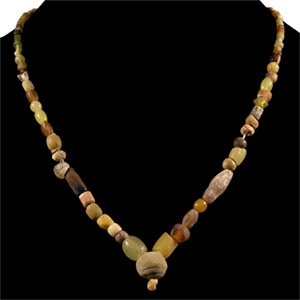
Roman Yellow Glass Bead Necklace String
1st-4th century A.D. and laterSold for (Inc. bp): £65
A designer necklace composed of mainly oblate and barrel-shaped beads, central feature composed of a large spherical bead with a small annular bead below. 35.5 grams, 41.5 cm
Acquired 1980-2015. Ex Abelita family collection. This lot is accompanied by an illustrated lot declaration signed by the Head of the Antiquities Department, Dr Raffaele D’Amato. -
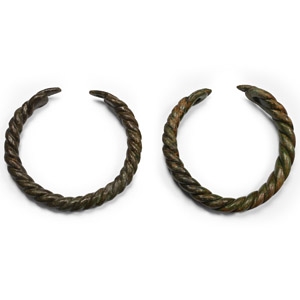
Late Roman Bronze Snake-Headed Bracelet Pair
4th-5th century A.D.Sold for (Inc. bp): £260
Each with braided shank and triangular terminals with snake-head detailing. 121 grams total, 68-70 mm
From the private collection of a London gentleman, from his grandfather's collection formed before the early 1970s. This lot is accompanied by an illustrated lot declaration signed by the Head of the Antiquities Department, Dr Raffaele D’Amato. -
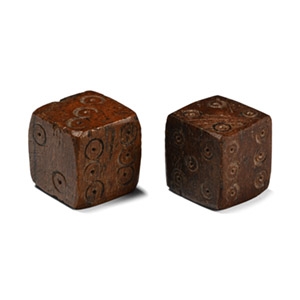
Roman Bone Dice Pair
1st-4th century A.D.Sold for (Inc. bp): £260
Each cuboid with ring-and-dot markings disposed 1:6, 2:5, 3:4. 8.16 grams total, 13.3-13.5 mm
Ex German art market, 2000s. Acquired from an EU collector living in London. From the collection of Surrey, UK, gentleman. This lot is accompanied by an illustrated lot declaration signed by the Head of the Antiquities Department, Dr Raffaele D’Amato. -
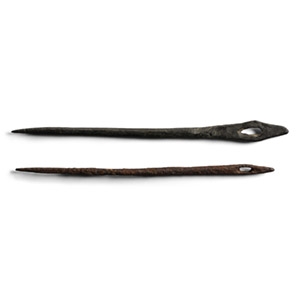
Roman Bronze and Iron Needles
1st-4th century A.D.Sold for (Inc. bp): £26
Bronze needle with flattened head and punched slit eye; similar in iron; with old identification label 'Roman Bronze & Iron Needles 1st-4th century AD authenticated by British Museum 30/5/2006'. 6.7 grams total, 81-86 mm
Acquired from Ancient & Oriental, circa 2001. Ian Wilkinson collection, Nottinghamshire, UK, formed since 1985. Accompanied by a laminated identification label. This lot is accompanied by an illustrated lot declaration signed by the Head of the Antiquities Department, Dr Raffaele D’Amato. -
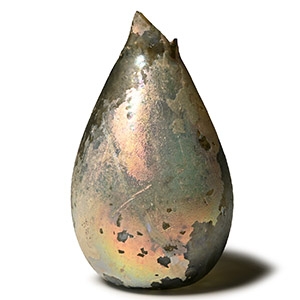
Roman Fragmentary Bottle with Iridescence
1st century A.D.Sold for (Inc. bp): £156
Bulbous body from an unguentarium; old collector's label to underside 'N10941'. 14.3 grams, 61 mm
Ex B.D., acquired in the 1930s. Accompanied by a copy of an Art Loss Register certificate no.S00075600. This lot is accompanied by an illustrated lot declaration signed by the Head of the Antiquities Department, Dr Raffaele D’Amato.
The specimen represents an unguentarium, usually a perfume bottle. However, many of the herbs used by Romans for cosmetics - henna, iris, and saffron, had medicinal value as well, so it is not surprising that bottles that so often assumed to have been containing perfumes were sometimes employed for the storage of astringents and soothing lotions. -
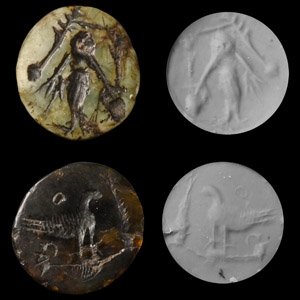
Eastern Roman Hardstone Gemstone Group
2nd century A.D.Sold for (Inc. bp): £91
Comprising two hardstone discs with incuse imagery: a standing figure amid branches; perching bird. 1.9 grams total, 13 mm each
From the collection of Walter Thomas Gaze Cooper (1895-1980); thence by descent. This lot is accompanied by an illustrated lot declaration signed by the Head of the Antiquities Department, Dr Raffaele D’Amato.

