-
.jpg)
England. 'Late Plantagenet' Pb Token. 1425-1490.
Sold for (Inc. bp): £13
London mint. Mitchiner Type La. Expanding cross with convex arms and central dot / Expanding cross with convex arms and central dot. Cf. Mitchiner & Skinner type L, 6-7. 1.03gr, 12mm.
Near Very Fine.
Found from Billingsgate spoil from the Thames foreshore, London, UK, in the 1980s. Property of an Essex collector. -
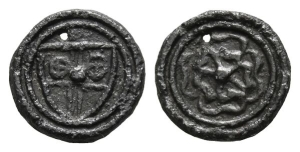
England. 'Shield and Rose' Pb Token. 1425-1672.
Sold for (Inc. bp): £26
Shield quartered by void and linear cross with central dot; cross-in-circle in two upper quarters / Tudor double rose of five and four petals. Mitchiner & Skinner -. 0.80gr, 11mm.
Very Fine. Pierced. Exceedingly rare and apparently unpublished.
Found from Billingsgate spoil from the Thames foreshore, London, UK, in the 1980s. Property of an Essex collector. -
.jpg)
England. 'Cross and Pellets' Pb Token. 1425-1490.
Sold for (Inc. bp): £13
London or Paris mint. Mitchiner Type Mb. IHC (retrograde) in Gothic within anti-clockwise ray border / Cross with dot in each angle; al within anti-clockwise ray border. Mitchiner & Skinner type M, 50 var. (IHC not retrograde; clockwise ray border). 0.69gr, 12mm.
Very Fine.
Found from Billingsgate spoil from the Thames foreshore, London, UK, in the 1980s. Property of an Essex collector.
The 'cross and pellets' tokens differ from the other series of fifteenth-century tokens found in London by virtue of their close links with a series of French tokens. They have been found with not quite equal frequency in London and in Paris. The uniformity of design suggests centralised production control (such as by a guild) but the range of symbols - religious, merchant, brothels - suggests a wide range of users. -
.jpg)
England. 'Cross and Pellets' Pb Token. 1425-1490.
Sold for (Inc. bp): £13
London or Paris mint. Mitchiner Type Ma. Large E in Gothic within clockwise ray border / Cross with dot-in-circle in each angle and expanded arms; al within clockwise ray border. Mitchiner & Skinner type M, 2. 0.62gr, 12mm.
Near Very Fine.
Found from Billingsgate spoil from the Thames foreshore, London, UK, in the 1980s. Property of an Essex collector.
The 'cross and pellets' tokens differ from the other series of fifteenth-century tokens found in London by virtue of their close links with a series of French tokens. They have been found with not quite equal frequency in London and in Paris. The uniformity of design suggests centralised production control (such as by a guild) but the range of symbols - religious, merchant, brothels - suggests a wide range of users. -
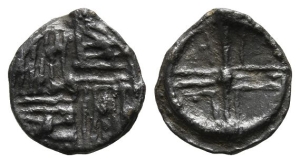
England. 'Late Plantagenet' Pb Token. 1425-1490.
Sold for (Inc. bp): £20
London mint. Mitchiner Type L. Quartered field with striate angles / Linear cross within void cross with central dot. Mitchiner & Skinner -. 1.19gr, 14mm.
Very Fine. Exceedingly rare and apparently unpublished.
Found from Billingsgate spoil from the Thames foreshore, London, UK, in the 1980s. Property of an Essex collector. -
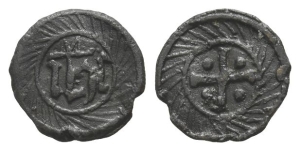
England. 'Cross and Pellets' Pb Token. 1425-1490.
Sold for (Inc. bp): £13
London or Paris mint. Mitchiner Type Mb. IHC in Gothic within anti-clockwise ray border / Cross with dot in each angle; all within anti-clockwise ray border. Mitchiner & Skinner type M, 50 var. (clockwise ray border). 0.69gr, 12mm.
Good Very Fine.
Found from Billingsgate spoil from the Thames foreshore, London, UK, in the 1980s. Property of an Essex collector.
The 'cross and pellets' tokens differ from the other series of fifteenth-century tokens found in London by virtue of their close links with a series of French tokens. They have been found with not quite equal frequency in London and in Paris. The uniformity of design suggests centralised production control (such as by a guild) but the range of symbols - religious, merchant, brothels - suggests a wide range of users. -
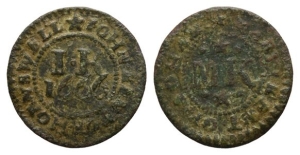
England. Cambridgeshire, Soham. Mary and John Kent AE Farthing. Dated 1666.
Sold for (Inc. bp): £39
★ IOHN • KENT • OF • HORNSWELL around, I • K over 1666 in centre / ★ MARY • KENT • OF • SOHAM around,•★• M K •★• in centre. Dickinson 174; W 174 and Suffolk 152. 1.12gr, 16mm, 12h.
Near Fine.
Acquired on the UK art market before 2000. Property of an Essex, UK, gentleman. -
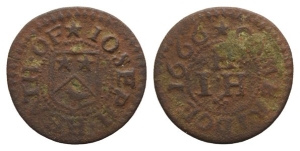
England. Cambridgeshire, Joseph Heath AE Farthing. Dated 1666.
Sold for (Inc. bp): £33
★ IOSEPH • HEATH • OF, shield of arms / ★ CAMBRIDGE • 1666, H I • H in three lines, stars in fields. Dickinson 52. 1.26gr, 16mm, 12h.
Near Fine.
Acquired on the UK art market before 2000. Property of an Essex, UK, gentleman. -
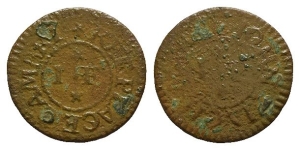
England. Cambridgeshire, Market Place. John Finch AE Farthing. 17th century.
Sold for (Inc. bp): £7
★ IOHN • FINCH • MAR : around, ★ I • F ★ in centre / ★ KET • PLACE • CAMBRI around, ★ I • F ★ in centre. Dickinson 44. 1.01gr, 15mm, 12h.
Fair.
Acquired on the UK art market before 2000. Property of an Essex, UK, gentleman. -
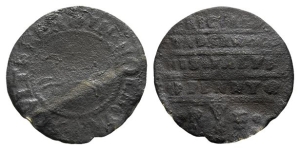
England. Holborn AE Halfpenny Token. 1649-1672.
Sold for (Inc. bp): £7
London (Holborn) mint. Richard Underwood, issuer. ✿ IN HOLBORN • POVLTERER, hare running to left / RICHARD UNDERWOOD HIS • HALFE ✿ PENNY ✿ • R V E • in five lines. Dickinson 1475. 0.70gr, 18mm, 12h.
Fair.
Found on various UK sites since 1974. Property of an Essex collector (collector's ticket included). -
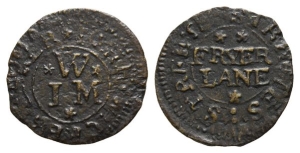
England. 'I W' of Fryer Lane, London CU Farthing Token. 1648-1672.
Sold for (Inc. bp): £46
London mint. [IOHN WICKES BAKER *?], initial W over IM, three cinquefoils in field / STREETES : STREET[E?], FRYER LANE in two lines, two cinquefoils above, one below. Dickinson -; cf. Williamson 3128 (THAMES STREETE); SCBI 59 -; UKDFD Recording Software Online 55733 (this token). 1.00gr, 16mm, 3h.
Near Very Fine. Apparently overstruck on an earlier type.
Found in Thames foreshore, 9 March 1985. Property of an Essex collector. -
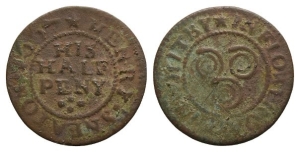
England. Yorkshire, Whitby. Henry Sneaton AE Halfpenny. Dated 1667.
Sold for (Inc. bp): £20
★ HENRY • SNEATON • 1667 around, HIS HALF PENY in three lines and four pellets below / ★ IN • FLOWER • GATE • IN • WHITBY around, three ammonite fossils in centre. Dickinson 371; Boyne 327; W 371. 1.29gr, 18mm, 12h.
Near Fine. Very rare token that displays three ammonite fossils, reflective of the Arms of Whitby Abbey.
Acquired on the UK art market before 2000. Property of an Essex, UK, gentleman.

