-
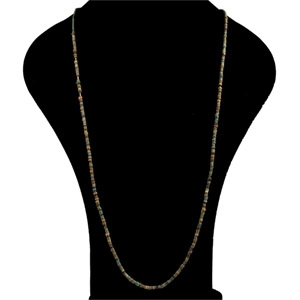
Egyptian Faience Mummy Bead Necklace
Late Period, 664-332 B.C.Sold for (Inc. bp): £130
Mainly annular beads in various shades with tubular beads to one section. 12.6 grams, 104 cm
From an old English deceased estate. Acquired on the Yorkshire art market in the early 1990s. Property of a London, UK, collector. This lot is accompanied by an illustrated lot declaration signed by the Head of the Antiquities Department, Dr Raffaele D’Amato. -
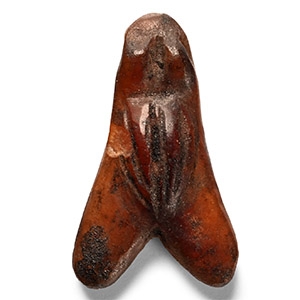
Egyptian Carnelian Fly Amulet
Late Period, 664-332 B.C.Sold for (Inc. bp): £182
Carved with simple body and eye detailing and polished; drilled through the eyes for suspension. 0.41 grams, 13 mm
From an early 20th century collection. This lot is accompanied by an illustrated lot declaration signed by the Head of the Antiquities Department, Dr Raffaele D’Amato.
Small fly amulets first appeared in burials during the Naqada II Period, c. 3200 B.C. These amulets grew in popularity and the materials used to make them expanded during the New Kingdom. They are crafted from a variety of materials such as gold, silver, lapis lazuli, carnelian, amethyst, faience, and bone. These amulets were thought to protect against insect bites and to ward off troublesome flying creatures through apotropaic magic. Some believe they may have even been intended to symbolise the fly’s fecundity. Additionally, pharaohs would bestow gold fly-shaped pendants as military awards to honour the bravery and fly-like persistence of soldiers in battle. -
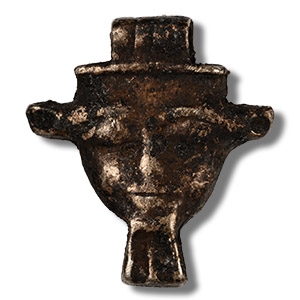
Egyptian Silver Hathor Amulet
Late-Ptolemaic Period, 664-30 B.C.Sold for (Inc. bp): £98
D-shaped mask representing the human-headed Hathor with cow ears and a short beard, with a ribbed suspension loop above. 0.66 grams, 10 mm
From an early 20th century collection. This lot is accompanied by an illustrated lot declaration signed by the Head of the Antiquities Department, Dr Raffaele D’Amato. -
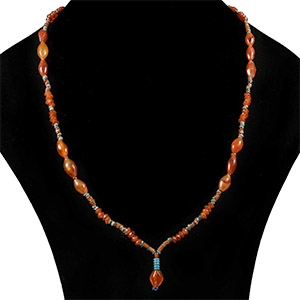
Egyptian Hardstone and Faience Necklace
Late Period, 664-332 B.C.Sold for (Inc. bp): £572
Designer necklace featuring symmetrical layout of carnelian oval beads, with faience annular beads and some smaller carnelian beads, with a central shaped carnelian bead pendant and S-shaped hook; restrung. 35 grams, 70 cm
From the private collection of the late Mrs Belinda Ellison, long time member of the Egyptian Exploration Society, c.1940-2020. This lot is accompanied by an illustrated lot declaration signed by the Head of the Antiquities Department, Dr Raffaele D’Amato. -
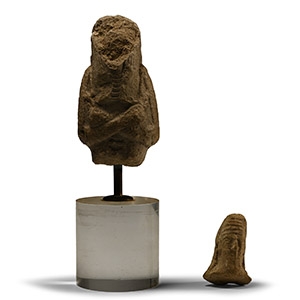
Egyptian Clay Shabti and Babylonian Head Group
Mid 1st millennium B.C.Sold for (Inc. bp): £85
Comprising: fragment of a shabti with tripartite wig and arms crossed at the chest, mounted on a custom-made stand; male head from a figurine. 268 grams total, 4.3-16.5 cm including stand
From an old English deceased estate. Property of a London, UK, collector. This lot is accompanied by an illustrated lot declaration signed by the Head of the Antiquities Department, Dr Raffaele D’Amato. -
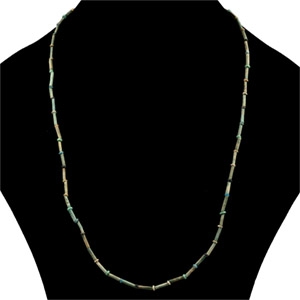
Egyptian Faience Bead Necklace String
Late Period, 664-332 B.C.Sold for (Inc. bp): £52
Comprising tubular beads with interstitial annular beads connecting. 5.11 grams, 70 cm
From an old English collection. Acquired from Helios Gallery, 2011. Ian Wilkinson collection, Nottinghamshire, UK, formed since 1985. This lot is accompanied by an illustrated lot declaration signed by the Head of the Antiquities Department, Dr Raffaele D’Amato. -
.jpg)
Egyptian Orange Carnelian Poppy Head Amulet
New Kingdom, 18th Dynasty, 1550-1292 B.C.Sold for (Inc. bp): £124
Polished and with integral pierced suspension loop; element from a broad collar. 0.20 grams, 11 mm
Ex UK gallery, early 2000s. This lot is accompanied by an illustrated lot declaration signed by the Head of the Antiquities Department, Dr Raffaele D’Amato.
Amulets in the form of poppies were used to heal and alleviate pain and to ward off death. These types of amulets were also linked to Osiris, the Egyptian deity of agriculture, death, and the afterlife. -
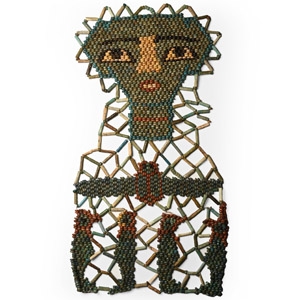
Egyptian Faience Bead Mummy Face Mask
Ptolemaic Period, 332-30 B.C.Sold for (Inc. bp): £715
Restrung; a netted beadwork panel of annular and tubular glazed composition beads in blues, greens, black, cream and red-brown colours, depicting a mummy face mask with false beard, a scarab with extended wings below, the 'Four Sons of Horus’ beneath the scarab, joined together with areas of open netting of tubular beads. 67 grams, 24 cm high
Acquired 1990s. Ex Mariaud des Serres, Paris, France. This lot is accompanied by an illustrated lot declaration signed by the Head of the Antiquities Department, Dr Raffaele D’Amato.
The 'Four Sons of Horus' protected the internal organs of the deceased. Depicted from left to right: the falcon-headed Qebhesenuef protected the intestines; human-headed Imsety, the liver; baboon-headed Hapi, the lungs; jackal-headed Duamutef, the stomach. -
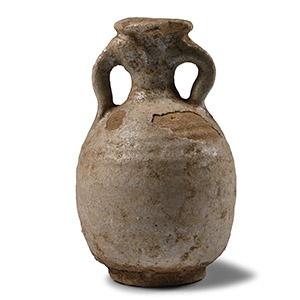
Faience Juglet
Parthian, 1st-2nd century A.D.Sold for (Inc. bp): £85
With barrel-shaped body. trumpet-shaped neck flanked by strap handles to the shoulder, horizontal ribbing. 106 grams, 10 cm
Acquired 1980-2015. Ex Abelita family collection. This lot is accompanied by an illustrated lot declaration signed by the Head of the Antiquities Department, Dr Raffaele D’Amato. -
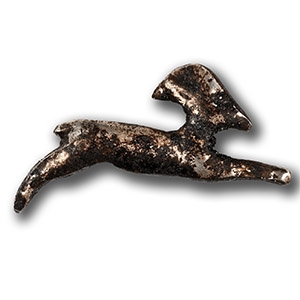
Egyptian Silver Gazelle Amulet
Late-Ptolemaic Period, 664-30 B.C. or earlierSold for (Inc. bp): £221
Figure of a leaping gazelle modelled in the half-round, two attachment loops to the reverse. 1 grams, 21 mm
From an early 20th century collection. This lot is accompanied by an illustrated lot declaration signed by the Head of the Antiquities Department, Dr Raffaele D’Amato.
The ‘flying gallop’ pose of animal figures, including the ibex, in ancient Egyptian jewellery elements is considered to be of Aegean influence. -
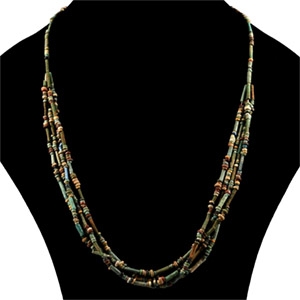
Egyptian Multi-Stranded Mummy Bead Necklace
Late Period, 664-332 B.C.Sold for (Inc. bp): £117
Multi-stranded designer necklace composed of beads of mainly annular and cylindrical types; restrung. 26 grams, 72 cm
Acquired before 1979. From the private collection of Mr F. A., South Kensington, London, UK; thence by descent 2014. This lot is accompanied by an illustrated lot declaration signed by the Head of the Antiquities Department, Dr Raffaele D’Amato.
For thousands of years, artisans in Egypt created vibrant ceramics to echo the beauty of rare jewels. These ornaments were created with almost every material, colour, and texture imaginable and they come from across Egypt and beyond: vibrant blue lapis lazuli from Afghanistan, glossy black obsidian from Turkey, and aqua-green turquoise from the Sinai. They were worn in life and, after death, they served as precious ornamentation for mummies. -
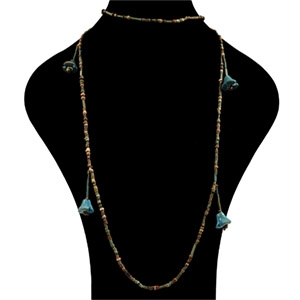
Egyptian Bead Necklace with Lotus Flowers
Late Period, 664-332 B.C. or laterSold for (Inc. bp): £234
Comprising annular and cylindrical beads in various colours, interspersed with four lotus-flower pendants. 24.2 grams, 104 cm
P.S., Netherlands, 1985. Ex Sands of Time U.S.A. with Treasuregate Gallery, 11 June 2015, Netherlands. Accompanied by a copy of an Art Loss Register certificate no.S00105718. This lot is accompanied by an illustrated lot declaration signed by the Head of the Antiquities Department, Dr Raffaele D’Amato.
The most common type of collars based on pendants found at various localities, was mainly composed of pendants imitating plant forms. The terminals of surviving collars of this design are usually triangular, representing lotus flowers, or rectangular, decorated with plant designs or spirals.

