-
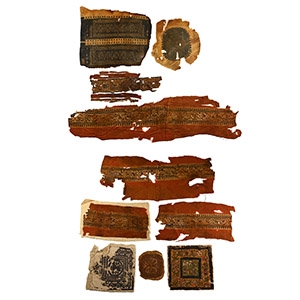
Coptic Textile Fragment Collection
4th-6th century A.D.Sold for (Inc. bp): £494
Mixed group, mainly decorative elements (clavi, orbiculi, tabulae) from various tunics made in late Antiquity; decoration partly figural (animals and mythical hybrid creatures, mostly in a separate tondo or panel) and partly ornamental (interlace patterns, lozenges, pomegranate borders, chevrons, heart-shaped leaves). 450 grams total, 12.5-65.5 cm
with Christie's London, 27 April 1976, no.91 & 92. Accompanied by a copy of an Art Loss Register certificate no.S00136676. This lot is accompanied by an illustrated lot declaration signed by the Head of the Antiquities Department, Dr Raffaele D’Amato. -

Egyptian Faience Beads and Other Fragments
Late Period, 664-332 B.C.Sold for (Inc. bp): £91
Including seed and tubular beads, and other items. 35 grams total, 1-14 mm
From an old English collection. Acquired from Brigantia, York, 1990s. Ian Wilkinson collection, Nottinghamshire, UK, formed since 1985. This lot is accompanied by an illustrated lot declaration signed by the Head of the Antiquities Department, Dr Raffaele D’Amato. -
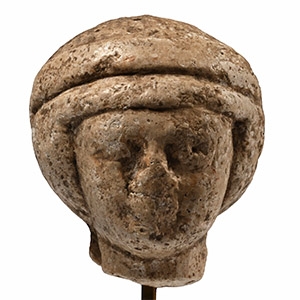
Egyptian Small Head with Wig
Ptolemaic Period, 331-30 B.C.Sold for (Inc. bp): £312
Small carved head with bobbed curly wig and and narrow hair band or diadem; surface slightly worn; mounted on a display stand. 29 grams, 35 mm (57.6 grams total, 10.4 cm)
Antoni Sikorski collection, London, formed between the 1950s and 1970s. with Chiswick Auctions, 11 May 2016, no.37 [Part]. This lot is accompanied by an illustrated lot declaration signed by the Head of the Antiquities Department, Dr Raffaele D’Amato.
Although worn, the presence of the narrow diadem and curly hair suggest that the head might depict a Ptolemaic priest. For better-preserved examples of the type cf. Bothmer, B.V., Egyptian Sculpture of the Late Period 700 B.C. to A.D. 100, New York, 1960, pp. 178-179, pls. 128 and 129, 343; Spier, J., Potts, T., and Cole, S.E. (eds.), Beyond the Nile: Egypt and the classical world, Los Angeles, 2018, p. 169 no. 101. -
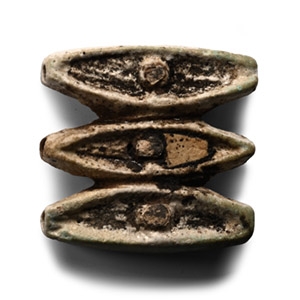
Egyptian Faience Triple Eye of Horus Amulet
Third Intermediate Period, 1070-713 B.C.Sold for (Inc. bp): £78
Amulet of a triple Eye of Horus, originally inlaid, pierced longitudinally for suspension. 4.27 grams, 28 mm
From an English deceased estate. Previously with Den of Antiquity, Cambridgeshire, UK, with stock code L838-3. Property of a Bristol, UK, gentleman. Ex TimesAncient, Bristol, UK. Accompanied by a copy of a previous catalogue entry, and a previous dealer's sales ticket. This lot is accompanied by an illustrated lot declaration signed by the Head of the Antiquities Department, Dr Raffaele D’Amato.
The Eye of Horus was a powerful symbol of protection in Ancient Egypt, also known as the Wedjet (or Ujat, meaning 'Whole One') and the 'all seeing eye'. It was believed to have healing and protective power and was used as an amulet. -
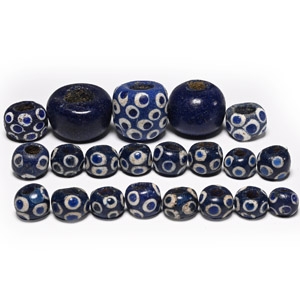
Phoenician Blue Glass Bead Group
6th-3rd century B.C. or laterSold for (Inc. bp): £624
Including drum-shaped types with marvered eye-motifs. 65 grams total, 10-25 mm
UK gallery, early 2000s. This lot is accompanied by an illustrated lot declaration signed by the Head of the Antiquities Department, Dr Raffaele D’Amato.
The category belongs to the cylindrical turquoise eye beads with dark blue and white decorations. Pre-Roman glass beads of this type, generally dated to the Iron Age (end of the ninth century B.C. to 218 B.C.), have been found in significant amounts in the Iberian Peninsula and the Balearic Islands, especially in Phoenician and Punic burial contexts. -
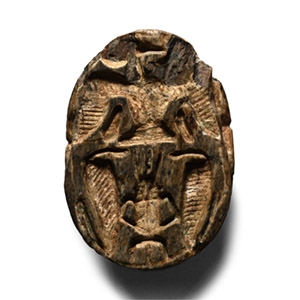
Egyptian Steatite Scarab with Bes, Vulture and Cobras
New Kingdom, 1550-1070 B.C.Sold for (Inc. bp): £247
Naturalistically carved scarab upper; underside carved with vulture atop a figure of Bes flanked by rearing cobras. 9.35 grams, 33 mm
UK private collection before 2000. Acquired on the UK art market. Property of a London gentleman. This lot is accompanied by an illustrated lot declaration signed by the Head of the Antiquities Department, Dr Raffaele D’Amato. -
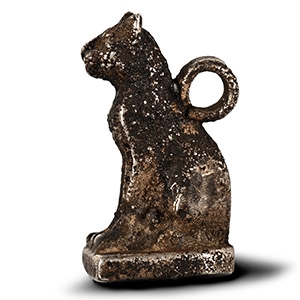
Egyptian Silver Goddess Bastet Cat Amulet
Late-Ptolemaic Period, 664-30 B.C.Sold for (Inc. bp): £338
Modelled seated on a tongue-shaped base, with suspension loop to the back. 0.33 grams, 8 mm
From an early 20th century collection. This lot is accompanied by an illustrated lot declaration signed by the Head of the Antiquities Department, Dr Raffaele D’Amato.
The cat was sacred to Bastet, a protective mother goddess and the daughter of the sun god Re. Amulets provided the wearer with the goddess's protection. -
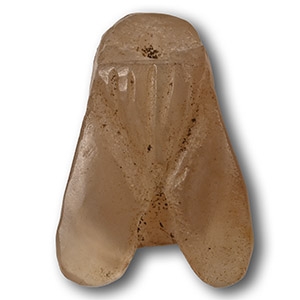
Egyptian Carnelian Fly Amulet
Late-Ptolemaic Period, 664-30 B.C.Sold for (Inc. bp): £52
Formed as a fly with long triangular wings on a tongue-shaped base. 0.65 grams, 12 mm
From an early 20th century collection. This lot is accompanied by an illustrated lot declaration signed by the Head of the Antiquities Department, Dr Raffaele D’Amato. -
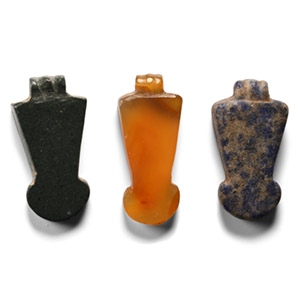
Egyptian Hardstone Menat Amulet Group
Ptolemaic Period, 332-30 B.C.Sold for (Inc. bp): £364
Lapis lazuli, carnelian, and schist (?) menat amulets, each with a distinctive keyhole shape and broad ribbed bale. 5.38 grams total, 20-22 mm
From a private collection acquired by the previous owner's father in the 1950s. Ex TimesAncient, Bristol, UK. Accompanied by a copy of a previous catalogue entry. This lot is accompanied by an illustrated lot declaration signed by the Head of the Antiquities Department, Dr Raffaele D’Amato.
The menat was a counterpoise that hung at the back of a heavy ornamental collar and was closely associated with the goddess Hathor. Amulets representing the counterpoise were thought to bring good luck, protect against evil spirits, and safeguard the wearer in the afterlife. Their Hathoric connection symbolised fertility and good health for women while representing virility for men. -
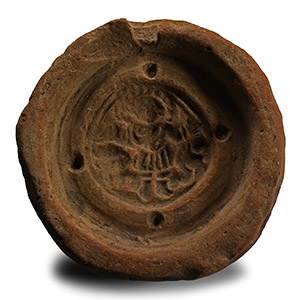
Coptic Terracotta Clay Mould
6th-7th century A.D.Sold for (Inc. bp): £72
Discoid receptacle with a military saint in Roman armour (Saint Menas), with muscular cuirass and pteryges, arms open in the manner of the orans pose, animals (camels?) on his side. 198 grams, 89 mm
Maurice Bouvier, Alexandrie, prior 1959. This lot is accompanied by an illustrated lot declaration signed by the Head of the Antiquities Department, Dr Raffaele D’Amato.
The majority of the terracotta ampullae come from Egypt and bear representations of St. Menas or Mennas, an Egyptian Christian officer decapitated during the persecutions of Diocletian's time. The legend relates that the saint's body was placed upon a camel which was let loose to follow what course it chose; in the place where the camel stopped, some miles from Alexandria, a grave and a shrine were subsequently built. In allusion to this legend, St. Menas is often represented as standing between two camels, though the animals are often of so fantastic a form as to be very difficult to recognise. -
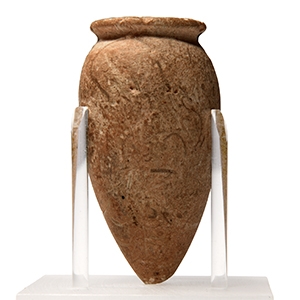
Egyptian Miniature Stone Alabastron
Late Old Kingdom, circa 2300 B.C.Sold for (Inc. bp): £260
The body with rounded shoulders, convex outer face and pointed base, everted rim; accompanied by a custom-made display base. 34.2 grams, 48 mm high (48.9 grams, 55 mm including stand)
Acquired in Europe before 1994. European collection. This lot is accompanied by an illustrated lot declaration signed by the Head of the Antiquities Department, Dr Raffaele D’Amato. -
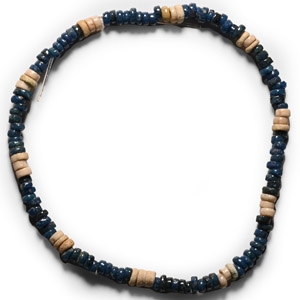
Egyptian Faience Bead Bracelet
Late Period, 664-332 B.C.Sold for (Inc. bp): £78
A restrung group of annular beads in shades of blue and white; mainly faience, but some possibly shell. 2.01 grams, 17.8 cm long
From the private collection of the late Mrs Belinda Ellison, a long time member of the Egyptian Exploration Society, c.1940-2020. This lot is accompanied by an illustrated lot declaration signed by the Head of the Antiquities Department, Dr Raffaele D’Amato.

