-
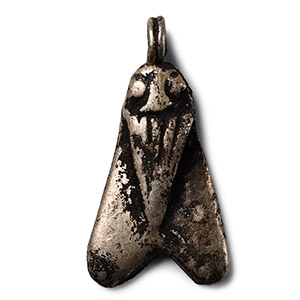
Egyptian Silver Fly Amulet
Late-Ptolemaic Period, 664-30 B.C.Sold for (Inc. bp): £208
With linear detailing to wings, raised eyes, suspension loop above the head. 1.28 grams, 20 mm
From an early 20th century collection. This lot is accompanied by an illustrated lot declaration signed by the Head of the Antiquities Department, Dr Raffaele D’Amato.
Small fly amulets first appeared in burials during the Naqada II Period, c. 3200 B.C. These amulets grew in popularity and the materials used to make them expanded during the New Kingdom. They are crafted from a variety of materials such as gold, silver, lapis lazuli, carnelian, amethyst, faience, and bone. These amulets were thought to protect against insect bites and to ward off troublesome flying creatures through apotropaic magic. Some believe they may have even been intended to symbolise the fly’s fecundity. Additionally, pharaohs would bestow gold fly-shaped pendants as military awards to honour the bravery and fly-like persistence of soldiers in battle. -

Egyptian Faience Beads and Other Fragments
Late Period, 664-332 B.C.Sold for (Inc. bp): £65
Including seed and tubular beads, and other items. 38 grams total, 1-14 mm
From an old English collection. Acquired from Brigantia, York, 1990s. Ian Wilkinson collection, Nottinghamshire, UK, formed since 1985. This lot is accompanied by an illustrated lot declaration signed by the Head of the Antiquities Department, Dr Raffaele D’Amato. -
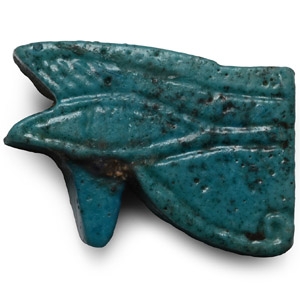
Egyptian Deep Blue Glazed Faience Eye of Horus Amulet
Late Period, 664-332 B.C.Sold for (Inc. bp): £234
Large wedjat-eye amulet with incised human and falcon elements. 11.7 grams, 38 mm
From the private collection of the late Mrs Belinda Ellison, a long time member of the Egyptian Exploration Society, c.1940-2020. This lot is accompanied by an illustrated lot declaration signed by the Head of the Antiquities Department, Dr Raffaele D’Amato.
The wedjat-eye amulet is a representation of the healed eye of the god Horus, featuring both human and falcon elements. The name wedjat in ancient Egyptian means ‘the one that is sound.’ According to Egyptian mythology, Horus' eye was wounded or taken by the god Seth and restored by Thoth. The wedjat-eye amulet was thought to protect its wearer and bestow the power of recovery and regeneration onto them. It was very popular and used by both the living and the dead. -
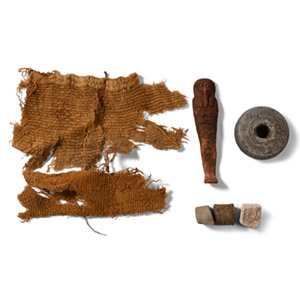
Egyptian Artefact Collection
Late-Coptic Period, 664 B.C.-6th century A.D.Sold for (Inc. bp): £143
Including textile fragment, spindle whorl, shabti and other items. 41 grams total, 1.4-11 cm
From an old English collection. The shabti acquired from Den of Antiquity in 2011. Ian Wilkinson collection, Nottinghamshire, UK, formed since 1985. This lot is accompanied by an illustrated lot declaration signed by the Head of the Antiquities Department, Dr Raffaele D’Amato. -
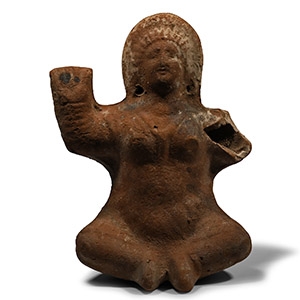
Egyptian Terracotta Figurine of Baubo
Ptolemaic Period, 2nd-1st century B.C.Sold for (Inc. bp): £211
Depicted wearing a long sleeveless vestis talaris with a V-opening, on the head a high propoloma falling on her shoulders, ears pierced to accept earrings, right arm raised and legs bent at knees. 642 grams, 19.2 cm
The Erotica Collection Christian von Faber-Castell, Küsnacgt ZH, Switzerland, since the late 1970s. This lot is accompanied by an illustrated lot declaration signed by the Head of the Antiquities Department, Dr Raffaele D’Amato.
Baubo was a minor divinity in Greek mythology, linked to the cult of Demeter and Persephone. The statuette belongs to the second type of Baubo figurines, widespread in the last Ptolemaic and Roman period in Egypt. The Egyptian Baubos are split into two groups, and this one belongs to the first group depicting a woman seating frontally whilst holding a musical instrument or with the open hand in blessing gesture. Many of them were used as amulets or as ex-voto. Christian von Faber-Castell (born 1950) is a renowned German entrepreneur and art collector, best known as a member of the prominent Faber-Castell family, famed for their iconic writing instruments. A passionate advocate for art and culture, Christian von Faber-Castell curated an extensive and diverse private collection of erotica, spanning centuries and cultures. His collection reflects a deep appreciation for the interplay of beauty, sensuality, and artistic expression, bringing together rare and unique works that explore themes of intimacy and human connection. Pieces from this collection have been featured in notable exhibitions and are celebrated for their artistic and historical significance. This offering represents a rare opportunity to acquire works from one of the most fascinating and eclectic private collections of its kind. -

Egyptian Faience Beads and Other Fragments
Late Period, 664-332 B.C.Sold for (Inc. bp): £91
Including seed and tubular beads, and other items. 27 grams total, 1-10 mm
From an old English collection. Acquired from Brigantia, York, 1990s. Ian Wilkinson collection, Nottinghamshire, UK, formed since 1985. This lot is accompanied by an illustrated lot declaration signed by the Head of the Antiquities Department, Dr Raffaele D’Amato. -
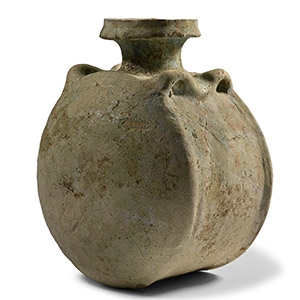
Egyptian Faience Pilgrim's Flask
Late-Ptolemaic Period, 664-30 B.C.Sold for (Inc. bp): £182
With domed faces and grooved edge, a pair of loop handles to each shoulder, slender neck and wide mouth. 825 grams, 17.2 cm
Ex London art market 1990s. From a London, UK, collection. This lot is accompanied by an illustrated lot declaration signed by the Head of the Antiquities Department, Dr Raffaele D’Amato. -
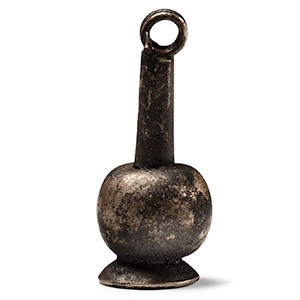
Egyptian Silver Poppy Amulet
Late-Ptolemaic Period, 664-30 B.C.Sold for (Inc. bp): £85
Silver poppy-head with loop at the apex. 1.46 grams, 19 mm
From an early 20th century collection. This lot is accompanied by an illustrated lot declaration signed by the Head of the Antiquities Department, Dr Raffaele D’Amato. -
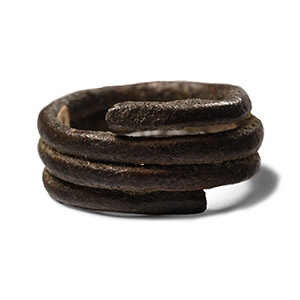
Egyptian Silver Hair Ring
New Kingdom, circa 1550-1070 B.C.Sold for (Inc. bp): £65
Formed as a single round-section rod in coils. 3.78 grams, 17 mm
From the collection of Walter Thomas Gaze Cooper (1895-1980); thence by descent. This lot is accompanied by an illustrated lot declaration signed by the Head of the Antiquities Department, Dr Raffaele D’Amato. -
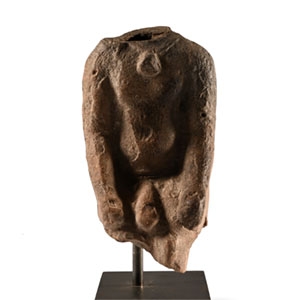
Egyptian Terracotta Seated Torso
Ptolemaic Period, 4th-3rd century B.CSold for (Inc. bp): £65
The headless deity, possibly Harpocrates, seated on a throne, forearms resting on thighs and flanking a protruding phallus, wearing a medallion around the neck; mounted on a custom-made display stand. 280 grams total, 97 mm including stand
The Erotica Collection Christian von Faber-Castell, Küsnacgt ZH, Switzerland, since the late 1970s. This lot is accompanied by an illustrated lot declaration signed by the Head of the Antiquities Department, Dr Raffaele D’Amato.
Figural plaques of ithyphallic Harpocrates seated on a block seat with forearms on thighs and hands each side of a projecting phallus were rare types from Naukratis, Temai el-Amohel. They can be dated to the early Hellenistic Period, circa 330 B.C. Christian von Faber-Castell (born 1950) is a renowned German entrepreneur and art collector, best known as a member of the prominent Faber-Castell family, famed for their iconic writing instruments. A passionate advocate for art and culture, Christian von Faber-Castell curated an extensive and diverse private collection of erotica, spanning centuries and cultures. His collection reflects a deep appreciation for the interplay of beauty, sensuality, and artistic expression, bringing together rare and unique works that explore themes of intimacy and human connection. Pieces from this collection have been featured in notable exhibitions and are celebrated for their artistic and historical significance. This offering represents a rare opportunity to acquire works from one of the most fascinating and eclectic private collections of its kind. -
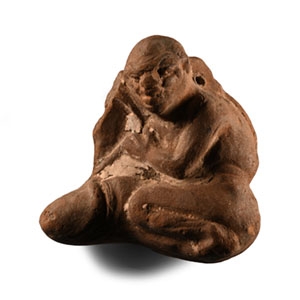
Egyptian Terracotta Ithyphallic Figurine of a Seated Male
Ptolemaic Period, 2nd-1st century B.C.Sold for (Inc. bp): £143
Representing a hunchback in a crouched position, leaning against his emphasised phallus and resting a triangular harp on it. 64 grams, 63 mm
The Erotica Collection Christian von Faber-Castell, Küsnacgt ZH, Switzerland, since the late 1970s. This lot is accompanied by an illustrated lot declaration signed by the Head of the Antiquities Department, Dr Raffaele D’Amato.
From the 4th century B.C. onwards, small-scale sculptures developed into a rich repertoire of grotesque types. These so-called grotesques were an enhancement of the Hellenistic interest in the human body and its weakness and imperfections by depicting disfigured individuals. According to some scholars, terracotta (and bronze) figurines of this kind were life-like representations of beggars and others who gathered at big feasts in temples or at the houses of the wealthy. In the latter case, they indicated the importance and wealth of the host as the more beggars an event attracted, the greater the fortune of the event organiser. By implication, the bronze and terracotta portraits of these marginal people could have become symbols and charms of good luck that would have been placed in private houses. Christian von Faber-Castell (born 1950) is a renowned German entrepreneur and art collector, best known as a member of the prominent Faber-Castell family, famed for their iconic writing instruments. A passionate advocate for art and culture, Christian von Faber-Castell curated an extensive and diverse private collection of erotica, spanning centuries and cultures. His collection reflects a deep appreciation for the interplay of beauty, sensuality, and artistic expression, bringing together rare and unique works that explore themes of intimacy and human connection. Pieces from this collection have been featured in notable exhibitions and are celebrated for their artistic and historical significance. This offering represents a rare opportunity to acquire works from one of the most fascinating and eclectic private collections of its kind. -
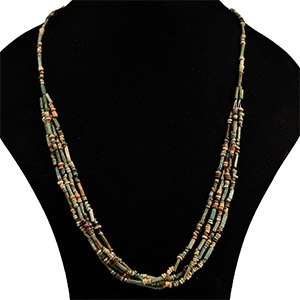
Egyptian Multi-Stranded Mummy Bead Necklace String
Late Period, 664-525 B.C.Sold for (Inc. bp): £143
A composition necklace composed of multiple strands of polychrome beads of mainly annular and tubular types. 28 grams total, 82 cm long
Acquired before 1979. From the private collection of Mr F. A., South Kensington, London, UK; thence by descent 2014. This lot is accompanied by an illustrated lot declaration signed by the Head of the Antiquities Department, Dr Raffaele D’Amato.
Red and yellow faience were among the new colours appeared in the 18th Dynasty, but they were in use until the Late Period. It was ideally formed from a core of sand and quartz and a vitreous alkaline glaze. It was the preferred medium of Egyptian jewellers even before the First Dynasty, because of its malleability and its ability to imitate other more expensive materials thanks to the colour of the glaze.

