-
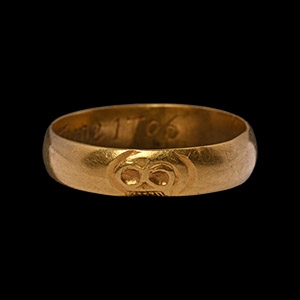
Queen Anne Engraved Gold Memento Mori Skull Ring
Dated 1706 A.D.Sold for (Inc. bp): £1,300
With stylised skull to the outer face, engraved to the inner face 'E. Judd ob. 6 June 1706 and maker's mark 'ID' for Josiah Daniel, London goldsmith of the early 18th century. 4.30 grams, 20.77 mm overall, 18.03 mm internal diameter (approximate size British P 1/2, USA 7 3/4, Europe 16.86, Japan 16)
Acquired on the UK art market. Property of an East Sussex collector. This lot is accompanied by an illustrated lot declaration signed by the Head of the Antiquities Department, Dr Raffaele D’Amato. -
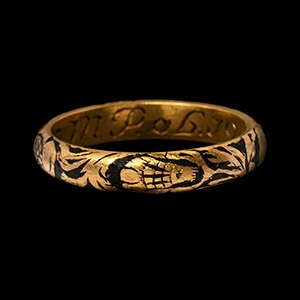
George I Engraved Gold Memento Mori Skull Ring with Black Enamel
Dated 1723 A.D.Sold for (Inc. bp): £3,120
D-shaped in section with black enamelled outer face and reserved skull, bones and foliage; engraving to inner face 'M.P. ob. 19 Aug .1723 aet 47' and maker's mark 'D.M'. 4.99 grams, 20.97 mm overall, 17.41 mm internal diameter (approximate size British N 1/2, USA 6 3/4, Europe 14.35, Japan 13)
Acquired on the UK art market. Property of an East Sussex collector. This lot has been checked against the Interpol Database of stolen works of art and is accompanied by a search certificate number no.12555-231633. This lot has been cleared against the Art Loss Register database, and is accompanied by an illustrated lot declaration signed by the Head of the Antiquities Department, Dr Raffaele D’Amato.
This maker's mark is not listed in the standard works, e.g. Jackson, Sir C.J., English Goldsmiths and Their Marks, London, 1921. -
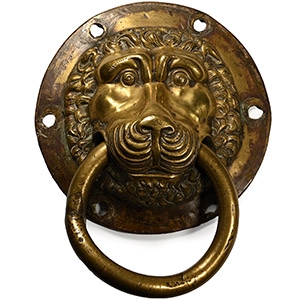
Bronze Knocker Decorated with Lion Mask
Germany, 16th century A.D.Sold for (Inc. bp): £3,900
Comprising a lion-mask cast in high-relief with retouched detailing to the mane and muzzle, substantial ring in the mouth, flange rim with six holes to accept fixing bolts. 2.81 kg, 26.8 cm
with Herbelin Auction, 3 April 2024, no.110. This lot has been checked against the Interpol Database of stolen works of art and is accompanied by a search certificate number no.12556-230729. This lot has been cleared against the Art Loss Register database, and is accompanied by an illustrated lot declaration signed by the Head of the Antiquities Department, Dr Raffaele D’Amato. -
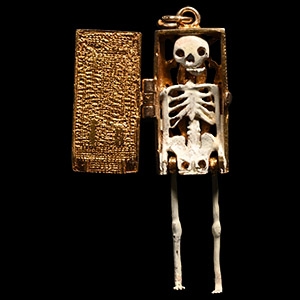
Articulated Skeleton in Gold Closet Memento Mori Pendant Charm
Early 20th century A.D.Sold for (Inc. bp): £3,380
Formed as a cupboard with hinged door, decorative openwork backplate and an applied large question mark to the door; inside the cupboard a white enamelled skeleton with articulated fold-out legs and articulated jaw operated by lever from the rear. 5.39 grams, 40 mm (legs extended)
Property of a County Durham collector; acquired on the UK art market. This lot is accompanied by an illustrated lot declaration signed by the Head of the Antiquities Department, Dr Raffaele D’Amato. -
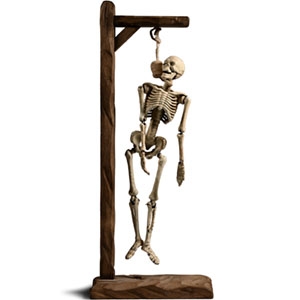
Enamelled Iron Articulated 'Hangman' Skeleton
Circa 1840 A.D.Sold for (Inc. bp): £780
Anatomically correct skeleton with articulated knees, hip joints, shoulders, elbows and wrists, the head formed of three pieces, the mouth slightly open; hanging from a later wooden gallows. 820 grams, 42 cm total
Property of a County Durham collector; acquired on the UK art market. This lot is accompanied by an illustrated lot declaration signed by the Head of the Antiquities Department, Dr Raffaele D’Amato. -
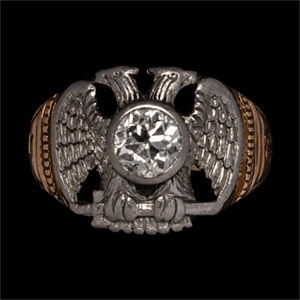
Scottish Masonic 32nd Degree Gold and Platinum Ring with 1 Carat Diamond
20th century A.D.Sold for (Inc. bp): £1,950
Comprising a wide D-shaped 14 carat yellow gold hoop expanding at the shoulders, pelletted band above a triangle to each shoulder, one with '32' and the other with Hebrew letter 'yod'; openwork platinum bezel formed as a double-headed eagle gripping a perch and with its wings spread, the body set with a one carat brilliant cut diamond (small chip); stamped to the inner face '14 KT PLAT'. 14.67 grams, 25.80 mm overall, 20.21 mm internal diameter (approximate size British R 1/2, USA 8 3/4, Europe 19.38, Japan 18)
Acquired on the UK art market. Ex Property of a County Durham collector. This lot has been checked against the Interpol Database of stolen works of art and is accompanied by search certificate no.12490-230251. This lot has been cleared against the Art Loss Register database, and is accompanied by an illustrated lot declaration signed by the Head of the Antiquities Department, Dr Raffaele D’Amato.
There is no officially mandated design for 32nd degree Scottish Rite rings beyond the double-headed eagle, hence they can vary greatly in appearance. Common symbols include the number 32, triangles, the Hebrew letter yod (as in this example), and the square and compasses. Since the 32nd degree ring is a reflection of its owner's Masonic journey, the rings can sometimes also contain symbols from other Masonic orders. -
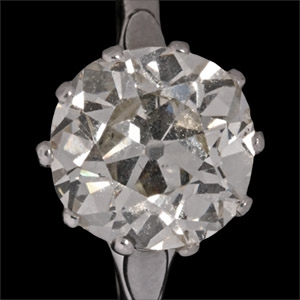
3.2 Carat Diamond Solitaire White Gold Ring
20th century A.D.Sold for (Inc. bp): £5,200
A brilliant cut diamond set in an 18 carat white gold claw setting, slender D-shaped hoop; the diamond chipped. 3.65 grams, 24.68 mm overall, 15.44 mm internal diameter (approximate size British J, USA 4 3/4, Europe 8.69, Japan 8)
Acquired on the UK art market. Ex property of a County Durham collector. This lot has been checked against the Interpol Database of stolen works of art and is accompanied by search certificate no.12489-230248. This lot has been cleared against the Art Loss Register database, and is accompanied by an illustrated lot declaration signed by the Head of the Antiquities Department, Dr Raffaele D’Amato. -
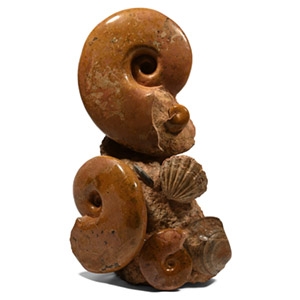
Orange Fossil Ammonite Display
Middle Jurassic Period, Aalenian stage, 174.1-170.3 million years B.P.Sold for (Inc. bp): £1,170
A large freestanding display containing polished specimens: a belemnite, scallops and Lytoceras dilucidum, Leioceras and other ammonites in various sizes, the largest 32 cm in diameter. 41.9 kg, 60 cm
with Science & Natural History, South Kensington, 27 April 2017, no.13. -
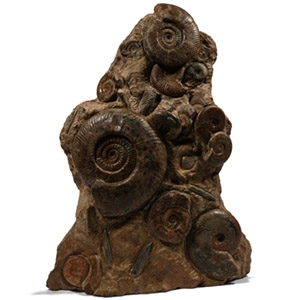
Detailed Fossil Ammonite Display
Jurassic Period, Toarcian, circa 184.2-174.7 million years B.P.Sold for (Inc. bp): £1,560
An impressive freestanding structure containing scallop and belemnite fossils, as well as Hammatoceras and Grammoceras sp. ammonites showing strong ribbing, the largest specimen measuring 23 cm in diameter. 50.1 kg, 64.5 cm
with Science & Natural History, South Kensington, 27 April 2017, no.27. -
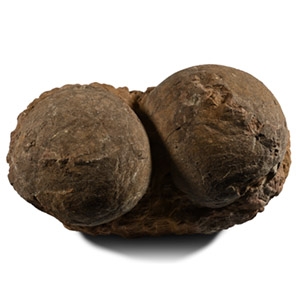
Fossil Hadrosaur Dinosaur Nest Egg Pair
Cretaceous Period, 145-65 million years B.P.Sold for (Inc. bp): £1,430
A pair of Charonosaurus sp. hadrosaur eggs on a matrix retaining evidence of the original leathery surface. 7.6 kg total, 26 x 14 cm
From a Lincolnshire, UK, collection, 1990s. Property of a Cambridgeshire gentleman.
Dinosaur eggs are known from about 200 sites around the world, the majority in Asia and mostly in terrestrial (non-marine) rocks of the Cretaceous Period. It may be that thick calcite eggshells evolved during the Cretaceous (145 to 65 million years ago). Most dinosaur eggs have one of two forms of eggshell that are distinct from the shells of related modern animal groups, such as turtles or birds; however, some eggs closely resemble the type of shells seen in present day ostrich eggs. -
.jpg)
Mosasaur 'Marine Dinosaur' Skull
Cretaceous Period, 145-65 million years B.P.Sold for (Inc. bp): £11,700
A magnificent, full three-dimensional fossil skull of a juvenile Mosasaur Prognathodon with upper and lower mandibles, eye sockets and brain cavity; including jaw and teeth; some restoration; with custom-made display stand. 5.8 kg total, 57 cm high including stand
From a Lincolnshire, UK, collection. Property of a Cambridgeshire gentleman. This lot has been checked against the Interpol Database of stolen works of art and is accompanied by search certificate no.12491-230295.
The Mosasaur is an extinct, large marine reptile dinosaur with an elongated body, long snout and paddle-like limbs. Found worldwide, they competed with other well-known sea predators of the Late Cretaceous, such as plesiosaurs and ichthyosaurs, for food, existing primarily on a diet of ammonoids, cuttlefish and fish. -
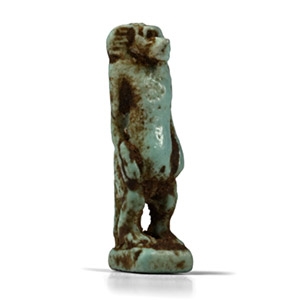
Egyptian Faience Amulet of a Vervet Monkey
Late-Ptolemaic Period, 664-30 B.C.Sold for (Inc. bp): £156
Turquoise-blue faience amulet of a vervet monkey standing with its long arms extended to the hips, supported on an integral base by its tail; suspension loop at the back. 1.52 grams, 27 mm
From a private collection acquired by the previous owner's father in the 1950s. Ex TimesAncient, Bristol, UK. Accompanied by a copy of a previous catalogue entry. This lot is accompanied by an illustrated lot declaration signed by the Head of the Antiquities Department, Dr Raffaele D’Amato.
Amulets featuring the vervet monkey were believed to serve as magical sexual aids for the living and the dead, ensuring these benefits in life and the afterlife.

