-
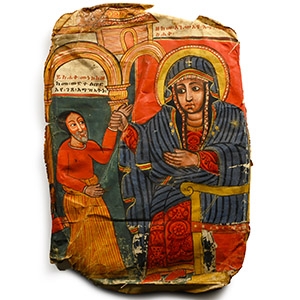
Ethiopian Painted Parchment of The Virgin's Miracle: Healing of the Paralysed Priest
Circa 1650 A.D.Sold for (Inc. bp): £845
Rectangular leaf with hand-coloured composite scene: right, Mary in blue mantle and rich embroidered red garment holding the fallen priest by the hand and raising him; behind him a prone male figure in colourful robes (the priest represented for the second time); ecclesiastic architecture on the background; a manuscript folio with text in Ge'ez to the reverse. 27 grams, 31.5 x 22 cm
Private collection, New York, circa 2016. This lot is accompanied by an illustrated lot declaration signed by the Head of the Antiquities Department, Dr Raffaele D’Amato.
The image refers to the 'Miracle of the healing of the Priest' in which a priest, who had grown old in the service of the Virgin Mary, fell over in the church when bowing before her, and broke his back. The Virgin appeared and healed his broken bones. -
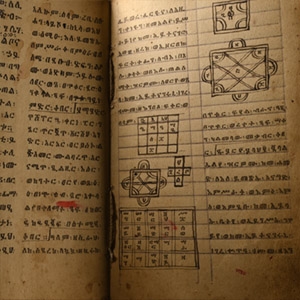
Ethiopian Vellum Manuscript of Talismanic Texts
19th-20th century A.D.Sold for (Inc. bp): £910
Comprising forty bound leaves written in Amharic, featuring 'spectacle scripts', small drawings of the Christ's passion, Salomon's seal, Moses' snakes and Patriarchal staff, and other drawings of a double-headed serpent; preserved in the original pouch with bindings. 168 grams, 16.3 x 10.5 cm
From a Brighton bookseller, circa 2000. This lot is accompanied by an illustrated lot declaration signed by the Head of the Antiquities Department, Dr Raffaele D’Amato.
This particular object is sometimes referred to as a talisman or amulet, and also known as a ketãb (document) or metshaf (book). It was used in Ethiopia by priests and common people, not only intended for reading but also for providing protection. It was worn with a rope around the neck or shoulders of the owner. -
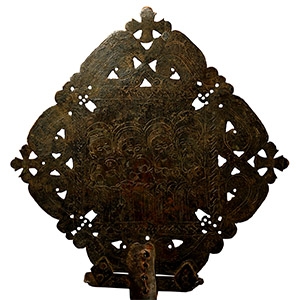
Ethiopian Engraved Bronze Cross with Figures of the Holy Fathers
Circa 1450-1480 A.D.Sold for (Inc. bp): £2,080
A bifacial Yämäṩor Mäsqäl processional cross finial comprising an openwork flat-section panel surmounted by a cross, with interlaced tendril design engraved with four seated saints on both faces in low-relief; tapering tubular socket with circumferential ribbing, lateral angled crosses. 404 grams, 30.5 cm
Ex central London gallery. This lot is accompanied by an illustrated lot declaration signed by the Head of the Antiquities Department, Dr Raffaele D’Amato.
In contrast with the hand cross that is fitted with a grip, the processional cross has a hollow shaft into which the pole supporting the cross is inserted, although the use of both is interconnected in the liturgy and ceremonial aspects of the Ethiopian Orthodox Church. In Amharic, it received the name of yämäṩor mäsqäl or "cross to [carry] on a pole", the term mäṩor also meaning a wooden handle. Processional crosses are used on "every qaddase day" occasions - an expression meaning whenever the liturgy is performed. This includes displaying the cross during the reading of the Gospels and other sacred texts, as well as holding it up to be viewed at the end of the service for the final blessing. -
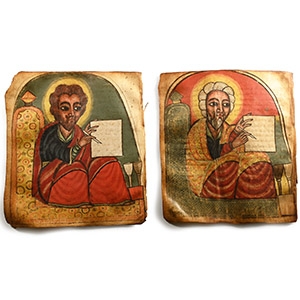
Ethiopian Painted Parchment of Two Evangelist Portraits from a Gospel
Circa 1650-1700 A.D.Sold for (Inc. bp): £1,235
Two leaves from a vellum manuscript, each with a hand-coloured image of a male figure (Evangelists) seated on low stools, covered with embroidered cloths, holding a vellum page in one hand and quill in the other, nimbus around their head; dressed in blue, red and green garments, in front of them two cups in brown and white colour. 19 grams total, 22.5 x 19.8 cm each
Ex central London gallery. This lot is accompanied by an illustrated lot declaration signed by the Head of the Antiquities Department, Dr Raffaele D’Amato.
During the Aksumite period, the Greek text of the Gospels was brought to Ethiopia and translated into Geez. Along with the Greek text came a standard method of Gospel manuscript production, as well as the Eusebian canon tables with their characteristic decoration and tholos miniature, and portraits of the evangelists. In the Gondar period, the tradition continued: usually the four Evangelists were portrayed as a series. Evangelist portraits serve as an introduction, and narrative illustrations were placed within the Gospel texts. -
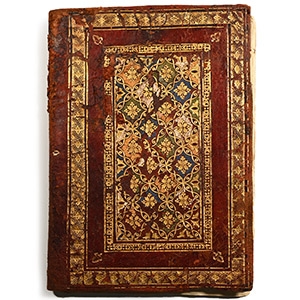
Hebrew Leather Bound Manuscript of Book of Psalms
North Africa, 18th-19th century A.D.Sold for (Inc. bp): £1,300
Morocco leather folding cover with applied gold-leaf and polychrome painted design to outer; holding a gathering of loose laid-paper sheets, some with extensive handwritten Hebrew texts. 170 grams, 23 x 16.5 cm
From the collection of a London antiquarian, formed since the 1980s. This lot is accompanied by an illustrated lot declaration signed by the Head of the Antiquities Department, Dr Raffaele D’Amato. -
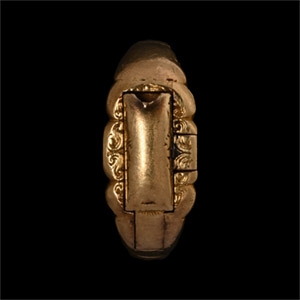
Civil War Period Gold Poison Ring
17th century A.D.Sold for (Inc. bp): £3,380
With expanding shoulders, scrolled outline to the plaque, hinged folding tube below the central panel. 7.49 grams, 22.28 mm overall, 18.87 mm internal diameter (approximate size British N 1/2, USA 6 3/4, Europe 14.35, Japan 13)
From the private collection of N.Thomas, 1979-1987. This lot has been checked against the Interpol Database of stolen works of art and is accompanied by search certificate number no.12481-229481. This lot has been cleared against the Art Loss Register database, and is accompanied by an illustrated lot declaration signed by the Head of the Antiquities Department, Dr Raffaele D’Amato. -
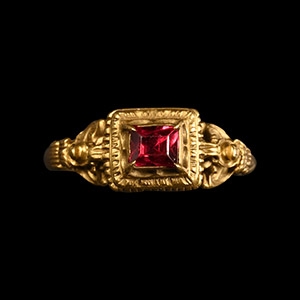
Renaissance Gold Ring with Burmese Spinel 'Ruby'
Late 16th century A.D.Sold for (Inc. bp): £9,100
Comprising a granule and scrolled frond to each shoulder, rectangular stepped cell to the bezel with inset table-cut Burmese spinel 'ruby'. 6.73 grams, 28.14 mm overall, 17.50 x 19.77 mm internal diameter (approximate size British O, USA 7, Europe 14.98, Japan 14)
Private collection of a North London lady before 2000. Property of a London gentleman. This lot has been checked against the Interpol Database of stolen works of art and is accompanied by a search certificate number no.12554-232024. This lot has been cleared against the Art Loss Register database, and is accompanied by an illustrated lot declaration signed by the Head of the Antiquities Department, Dr Raffaele D’Amato. -
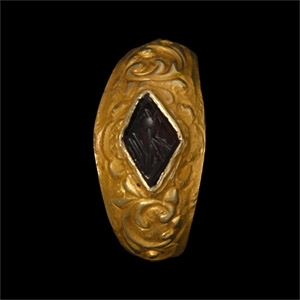
Renaissance Gold Ring with Roman Hare Gemstone
17th century A.D. and earlierSold for (Inc. bp): £1,820
Comprising a D-shaped hollow-form hoop with raised foliate decoration around the lozenge-shaped bezel set with a garnet, intaglio image of a running hare. 3.12 grams, 23.69 mm overall, 18.24 mm internal diameter (approximate size British P 1/2, USA 7 3/4, Europe 16.86, Japan 16)
Acquired on the UK art market. Ex property of a County Durham collector. This lot is accompanied by an illustrated lot declaration signed by the Head of the Antiquities Department, Dr Raffaele D’Amato. -
.jpg)
Tudor Period Gold 'DENIAL IS DEATH' Decorated Posy Ring
16th century A.D.Sold for (Inc. bp): £1,430
With reserved rosettes and pellets to the outer face; legend in seriffed capitals to the inner face 'DENIAL IS DEATH'. 1.22 grams, 16.80 mm overall, 15.43 mm internal diameter (approximate size British I 1/2 , USA 4 1/2, Europe 8.07, Japan 7)
From the collection of the famous author, writer and speaker, Gordon Bailey, Essex, UK; formed since 1968. This lot is accompanied by an illustrated lot declaration signed by the Head of the Antiquities Department, Dr Raffaele D’Amato. -
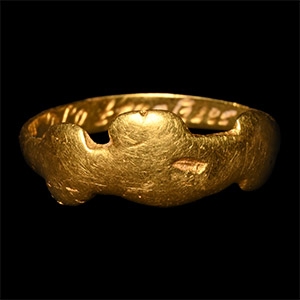
'The Burstow' Clasped Hands 'No Treasure to a True Friend' Gold Posy Ring
1650-1780 A.D.Sold for (Inc. bp): £624
The bezel with a clasped hands motif with a heart at the centre and elaborate cuffs, narrow D-section hoop; inscribed to the inner face 'No treasure to a true friend' with a long S, worn maker's mark at the end of the inscription, appearing to have the letters 'IV' or IW' in Roman capitals within a simple escutcheon. 2.26 grams, 18.54 mm overall, 16.40 mm internal diameter (approximate size British L, USA 5 3/4, Europe 11.24, Japan 10)
Found near Burstow, Tanbridge, Surrey, UK, on Monday 1st May 2023; disclaimed with treasure reference 2023 T419. Accompanied by a copy of the British Museum's Portable Antiquities Scheme report no.SUR-OAA74B. This lot is accompanied by an illustrated lot declaration signed by the Head of the Antiquities Department, Dr Raffaele D’Amato.
If the maker's mark is 'IV' it may correspond to John Vickerman, a goldsmith active in London from 1768 to 1773. Alternatively, if the maker's mark is 'IW' it may correspond to a number of makers: John Williamson, 1650; John Ward, 1660; James Wilkes, 1722; or John White, 1724. -
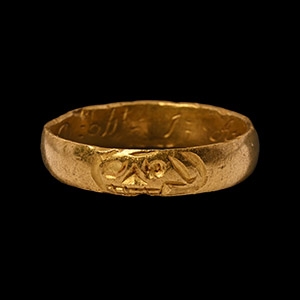
James II Engraved Gold Memento Mori Skull Ring
Dated 1685 A.D.Sold for (Inc. bp): £1,170
With cartouche to the outer face bearing stylised skull; inner face engraved 'J=D = obt = 1 = 1 = Aug = 85' and maker's mark 'I.C' in a scalloped panel. 3.46 grams, 18.76 mm overall, 16.56 mm internal diameter (approximate size British K 1/2, USA 5 1/2, Europe 10.58, Japan 10)
Acquired on the UK art market. Property of an East Sussex collector. This lot is accompanied by an illustrated lot declaration signed by the Head of the Antiquities Department, Dr Raffaele D’Amato. -
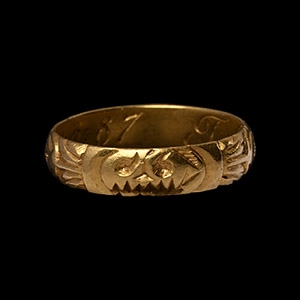
Charles II Engraved Gold Memento Mori Skull Ring
Dated 1687 A.D.Sold for (Inc. bp): £2,470
With stylised skull flanked by foliage to the outer face, engraved in copperplate to the inner face: 'T.D - obyt - 8.Octo=87'. 4.74 grams, 21.20 mm overall, 18.16 mm internal diameter (approximate size British Q, USA 8, Europe 17.49, Japan 16)
Acquired on the UK art market. Property of an East Sussex collector. This lot has been cleared against the Art Loss Register database, and is accompanied by an illustrated lot declaration signed by the Head of the Antiquities Department, Dr Raffaele D’Amato.

