-
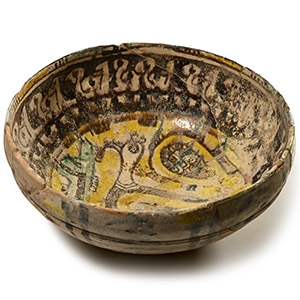
Nishapur Glazed Buffware Bowl
Central Asia, 11th century A.D.Sold for (Inc. bp): £130
With broad mouth, indented ring below the rim to the exterior, low flared foot, vertical painted motifs to the exterior, horizontal band of calligraphic text to interior around tondo with bird motif. 885 grams, 24 cm
Dubai, 2001. Ex central London gallery. This lot has been cleared against the Art Loss Register database, and is accompanied by an illustrated lot declaration signed by the Head of the Antiquities Department, Dr Raffaele D'Amato. -
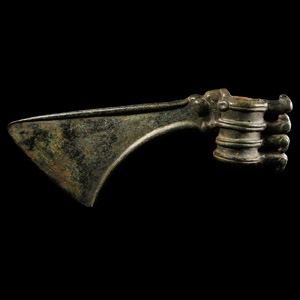
Luristan Bronze Bird Spike-Butted Axehead
11th-8th century B.C.Sold for (Inc. bp): £3,250
Blade with folded upper and lower edge, cylindrical socket with projecting ribs formed as the necks and heads of birds, blade 'projecting' from the mouth of a roaring lion at the neck. 478 grams, 22.5 cm
Ex Parisian private collection. with Cuvreau Expertises Enchères S.A., sale 60, 21 June 2009, lot 105. This lot has been checked against the Interpol Database of stolen works of art and is accompanied by search certificate number no.11876-206787. This lot has been cleared against the Art Loss Register database, and is accompanied by an illustrated lot declaration signed by the Head of the Antiquities Department, Dr Raffaele D’Amato. -
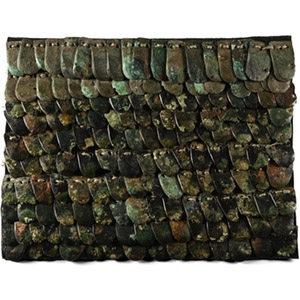
Scythian Bronze Scale Armour Section
6th-5th century B.C.Sold for (Inc. bp): £1,040
A section of scale armour coat composed of 162 overlapping tongue-shaped scales mounted onto a cloth panel, each with three holes to the top and some with one or two holes to the right for fastening onto the original leather backing. 165 grams, 16 x 12 cm
From the private collection of a London gentleman, from his grandfather's collection formed before the early 1970s. Accompanied by an academic report by Dr Raffaele D’Amato. This lot has been checked against the Interpol Database of stolen works of art and is accompanied by search certificate number no.12469-231236. This lot is accompanied by an illustrated lot declaration signed by the Head of the Antiquities Department, Dr Raffaele D’Amato.
The favourite armour of the Scythian noblemen was composed of scales, usually protecting the torso, sometimes the entire body (kataphraktoi). The Scythians found that the most efficient method was to arrange the overlapping ‘fish-scales’ as a corselet made of a number of bronze and iron plates, which then protected the wearer against sword and spear thrusts. Our scales correspond well to bronze scales found in May 1961 in an accidentally destroyed burial in a barrow, near the village of Nadezhda Sovetsky district. They were discovered together with iron scales, a Greek Corinthian helmet, fragments of an amphora, five arrowheads and fragments of an iron sword. Most of these bronze scales were oblong in shape, with a sub-rectangular upper end and a rounded lower end, but slightly bigger than our scales. -
.jpg)
Scythian Chalcidian Helmet with Embossed Stags
3rd-1st century B.C.Sold for (Inc. bp): £24,700
Chalcidian or Illyrian variant (Caucasian type), constructed from two halves with the right side overlapping the left, embossed ram horns on the brow, with a profile image of a stag to both sides; hinged cheek-pieces with regularly disposed holes to the outer edges; some restoration. 696 grams, 31cm high
Acquired on the European art market, mid-1980s. Private collection, Oxford, UK. From the collection of a London doctor. Accompanied by an academic report by Dr Raffaele D’Amato. This lot has been checked against the Interpol Database of stolen works of art and is accompanied by search certificate number no.12339-228100. This lot has been cleared against the Art Loss Register database, and is accompanied by an illustrated lot declaration signed by the Head of the Antiquities Department, Dr Raffaele D’Amato.
The cultural interchange and the military contacts between the Nomads of Kuban and the Hellenic peoples allowed the Sindo-Meothic, Scythian, or Sarmatian noblemen to equip themselves with such beautiful defensive equipment. The helmet finds its closest parallel in a specimen published by A.E. Negin, belonging to the Puskin Fine Arts Museum of Moscow, originally in the collection of S. Karakowskij (Negin, 2010, p.354 no.6; Hixenbaugh H304). Some of the helmets of this type were modified according to the nomadic (Scythian or Sarmatian) taste, being decorated with religious elements, like the deer. -
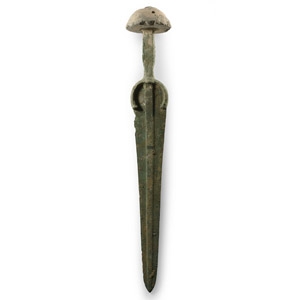
Luristan Bronze Sword
Late 2nd millennium B.C.Sold for (Inc. bp): £468
With solid cast hilt and penannular guard, a massive grip with a later mushroom pommel, blade with central flat midrib tapering to a sharp tip. 967 grams, 52.5 cm
Acquired 1980-2015. Ex Abelita family collection. This lot is accompanied by an illustrated lot declaration signed by the Head of the Antiquities Department, Dr Raffaele D’Amato.
This sword is typical of the North-Western Iranian regions at the end of 2nd millennium B.C. Corresponding specimens found in Amarlu or other localities (Gheshlag Mazandaran Province) show that they were fitted with hollow-cast bronze mushroom pommels. The hilt was solid cast with penannular guard, and the blade was usually multi-fullered, but the specimen from Northern Iran published by Khorasani is fitted with a single fuller like our sword. -
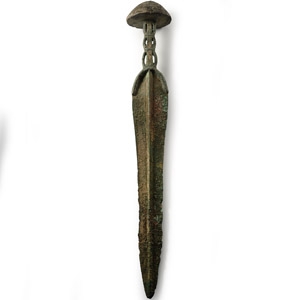
Luristan Bronze Sword
Late 2nd millennium B.C.Sold for (Inc. bp): £598
Later hilt with mushroom-shaped pommel, openwork grip with 'chain'-shaped pattern, crescentic guard, long sloping blade with rectangular-section mid-ridge. 1.05 kg, 55.2 cm
Acquired 1980-2015. Ex Abelita family collection. This lot is accompanied by an illustrated lot declaration signed by the Head of the Antiquities Department, Dr Raffaele D’Amato.
These bronze swords were characterised by a solid-cast hilt with penannular guard, a grip equipped with raised shaped figures and a conical, hollow-cast mushroom pommel. The blade had a very pronounced shaped central midrib. In the complete specimens the hilt was usually cast with the blade. -
.jpg)
Marlik Bronze Short Sword
14th-10th century B.C.Sold for (Inc. bp): £1,105
Formed with a slender triangular blade, raised midrib with flat upper face, penannular guard and scooped shoulders, columnar grip with gusseted collar; the upper grip decorated with vertical lines, the lower part with horizontal grooves; crescent pommel. 430 grams, 44 cm
Ex Alexander Cotton collection, Hampshire, UK 1980s. This lot is accompanied by an illustrated lot declaration signed by the Head of the Antiquities Department, Dr Raffaele D’Amato.
This short sword or dagger belongs to the category of blades with pennanular guard, with hilt and guard cast in one piece with the grip. This solid weapon has separate sets of encircling ribs on the grip. Negahban excavated similar weapons from the Marlik cemeteries, although sometimes the type combines grip and penannular guard with flanged hilts open to accept inlays. -
.jpg)
Iron Age Thracian Iron Machaira Sword with Chape
3rd century B.C.-1st century A.D.Sold for (Inc. bp): £3,640
Single-edged iron blade with sturdy back and slightly curved inner cutting edge; fixing pegs with rosette finials for a scale-tang hilt and ellipsoid pommel above with pierced upper face; scabbard chape with trumpet-shaped foot. 1.34 kg total, 84 cm long
Ex German art market, 2000s. Acquired from an EU collector living in London. From the collection of Surrey, UK, gentleman. Accompanied by an academic report by Dr Raffaele D'Amato. This lot has been checked against the Interpol Database of stolen works of art and is accompanied by search certificate no.12495-230594. This lot has been cleared against the Art Loss Register database, and is accompanied by an illustrated lot declaration signed by the Head of the Antiquities Department, Dr Raffaele D’Amato. -
.jpg)
Iberian Iron Dagger with Rivetted Hilt
2nd century B.C.Sold for (Inc. bp): £2,080
A pugio military dagger with waisted leaf-shaped blade, rounded midrib, rectangular rivetted baluster, short grip with crescent pommel. 235 grams, 30.6 cm
Ex North American private collection, 1970s-1990s. This lot is accompanied by an illustrated lot declaration signed by the Head of the Antiquities Department, Dr Raffaele D’Amato.
The pugio appeared as a side weapon of the Roman legionary in the 2nd century B.C. However, its full diffusion within the Roman army begun with Caesar and Augustus, where it appeared as the reserve weapon for the heavy infantryman. The present specimen belongs to the Celtiberian tribes who fought against the Roman army in the 2nd century B.C., but represents one of the first prototypes adopted from the Iberians by the Roman legionaries. -
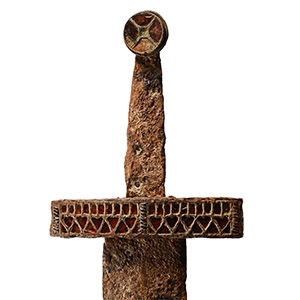
Migration Period Iron Sword with Jewelled Hilt
5th-6th century A.D.Sold for (Inc. bp): £5,460
Comprising: a spatha-type two-edged tapering blade, lentoid in section with sloped shoulders and short tang pierced by an attachment rivet for the grip; traces to both faces of the blade of wooden fibre from the scabbard; edges lightly notched but substantially complete; the lower guard rectangular in plan and scaphoid in section with inset garnet cloisons, triangular along the lower row and heart-shaped above, rectangular at the top, with small rectangular slivers at each end; accompanied by the upper roundel of the pommel, set with four garnet cloisons. 954 grams, 84.5 cm
From the private collection of a London gentleman, from his grandfather's collection formed before the early 1970s. Accompanied by an academic report by Dr Raffaele D’Amato. This lot has been checked against the Interpol Database of stolen works of art and is accompanied by search certificate no. 12357-225921. This lot has been cleared against the Art Loss Register database, and is accompanied by an illustrated lot declaration signed by the Head of the Antiquities Department, Dr Raffaele D’Amato.
These ‘ceremonial’ swords (in reality widely used in battle) with an inlaid guard are according to Kazanski Late Roman in origin. The cloisonné decoration was probably linked with the production of particularly ornamented swords in the ateliers of the Roman capital of Constantinople. This typology of weapon was not only produced as a gift for foreign chiefs allied to the empire, but it was also adopted by the Imperial army, and reserved for the Imperial officers, who were often of Germanic or Asiatic origin. -
.jpg)
Viking Battle Axe Head with Silver Inlays
Northern Europe, 9th-11th century A.D.Sold for (Inc. bp): £8,970
With short, cylindrical socket to rear, narrow neck, flared blade with curved cutting edge; underside of the blade swept in a gentle curve; short flanges above and below the rear of the socket; decorated overall with finely engraved silver inlays forming two dragons and interlace patterns (probably not original); provided with a display stand. 390 grams, 15.7 cm (813 grams total, 26.2 cm high including stand)
Acquired 1982 in Kaliningrad and transported to Riga in 1986, moved to East Berlin in 1988, and again to Germany in 2000, then UK in 2014. Ex West London collection. Accompanied by a copy of an Art Loss Register certificate no.S00141022. Accompanied by an academic report by Dr Raffaele D'Amato. This lot has been checked against the Interpol Database of stolen works of art and is accompanied by search certificate number no.12476-228759. This lot has been cleared against the Art Loss Register database, and is accompanied by an illustrated lot declaration signed by the Head of the Antiquities Department, Dr Raffaele D’Amato. -
.jpg)
Medieval Bronze Handled Iron Dagger with Raven
11th-14th century A.D.Sold for (Inc. bp): £338
Comprising a long single-edged blade with swept tip, lentoid-section hilt with long shoulder, ribbed and pelletted detailing to upper grip and openwork pommel formed as a perching raven. 157 grams, 30 cm
From the private collection of a London gentleman, from his grandfather's collection formed before the early 1970s. This lot is accompanied by an illustrated lot declaration signed by the Head of the Antiquities Department, Dr Raffaele D’Amato.

