-
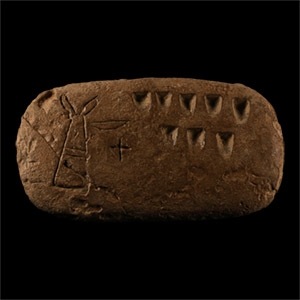
Proto-Sumerian Pictographic Terracotta Tablet
Uruk III, circa 3200-3000 B.C.Sold for (Inc. bp): £1,300
Lentoid in section with incised and impressed design to one face; trapezoidal figure with bowl(?) and incised cross, two rows of impressed D-shapes; probably a tally token. 73.3 grams, 81 mm
From an important collection formed before 1988. Examined by Professor Wilfrid George Lambert FBA (1926-2011), historian, archaeologist, and specialist in Assyriology and Near Eastern archaeology, in the late 1980s and 1990s. This lot has been cleared against the Art Loss Register database, and is accompanied by an illustrated lot declaration signed by the Head of the Antiquities Department, Dr Raffaele D'Amato. -
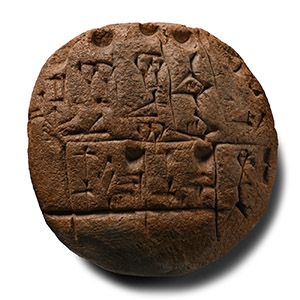
Sumerian Terracotta Cuneiform Tablet
Akkadian, 22nd-21st century B.C.Sold for (Inc. bp): £845
Discoid with convex faces, the top with impressed cuneiform text. 37.5 grams, 50 mm
Specialised collection of cuneiform texts, the property of a London gentleman and housed in London before 1988. Thence by descent to family members. Examined by Professor Wilfrid George Lambert FBA (1926-2011), historian, archaeologist, and specialist in Assyriology and Near Eastern archaeology, in the late 1980s and early 1990s. The collection is exceptional for the variety of types, including some very rare and well preserved examples. This lot has been cleared against the Art Loss Register database, and is accompanied by an illustrated lot declaration signed by the Head of the Antiquities Department, Dr Raffaele D'Amato. -
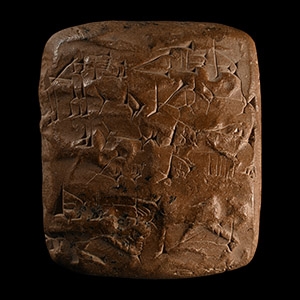
Old Babylonian Terracotta Cuneiform Tablet, Dated to the Seventh Year of King Amar-Suen
21st century B.C.Sold for (Inc. bp): £2,340
Pillow-shaped tablet containing a record of administrative records for arrears owed by Lugal-Ishtaran from the Bala-Offerings, at the end of day 15, it is dated to the year seven of King Amar-Suen, one side with a seal impression showing a man fighting with a rampant lion, possibly depicting Gilgamesh, cuneiform text behind the beast; the other side with cuneiform text overlapped by a seal impression in two registers showing advancing offerants with their arms raised; supplied in an old box with typed collection label to the cover. 40 grams, 45 mm
Found at Jokha, the ruin of the ancient city of Umma in Central Babylonia. Ex Edgar J. Banks (1866-1945). Purchased by Dr John Harvey Kellogg (1852-1943); by family descent to consignor. Edgar Banks was a diplomat and archaeologist upon whom the fictional character of Indiana Jones was based. Dr J.H. Kellogg was the founder of the Battle Creek Sanitarium and inventor of the Corn Flake. This lot has been cleared against the Art Loss Register database, and is accompanied by an illustrated lot declaration signed by the Head of the Antiquities Department, Dr Raffaele D'Amato. -
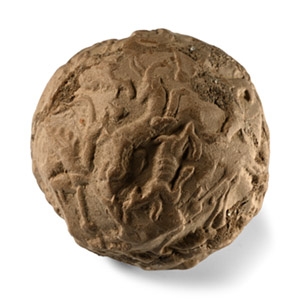
Sumerian Terracotta Bulla Envelope with Impressed Decoration
Uruk Period, 5500-3100 B.C.Sold for (Inc. bp): £1,820
Spherical and hollow-formed with moulded animal and other ornament to the outer face; clay tokens inside. 74 grams, 55 mm
Specialised collection of cuneiform texts, the property of a London gentleman and housed in London before 1988. Thence by descent to family members. Examined by Professor Wilfrid George Lambert FBA (1926-2011), historian, archaeologist, and specialist in Assyriology and Near Eastern archaeology, in the late 1980s and early 1990s. The collection is exceptional for the variety of types, including some very rare and well preserved examples. Accompanied by a copy of a previous two page illustrated cataloguing note. This lot has been cleared against the Art Loss Register database, and is accompanied by an illustrated lot declaration signed by the Head of the Antiquities Department, Dr Raffaele D'Amato. -
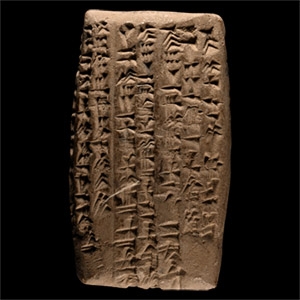
Neo Babylonian Terracotta Cuneiform Tablet for irbu-income
Circa 600 B.C.Sold for (Inc. bp): £2,470
Pillow-shaped tablet with cuneiform text identified as 'irbu-income of dates from five people, with additional accounting on reverse, dating to year twenty of an unnamed king'; in glass-topped wooden display box. 24.9 grams, 45 mm (68 grams total, 66 x 50 mm including box)
Acquired in a Dorset/Somerset saleroom in the late 1950s. From the private collection of Colonel E.J. Martin (1911-1981) Indian Army and Artillery Regiment; collected since before 1954, and still with its original box with old information label. Identified by Colonel Martin's friend, the 'Keeper of Antiquities' at the British Museum. This lot has been cleared against the Art Loss Register database, and is accompanied by an illustrated lot declaration signed by the Head of the Antiquities Department, Dr Raffaele D'Amato. -
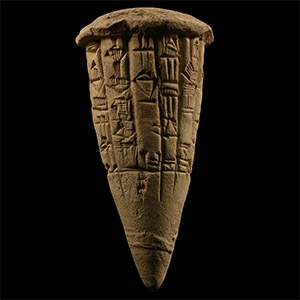
Sumerian Terracotta Foundation Cone From Lagash
Circa 2100 B.C.Sold for (Inc. bp): £3,120
Conical with a domed top, ten-line inscription of Gudea of Lagash, giving a record of the building of Eninnu, the temple of Ningirsu: 'For Ningirsu, might warrior of Enlil, Gudea, ruler of Lagash, produced everything appropriate and built for him Eninnu, this shining Imdugud bird, and restored it.'. 192 grams, 11 cm
From an important collection formed before 1988. Examined by Professor Wilfrid George Lambert FBA (1926-2011), historian, archaeologist, and specialist in Assyriology and Near Eastern archaeology, in the late 1980s and 1990s. Accompanied by a copy of a scholarly note by Professor Wilfrid George Lambert. This lot has been cleared against the Art Loss Register database, and is accompanied by an illustrated lot declaration signed by the Head of the Antiquities Department, Dr Raffaele D'Amato. -
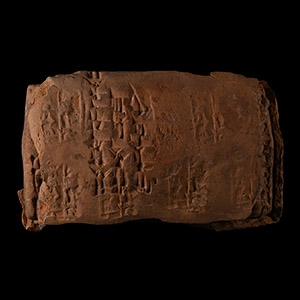
Old Babylonian Cuneiform Contract Tablet for the Purchase of Land with Silver During the Reign of King Manabaltiel of Kisurra
2nd millennium B.C.Sold for (Inc. bp): £2,080
Pillow-shaped ceramic tablet with impressed cuneiform inscriptions, listing the purchase of a parcel of land for 1/3 of a mina of silver, a purchase that cannot be contested, with a list of witnesses; wrapped and enclosed in a clay envelope with cuneiform text to both flat faces. 180 grams, 96 mm
From an important collection of a London gentleman, 1980-2000s. This lot has been cleared against the Art Loss Register database, and is accompanied by an illustrated lot declaration signed by the Head of the Antiquities Department, Dr Raffaele D'Amato. -
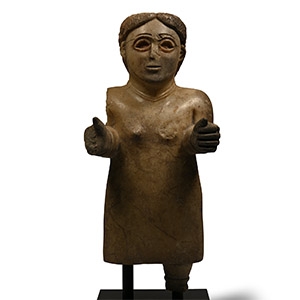
Large South Arabian Alabaster Standing Figure of a Goddess
1st century B.C.-1st century A.D.Sold for (Inc. bp): £54,600
Modelled in the round figure of a standing deity with textural detailing to the hair, naïve facial features with exaggerated eyes to accept inserts (absent) and slit mouth, gripping hands held out at the chest and one pierced to accept an attribute, knee-length garment, collar or necklace below the throat; mounted on a custom-made stand. 15.55 kg total, 47.5 cm high including stand
Ex Hans G. collection, Belgium, 1967-1983. Belgian art market, 1983. Private German collection of Mrs H., 1985-1993. with Pierre Bergé & Associés, Paris, 26 November 2013, no.198 (€40,000-45,000). Accompanied by an academic report by Dr Raffaele D’Amato. Accompanied by a copy of the relevant Pierre Bergé & Associés printed catalogue pages (double page spread). Accompanied by a copy of an Art Loss Register certificate no.S00119290. This lot has been checked against the Interpol Database of stolen works of art and is accompanied by search certificate number no.12468-230327. This lot has been cleared against the Art Loss Register database, and is accompanied by an illustrated lot declaration signed by the Head of the Antiquities Department, Dr Raffaele D'Amato.
Similar free-standing statues have been found in the royal cemetery in Aswan (probably Khazinet ed-Darb in the Wādī Markha), and at Hayd ibn Aqil (Timna), in Yemen. They are mainly statuettes from the Yemeni kingdoms of Awsan and Qataban, which developed in the Beihan Valley. They represent rulers or important dignitaries of both reigns. The statue is remarkable for the detailed treatment of the facial features, hair and dress: the woman is portrayed wearing a long plain dress, similar to the modern futah of Yemenite people. The eyes were originally inlaid with shell set with polished obsidian pupils, giving a life-like effect to the static statuettes. -
.jpg)
South Arabian Alabaster Head of a Man
3rd-1st century B.C.Sold for (Inc. bp): £1,040
Tongue-shaped carved bust reserved on an unworked block; bas-relief facial detailing with long vertical D-section nose, slit mouth and two shallow lentoid eyes; mounted on a custom-made stand. 2.42 kg total, 22.5 cm including stand
with Arte Primitivo, New York. American private collection, New York, before 2000. This lot has been cleared against the Art Loss Register database, and is accompanied by an illustrated lot declaration signed by the Head of the Antiquities Department, Dr Raffaele D'Amato. -
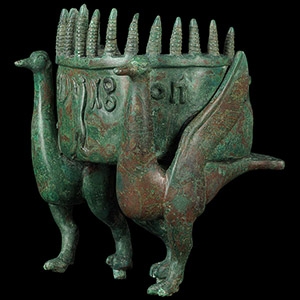
'The Moussaieff' South Arabian Bronze Incense Burner
Circa 7th-6th century B.C.Sold for (Inc. bp): £39,000
In the form of a bowl with one part of the rim raised and surmounted by spikes decorated with concentric rings; flanked by two large aviform supporters, each with one long curving wing to the outer side of the bowl and legs placed one in front of the other in advancing pose; obverse decorated with a raised legend in South Arabian script intersected by a quadruped with long tail, possibly a lion, rearing on its hind legs; accompanied by a display stand. 9.17 kg total, 28 cm including stand
Reputedly from the temple of ʿAthtar dhu-Garb in al-Sawdāʾ (ancient Nashshān) in the Jawf of Yemen. Previously in the private collection of Shlomo Moussaieff (1925–2015), Israel. Thence by descent. Acquired from the above 18 May 2021. Accompanied by Israeli export license. Accompanied by an Art Loss Register Search Confirmation number S00224376 with IADAA Certificate. This lot has been checked against the Interpol Database of stolen works of art and is accompanied by search certificate no.12483 -229826. This lot has been cleared against the Art Loss Register database, and is accompanied by an illustrated lot declaration signed by the Head of the Antiquities Department, Dr Raffaele D'Amato.
The animals represented do not fit with any common South Arabian models, and it is possible they are based on interpretation of foreign designs. The legend is a dedicatory text in Maʿīnic, and reads (from right to left): ' kʿ ṯt {animal} r/ḏ Grb k-ʿṯtr ḏ-Grb' (For {the god} ʿAthtar duh-Garb ) Ashtar, or Attar, was an ancient Semitic god of war, associated with the morning star, the gazelle and thunderstorms. As a thunder-god he was also associated with fertility, represented by rainstorms. It is likely this incense burner was dedicated to his temple in al-Sawdā, where it would have been used in his ceremonial rites. Al-Sawdā was known in ancient Yemeni inscriptions as 'Nashan' and was described as a great city with a robust wall. Nashan dates back to the 8th century BC (715 BC). In its first phase, it was an independent sovereign state, later joining the Ma’in state. It was a rich city, with commercial, religious and industrial success. In a later phase, it joined the kingdom of Sheba with the rest of the Ma’in state. It was known as one of the most important cities in the Ma’in Kingdom for the manufacture of metal vessels and the remains of ores of different minerals have been found there. But the great importance of the city was due to the fact that it was the city of temples; it retains the remnants of several examples described as some of the most beautiful temples in the entire Arabian Peninsula, amongst which is a group known as the “daughters of Aad” (temples of Attar), from which this incense burner likely came. South Arabia, called Arabia Felix (Fortunate Arabia) by the ancient Romans, was the southern fringe of the Arabian Peninsula. It owed its wealth to its position on the trade routes, in particularly those that supplied incense and myrrh. The production and export of incense was a fundamental part of the thriving economy of ancient South Arabian, and the variety of surviving incense burners is testament to this. Incense was of central importance to many of the ceremonies of the religions of the ancient world, burned to honour the gods and the dead. The kingdoms of South Arabia held a tight monopoly on these trades. Large metal incense burners such as this were doubtless the most valuable items of their type but few survive, making this an important example. The importance of the manufacture of bronze objects in ancient South Arabia can be seen from archaeological finds and inscriptions; bronze artefacts occur in South Arabian archaeological sites as often as donations of statues in dhb (the ancient South Arabian term for ‘bronze’) are recorded in South Arabian inscriptions. There are a great number of zoomorphic statues and statuettes, which in addition to being decorative, were probably used in some instances to represent divine hypostasis or to allude symbolically to the dedication of the temple. Shlomo Moussaieff (1925-2015) owned one of the world’s largest private collections of Near Eastern antiquities, surpassing those of many major museums. He collected widely for most of his life with a large expanse of interests, but mostly focussing on ancient artefacts. The Israel Museum and the Bible Lands Museum both displayed items from his collection, including elegant glassware fashioned by Ennion, the greatest of the Greek glassmakers, of which Moussaieff owned more than either the Sorbonne or the British Museum. Bar-Ilan University in Tel Aviv awarded Moussaieff an honorary doctorate in gratitude for his gift of rare Jewish mystical texts (kabbalah) and in 2003 the Smithsonian Institution in Washington, D.C., mounted a special exhibition consisting solely of seven of the world’s rarest and greatest diamonds displayed in a single vitrine. One of these diamonds, a nearly perfect red diamond of more than 5 carats, is known as the 'Moussaieff Red'. -
.jpg)
Sasanian Silver-Gilt Jar with Dancing Girls
6th-7th century A.D.Sold for (Inc. bp): £28,600
Piriform in profile with flared foot, thick ropework collar above the shoulder, socketted rim; repoussé frieze depicting three nude dancing girls in vigorous motion with draped swags of cloth and holding cymbals; between, a peacock, small boy with a vase and another holding a dove; old collector's labels to underside. 481 grams, 18.7 cm
Private collection, 1960s. Accompanied by a report by Professor François de Blois, Affiliated Researcher at the Faculty of Asian and Middle Eastern Studies, University of Cambridge. Accompanied by a positive scientific statement from Striptwist Limited, a London-based company run by historical precious metal specialist Dr Jack Ogden, reference number 170163. Accompanied by an academic report by Dr Raffaele D'Amato. This lot has been checked against the Interpol Database of stolen works of art and is accompanied by search certificate number no.12482-229825. This lot has been cleared against the Art Loss Register database, and is accompanied by an illustrated lot declaration signed by the Head of the Antiquities Department, Dr Raffaele D'Amato. -
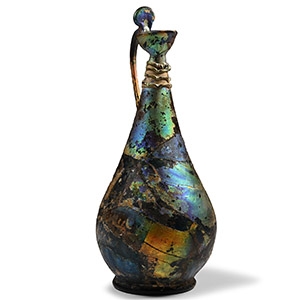
Large Western Asiatic Piriform Glass Jug with Iridescence
7th-9th century A.D.Sold for (Inc. bp): £1,053
Tall piriform body with applied basal ring and dimpled base, applied trails to neck, dished piriform mouth with strap handle and thumb-pad. 180 grams, 23.3 cm
Sotheby's, Islamic Art, London 28 March 1994, no.61. This lot has been cleared against the Art Loss Register database, and is accompanied by an illustrated lot declaration signed by the Head of the Antiquities Department, Dr Raffaele D'Amato.

