-
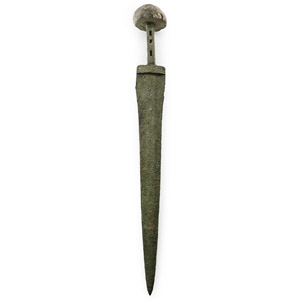
Talish Bronze Blade
13th-7th century B.C.Sold for (Inc. bp): £338
Comprising a pointed blade with shallow midrib and concave sides, square shoulders with transverse horizontal ribbed guard, square-section tang with later mushroom pommel. 595 grams, 50 cm
Acquired 1980-2015. Ex Abelita family collection. This lot is accompanied by an illustrated lot declaration signed by the Head of the Antiquities Department, Dr Raffaele D’Amato.
These swords developed in the Period of the Wars of the Assyrian Empire. One may also compare the square shoulders and the ribs at the junction of hilt and blade here visible (and also visible on blades from Talish) with the Gandzha-Karabagh culture swords of Eastern Transcaucasia. -

Norman Bronze Prick Spur
11th-12th century A.D.Sold for (Inc. bp): £299
With D-section curving arms and biconical prick to the rear. 64 grams, 12.2 cm
From the private collection of a London gentleman, from his grandfather's collection formed before the early 1970s. This lot is accompanied by an illustrated lot declaration signed by the Head of the Antiquities Department, Dr Raffaele D’Amato. -
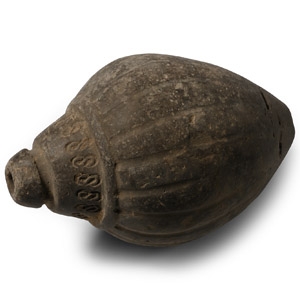
Byzantine 'Greek Fire' Ceramic Fire Bomb or Hand Grenade
9th-11th century A.D.Sold for (Inc. bp): £182
A piriform missile with dimed filler-hole, ribbed body and a band of stamped S-motifs around the neck, intended to be filled with explosive liquid and wick, used as a hand grenade. 560 grams, 14.2 cm
From an important specialist collection, London, UK, 1990s onwards. Accompanied by an academic paper by military specialist Dr Raffaele D'Amato, dated 15 July 2019 and titled 'Eastern Roman Empire - Greek Fire Bomb or Hand Grenade (μεσαίον kακάβιον) 9th-11th century AD'. This lot is accompanied by an illustrated lot declaration signed by the Head of the Antiquities Department, Dr Raffaele D’Amato. -
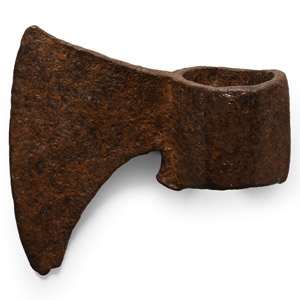
Medieval Iron Triangular Axehead
Circa 15th-16th century A.D.Sold for (Inc. bp): £13
A small axe with a gently curving blade and circular socket. 163 grams, 85 mm
Ex North American private collection, 1970s-1990s. This lot is accompanied by an illustrated lot declaration signed by the Head of the Antiquities Department, Dr Raffaele D’Amato. -
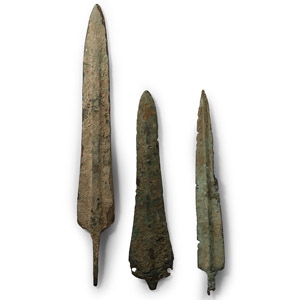
Western Asiatic Bronze Blade Group
25th-11th century B.C.Sold for (Inc. bp): £143
Comprising two bronze spearheads with a short tang and flat midrib, a dagger pointed blade with short tang and two rivets in the shoulders which slope to a narrow tang. 207 grams total, 18-26 cm
Acquired 1980-2015. Ex Abelita family collection. This lot is accompanied by an illustrated lot declaration signed by the Head of the Antiquities Department, Dr Raffaele D’Amato.
The spearheads belongs to type 2 of spearhead according to the classification of Khorasani. A similar specimen was excavated by Negahban in Marlik. The dagger blade belongs to the type 5 of Maxwell-Hyslop classification, with pointed blade, straight sides and curved section. -
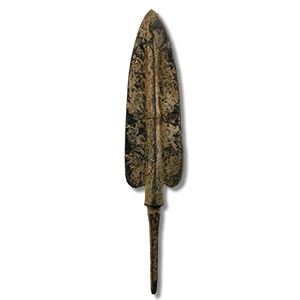
Luristan Bronze Spear Point
13th-6th century B.C.Sold for (Inc. bp): £98
Comprising a broad leaf-shaped blade with rounded shoulders, raised midrib extending to a tubular socket with tapering rectangular-section extension. 43.2 grams, 14.8 cm
Acquired 1980-2015. Ex Abelita family collection. This lot is accompanied by an illustrated lot declaration signed by the Head of the Antiquities Department, Dr Raffaele D’Amato. -
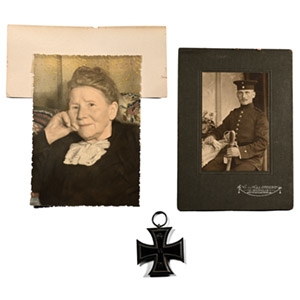
WWI Imperial German Iron Cross with Military Photograph
1914-1918 A.D.Sold for (Inc. bp): £33
2nd class; with KO' on ring, probably for 'Königliches Munzamt Orden, Berlin'; offered with a photograph of the awardee, and another of his relative. 49 grams, 5.8-17 cm
Ex Leipzig collection, Germany. From a Leicestershire, UK, collection. This lot is accompanied by an illustrated lot declaration signed by the Head of the Antiquities Department, Dr Raffaele D’Amato. -
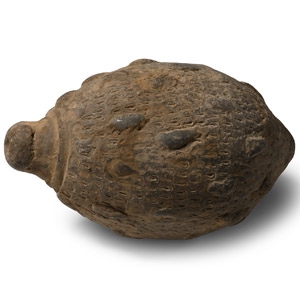
Byzantine 'Greek Fire' Ceramic Fire Bomb or Hand Grenade
9th-11th century A.D.Sold for (Inc. bp): £98
A large piriform missile with raised lugs and impressed teardrop-shaped motifs to the body, domed filler-hole, intended to be filled with explosive liquid and wick, used as a hand grenade. 1.19 kg, 17.5 cm
From an important specialist collection, London, UK, 1990s onwards. Accompanied by an academic paper by military specialist Dr Raffaele D'Amato, dated 15 July 2019 and titled 'Eastern Roman Empire - Greek Fire Bomb or Hand Grenade (μεσαίον kακάβιον) 9th-11th century AD'. This lot is accompanied by an illustrated lot declaration signed by the Head of the Antiquities Department, Dr Raffaele D’Amato. -
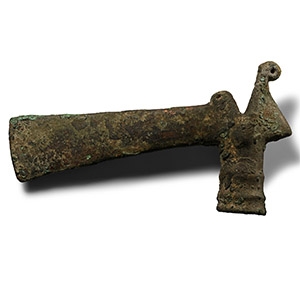
Luristan Decorated Bronze Axehead
Circa 12th-8th century B.C.Sold for (Inc. bp): £156
Wedge-shaped blade and a cylindrical socket with collared base and an upper face of stylised zoomorphic form, possibly representing a moufflon with jutting muzzle and horns above represented by a single scroll; the blade long, with a slightly convex blunt edge. 236 grams, 14.1 cm
Acquired 1980-2015. Ex Abelita family collection. Ex TimesAncient, Bristol, UK. Accompanied by a copy of a previous catalogue entry. This lot is accompanied by an illustrated lot declaration signed by the Head of the Antiquities Department, Dr Raffaele D’Amato.
The moufflon is a regularly used symbol in Luristan art. -
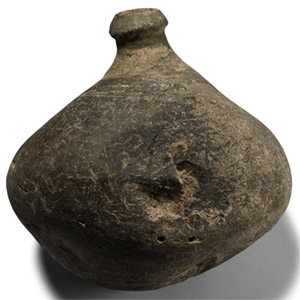
Byzantine 'Greek Fire' Ceramic Fire Bomb or Hand Grenade
9th-11th century A.D.Sold for (Inc. bp): £124
Biconvex in profile with tall neck and domed mouth, deformed when the clay was still wet. 1.1 kg total, 13 cm
From a specialist London, UK, arms and armour collection, 1990s. Accompanied by an academic paper by military specialist Dr Raffaele D'Amato, dated 15 July 2019 and titled 'Eastern Roman Empire - Greek Fire Bomb or Hand Grenade (μεσαίον kακάβιον) 9th-11th century AD'. This lot is accompanied by an illustrated lot declaration signed by the Head of the Antiquities Department, Dr Raffaele D’Amato.
Apart from the use of siphons or manual flame-throwers called cheirosiphona, special corps of Roman soldiers employed terracotta grenades, in the form of small jars, abundantly evidenced in archaeological excavations. They were called μεσαία kακαβιά or κυτροκακάβια where the former had a bulbous shape and the latter a more cylindrical form. -
.jpg)
Medieval Iron Spur with Rowel
12th-14th century A.D.Sold for (Inc. bp): £78
With curving flat-section with looped finials, six-pointed rowel. 50 grams, 14.5 cm
From the private collection of a London gentleman, from his grandfather's collection formed before the early 1970s. This lot is accompanied by an illustrated lot declaration signed by the Head of the Antiquities Department, Dr Raffaele D’Amato. -
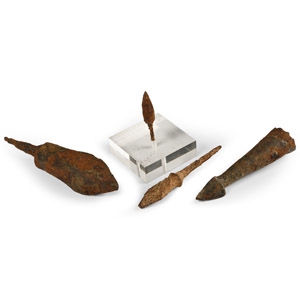
Medieval Iron Crossbow Bolt and Arrowhead Collection
12th-16th century A.D.Sold for (Inc. bp): £52
Comprising a heavy quadrilateral bolt with short tang, two tanged arrowheads and one with a conical socket. 77 grams total, 33-71 mm
One acquired from Coincraft, London, UK. From the private collection of Kenneth Machin (1936-2020), Buckinghamshire, UK; his collection of antiquities and natural history was formed since 1948; thence by descent. Accompanied by an original certificate of authenticity from Coincraft. This lot is accompanied by an illustrated lot declaration signed by the Head of the Antiquities Department, Dr Raffaele D’Amato.

