-
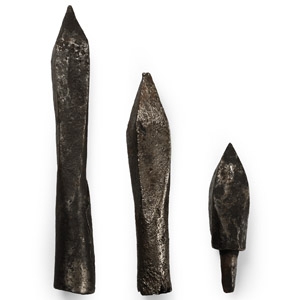
Medieval Iron Crossbow Bolt Collection
15th-16th century A.D.Sold for (Inc. bp): £117
Comprising three hefty bolts, two socketted and one with a short tang. 174 grams total, 5.5-10.6 cm
Acquired from Coincraft, London, UK. From the private collection of Kenneth Machin (1936-2020), Buckinghamshire, UK; his collection of antiquities and natural history was formed since 1948; thence by descent. Accompanied by three original certificates of authenticity from Coincraft. This lot is accompanied by an illustrated lot declaration signed by the Head of the Antiquities Department, Dr Raffaele D’Amato. -
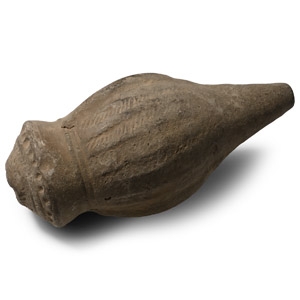
Turco-Mongol 'Greek Fire' Ceramic Fire Bomb or Hand Grenade
13th-15th century A.D.Sold for (Inc. bp): £72
A hollow vessel with cylindrical body, short neck and domed mouth, three raised lugs to the body; intended to be filled with explosive liquid and a wick, and used as a hand grenade. 409 grams, 16 cm
From an important specialist collection, London, UK, 1990s onwards. This lot is accompanied by an illustrated lot declaration signed by the Head of the Antiquities Department, Dr Raffaele D’Amato. -
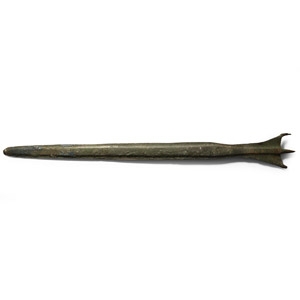
Western Asiatic Bronze Short Sword with Integral Hilt with Horns
Late 2nd-1st millennium B.C.Sold for (Inc. bp): £195
With prominently curved guard, which extends out from the ricasso of the blade and partly frames the hilt, thick flat midrib extending slightly above the ricasso where it held the hilt. 466 grams, 53 cm
Acquired 1980-2015. Ex Abelita family collection. This lot is accompanied by an illustrated lot declaration signed by the Head of the Antiquities Department, Dr Raffaele D’Amato.
The hilt of such swords was made separately, and unfortunately is nearly always missing from the archaeological records. Similar daggers had a northern Iranian background and excavated examples have been recorded from the South Caspian Area from Tomadjan and Ghalekuti. -
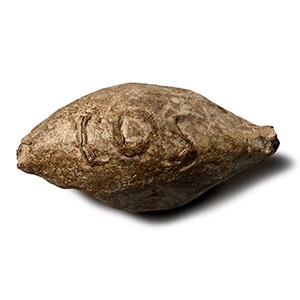
Roman 'Consular' Lead Slingshot
1st century B.C.Sold for (Inc. bp): £338
Fusiform shot with casting nipple at each end, low-relief legend 'COS' to one face. 38 grams, 36 mm
From the collection of a London antiquarian, formed since the 1980s. This lot is accompanied by an illustrated lot declaration signed by the Head of the Antiquities Department, Dr Raffaele D’Amato. -
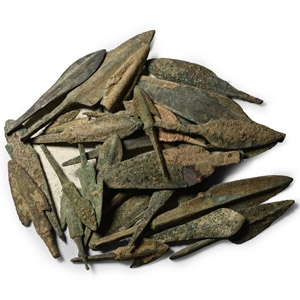
Western Asiatic Arrowhead Group
19th-6th century B.C.Sold for (Inc. bp): £234
Comprising paddle-shaped arrowheads with a flat, comparatively wide mid-rib; socketted types with thick midrib, leaf-shaped, and other types. 272 grams total, 4.2-11.3 cm
Acquired 1980-2015. Ex Abelita family collection. This lot is accompanied by an illustrated lot declaration signed by the Head of the Antiquities Department, Dr Raffaele D’Amato.
Some of the represented arrowheads (paddle-shaped) were typical of the Old Babylonian Empire. The shoulders were pronounced and the arrowhead had a rectangular-section tapering tang. This simple form was popular throughout and are comparatively common finds in the Holy Land. -
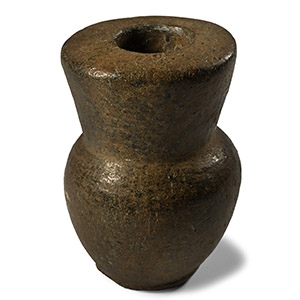
Anglo-Zulu War 'Battle of Khambula' Carved Stone Smoking Pipe Head
29 March 1879 A.D.Sold for (Inc. bp): £117
Columnar pipe bowl with waisted profile. 236 grams, 74 mm
Found by Zulu natives, Khambula, South Africa, 1990s-early 2000s. Ian Wilkinson collection, Nottinghamshire, UK, formed since 1985. This lot is accompanied by an illustrated lot declaration signed by the Head of the Antiquities Department, Dr Raffaele D’Amato.
Following defeats by the Zulu army at Isandlwana and Hiobane, the British were desperate for a victory, which they secured at Khambula. -
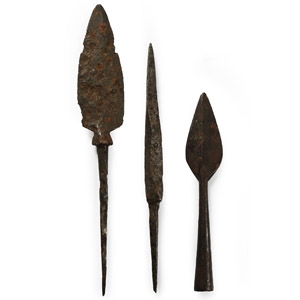
Medieval Iron Arrowhead Collection
12th-16th century A.D.Sold for (Inc. bp): £59
Including a square-section bodkin type with spiked tang. 40.9 grams total, 8.6-12.6 mm
From the private collection of Kenneth Machin (1936-2020), Buckinghamshire, UK; his collection of antiquities and natural history was formed since 1948; thence by descent. This lot is accompanied by an illustrated lot declaration signed by the Head of the Antiquities Department, Dr Raffaele D’Amato. -
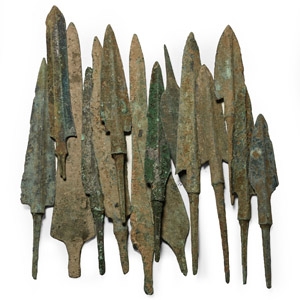
Luristan Bronze Arrowhead Group
13th-6th century B.C.Sold for (Inc. bp): £234
Including heater-shaped, barbed, triangular and other tanged types. 408 grams total, 10-16.7 cm
Acquired 1980-2015. Ex Abelita family collection. This lot is accompanied by an illustrated lot declaration signed by the Head of the Antiquities Department, Dr Raffaele D’Amato. -
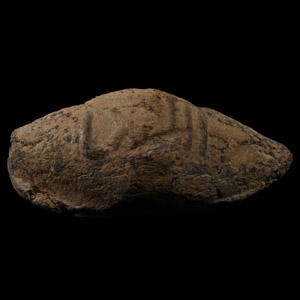
Roman Legion XIII 'Battle of Munda' Lead Slingshot
1st century B.C.Sold for (Inc. bp): £650
Fusiform with reserved legend 'LXIII' (for LEGIO XIII = 13th Legion). 50.3 grams, 41 mm
Acquired on the UK art market. Property of a gentleman collector. This lot is accompanied by an illustrated lot declaration signed by the Head of the Antiquities Department, Dr Raffaele D’Amato.
The shot (Völling type 1C) is marked with the abbreviated name of Legion XIII, and was probably used at the Battle of Monda (or Munda) against Julius Caesar, 17th March 45 B.C., or against the sons of Pompey, because both the generals (Pompey sons and Caesar) had in their army a Legio with the numeral XIII on that day. Interestingly, other glandes of the same typology from the same battlefield bear the name of Pompey, so that it is much possible that the glans belongs to the Legio XIII of Pompey, who was destroyed during the battle and whose survivors were massacred among the 22,000 defenders of Cordoba by the troops of Caesar (D'Amato, 2021, pp.421 and 424). The projectiles were made of different materials: lead (glandes) or in pottery or stone (lapides missiles). -
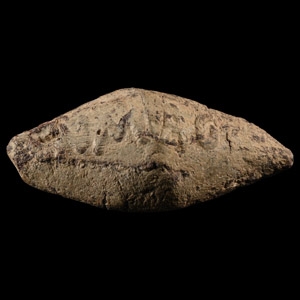
Roman Pompey the Great 'Battle of Munda' Lead Slingshot
1st century B.C.Sold for (Inc. bp): £260
Biconical lead slingshot (glans) with inscription in Latin letters 'CN' (Cneius) 'MAG' (Magnus) on one side, and 'IMP' for 'IMPERATOR' (victorious general) to the other side, i.e Gnaeus Pompeius Magnus Imperator (Pompey the Great the victorious general). 40.7 grams, 41 mm
Acquired on the UK art market. Property of a gentleman collector. This lot is accompanied by an illustrated lot declaration signed by the Head of the Antiquities Department, Dr Raffaele D’Amato.
The shot (Völling type 1C) is marked with the abbreviated name of Gnaeus Pompey; it was used in quantity at the Battle of Monda (or Munda) against Julius Caesar, 17th March 45 BC. The projectiles were made of different materials: lead (glandes) or in pottery or stone (lapides missiles). Sometimes they were signed with the name of the general, like our specimen. -
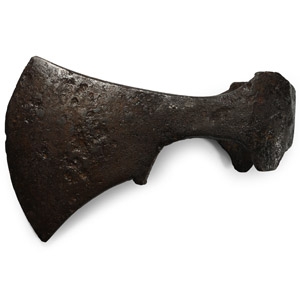
Viking Age Iron Bearded Axehead
9th-11th century A.D.Sold for (Inc. bp): £234
With curved blade, spur below, round socket with lateral flanges. 635 grams, 15 cm
From the private collection of a London gentleman, from his grandfather's collection formed before the early 1970s. This lot is accompanied by an illustrated lot declaration signed by the Head of the Antiquities Department, Dr Raffaele D’Amato. -
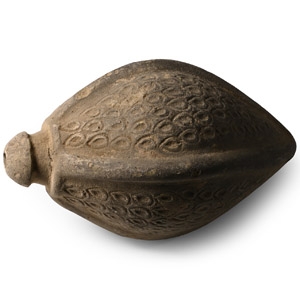
Byzantine 'Greek Fire' Ceramic Fire Bomb or Hand Grenade
9th-11th century A.D.Sold for (Inc. bp): £182
A piriform missile with domed filler-hole, raised vertical ribs and impressed teardrop-shaped motifs to the body, intended to be filled with explosive liquid and wick, used as a hand grenade. 547 grams, 15.3 cm
From an important specialist collection, London, UK, 1990s onwards. Accompanied by an academic paper by military specialist Dr Raffaele D'Amato, dated 15 July 2019 and titled 'Eastern Roman Empire - Greek Fire Bomb or Hand Grenade (μεσαίον kακάβιον) 9th-11th century AD'. This lot is accompanied by an illustrated lot declaration signed by the Head of the Antiquities Department, Dr Raffaele D’Amato.

