-
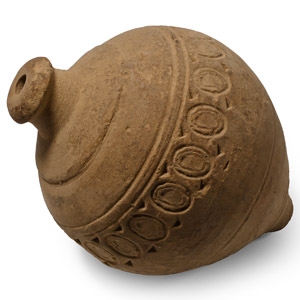
Byzantine 'Greek Fire' Ceramic Fire Bomb or Hand Grenade
9th-11th century A.D.Sold for (Inc. bp): £124
A piriform missile decorated with a band of annulets and chevrons, domed filler hole, intended to be filled with explosive liquid and wick, used as a hand grenade. 406 grams, 12.2 cm
From an important specialist collection, London, UK, 1990s onwards. Accompanied by an academic paper by military specialist Dr Raffaele D'Amato, dated 15 July 2019 and titled 'Eastern Roman Empire - Greek Fire Bomb or Hand Grenade (μεσαίον kακάβιον) 9th-11th century AD'. This lot is accompanied by an illustrated lot declaration signed by the Head of the Antiquities Department, Dr Raffaele D’Amato. -
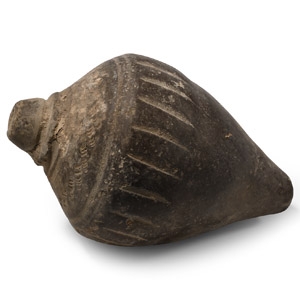
Byzantine 'Greek Fire' Ceramic Fire Bomb or Hand Grenade
9th-11th century A.D.Sold for (Inc. bp): £85
A piriform missile with domed filler-hole, vertical shoulders to the shoulder, intended to be filled with explosive liquid and wick, used as a hand grenade. 548 grams, 14.1 cm
From an important specialist collection, London, UK, 1990s onwards. Accompanied by an academic paper by military specialist Dr Raffaele D'Amato, dated 15 July 2019 and titled 'Eastern Roman Empire - Greek Fire Bomb or Hand Grenade (μεσαίον kακάβιον) 9th-11th century AD'. This lot is accompanied by an illustrated lot declaration signed by the Head of the Antiquities Department, Dr Raffaele D’Amato. -
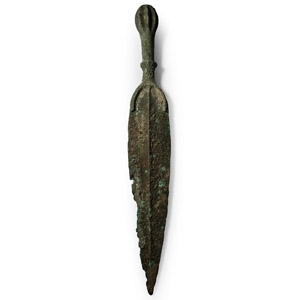
North-Western Persian Bronze Short Sword with Spherical Pommel
Late 2nd-early 1st millennium B.CSold for (Inc. bp): £247
The hilt with flanged pommel, round grip with horizontal flange, crescentic guard, long foliate blade with rectangular-section mid-rib. 910 grams, 47.5 cm
Acquired 1980-2015. Ex Abelita family collection. This lot is accompanied by an illustrated lot declaration signed by the Head of the Antiquities Department, Dr Raffaele D’Amato.
Moorey studied pommelled swords and attributed their production to north-western Iran, dating them to the end of the 2nd millennium B.C. Dimensions of these swords varied from circa 49 cm (Khorasani, 2006, p.395) to 74 cm (sword in the Ashmolean Museum). While the blade belongs to the usual typology, like the penannular guard, the fashion of the pommel is unusual. -
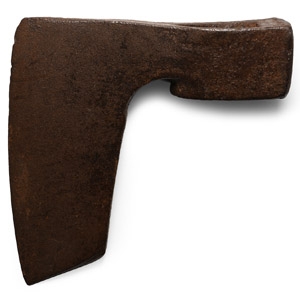
Medieval Iron Bearded Axehead
Circa 15th-16th century A.D.Sold for (Inc. bp): £39
With a long narrow blade and short neck, tongue-shaped socket. 540 grams, 11.7 cm
Ex North American private collection, 1970s-1990s. This lot is accompanied by an illustrated lot declaration signed by the Head of the Antiquities Department, Dr Raffaele D’Amato. -
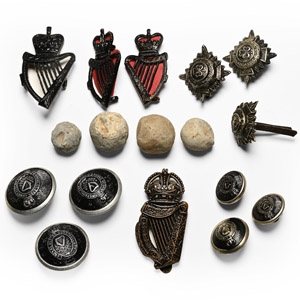
Items of Irish Military and Services Interest
17th-20th century A.D.Sold for (Inc. bp): £26
Comprising: four musket balls from the banks of the river Foyle in Derry; six Royal Ulster Constabulary (obsolete) buttons; Royal Irish Constabulary cap and collar badges from the 1950s-1960s; three Royal Irish Constabulary rank badges; WWI London Irish Rifles cap badge. 162 grams total, 14-50 mm
Ex Irish collection, Germany. From a Leicestershire, UK, collection. This lot is accompanied by an illustrated lot declaration signed by the Head of the Antiquities Department, Dr Raffaele D’Amato. -
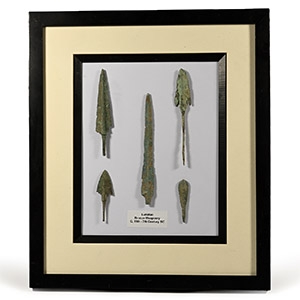
Cased Luristan Arrowhead Collection
Circa 11th-7th century B.C.Sold for (Inc. bp): £39
Including leaf-shaped and barbed types in a glazed frame. 1.1 kg, 33.5 x 38.5 cm
Ex G. While collection, South Wales, 1980s. This lot is accompanied by an illustrated lot declaration signed by the Head of the Antiquities Department, Dr Raffaele D’Amato. -
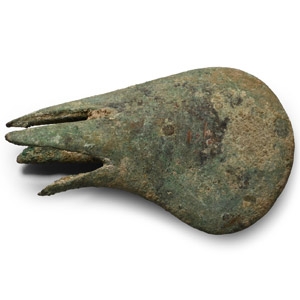
Bactrian Bronze Ceremonial Clawed Macehead
2nd-1st millennium B.C.Sold for (Inc. bp): £46
Comma-shaped in plan with a lentoid-section head and clawed socket. 89 grams, 73 mm
Acquired 1980-2015. Ex Abelita family collection. This lot is accompanied by an illustrated lot declaration signed by the Head of the Antiquities Department, Dr Raffaele D’Amato.
The 'claw mace' was an enigmatic ancient bronze weapon from the Bronze Age Near East. The hollow bulbous head was trailed by tines of varying lengths. It is believed that it was affixed over a wooden shaft and used like a club in combat, and not necessarily used as ceremonial weapon. The knife edge bulb end could have broken bones and proven to be a formidable striking weapon requiring no skill to wield. The tines would have not only been decorative, but have served to add strength below the striking end to prevent breakage. In battle, maces were often used by commanders to display rank when giving orders in battle and leading soldiers, inspiring leadership and power. -
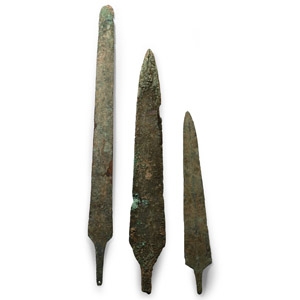
Western Asiatic Bronze Dagger Group
2nd millennium B.C.Sold for (Inc. bp): £124
With a narrow pointed blade and wide shallow raised flange to the centre, straight sides, well marked shoulders with narrow tang, one rivet hole still preserved in one specimen. 358 grams total, 20.7-33.5 cm
Acquired 1980-2015. Ex Abelita family collection. This lot is accompanied by an illustrated lot declaration signed by the Head of the Antiquities Department, Dr Raffaele D’Amato.
The type was technically more advanced than previous types of blades in the Near East, owing to the shape of the weapon, with its slightly convex sides widening out near the point, which combined the advantages of the leaf-shaped and straight-sided forms. This kind of dagger was used in the early second millennium in Mesopotamia and in Syria, and as late as the mid-first millennium in Luristan. -
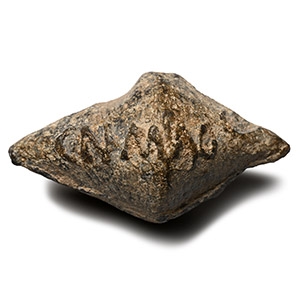
Roman 'Pompey the Great' Lead Slingshot
1st century B.C.Sold for (Inc. bp): £364
Biconical lead slingshot (glans) with inscription in Latin letters 'CN' (Cneius) 'MAG' (Magnus) on one side, and 'IMP' for 'IMPERATOR' (victorious general) to the other side, i.e Gnaeus Pompeius Magnus Imperator (Pompey the Great the victorious general). 81 grams, 47 mm
From the collection of a London antiquarian, formed since the 1980s. This lot is accompanied by an illustrated lot declaration signed by the Head of the Antiquities Department, Dr Raffaele D’Amato. -
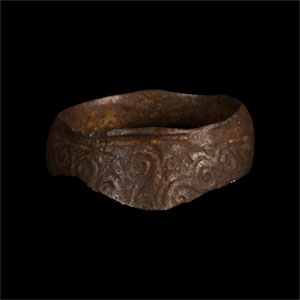
Medieval Bronze Archer's Thumb Ring
14th-15th century A.D.Sold for (Inc. bp): £72
Applied boss to the base of the hoop, triangular extension with foliate scrolls. 2.77 grams, 28.57 mm overall, 19.77 mm internal diameter (approximate size British T, USA 9 1/2, Europe 21.26, Japan 20)
From an English collection formed before 2000. This lot is accompanied by an illustrated lot declaration signed by the Head of the Antiquities Department, Dr Raffaele D’Amato. -
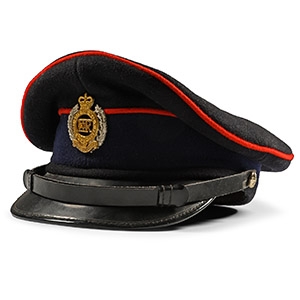
Royal Engineers Officer's Cap
1938-1945 A.D.Sold for (Inc. bp): £20
Army Cap No.1 - British Army, Royal Engineers Officers' Dress Cap with Royal Engineers gilt badge fitted, 'G.D. Golding' maker's label inside; side buttons silver-coloured with Gurkha regiment insignia. 280 grams, 28.5 cm
From a Cambridgeshire, UK, collection. This lot is accompanied by an illustrated lot declaration signed by the Head of the Antiquities Department, Dr Raffaele D’Amato. -
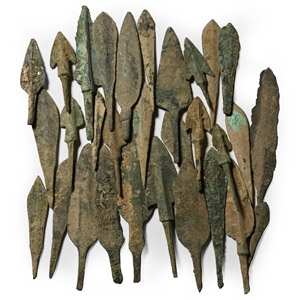
Luristan Bronze Arrowhead Group
13th-6th century B.C.Sold for (Inc. bp): £182
Including barbed-and tanged, leaf-shaped, tongue-shaped, and other types. 295 grams total, 41-91 mm
Acquired 1980-2015. Ex Abelita family collection. This lot is accompanied by an illustrated lot declaration signed by the Head of the Antiquities Department, Dr Raffaele D’Amato.

