-
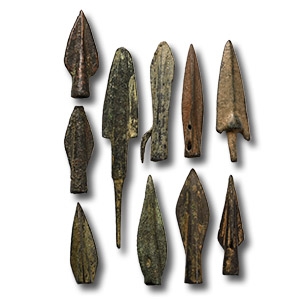
Greek Period Large Bronze Arrowhead Collection
5th-3rd century B.C.Sold for (Inc. bp): £143
High-quality, including triangular-section, barbed-and-tanged and other types. 61 grams total, 32-81 mm
From an English collection formed before 2000. This lot is accompanied by an illustrated lot declaration signed by the Head of the Antiquities Department, Dr Raffaele D’Amato. -
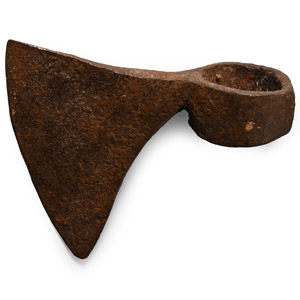
Medieval Iron Triangular Axehead
Circa 15th-16th century A.D.Sold for (Inc. bp): £65
With a wide curved blade and a circular socket. 251 grams, 12 cm
Ex North American private collection, 1970s-1990s. This lot is accompanied by an illustrated lot declaration signed by the Head of the Antiquities Department, Dr Raffaele D’Amato. -
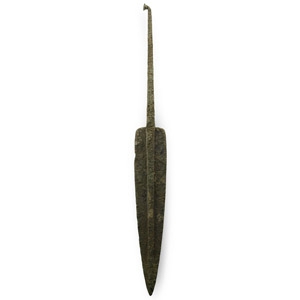
Marlik Bronze Spearhead
14th-10th century B.C.Sold for (Inc. bp): £195
Elongated tapering triangular blade, with broad midrib and squared shoulders slightly rounded at the corners, rectangular sectioned tang with a bent button end. 387 grams, 49 cm
Acquired 1980-2015. Ex Abelita family collection. This lot is accompanied by an illustrated lot declaration signed by the Head of the Antiquities Department, Dr Raffaele D’Amato.
The spearhead belongs to the sub-type A of the spearhead classification of Khorasani. Similar specimens, now in the National Museum of Iran, Teheran, were excavated in the Royal Cemetery of Marlik and found in tomb 5 trench 8 of that Necropolis. -
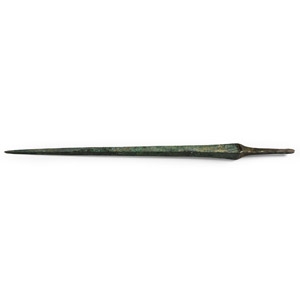
Luristan Bronze Pointed Spear
9th-7th century B.C.Sold for (Inc. bp): £234
Square in section and tapering to a substantial point, with short neck and square-section tang. 201 grams, 34.2 cm
Ex London, UK, gallery, 1971-early 2000s. London, UK, collection. This lot is accompanied by an illustrated lot declaration signed by the Head of the Antiquities Department, Dr Raffaele D’Amato. -
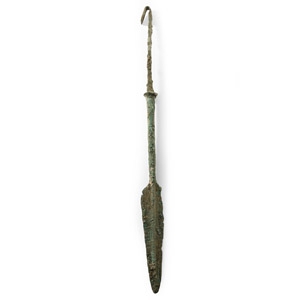
Mesopotamian Bronze Javelin Head
3rd-2nd millennium B.CSold for (Inc. bp): £117
With foliate blade, rhomboidal in section, raised mid-rib, medium length stem widening at its base and forming a small stop, rectangular-section tang with bent terminal. 208 grams, 43.2 cm
Acquired 1980-2015. Ex Abelita family collection. This lot is accompanied by an illustrated lot declaration signed by the Head of the Antiquities Department, Dr Raffaele D’Amato.
The specimen belongs to the category of tripartite spears with long pointed biconvex blade and single bevelled tang. They seem to be a Mesopotamian and Susian (Elamite) variant, and this type also includes decorated blades, like the spear from Tello with the inscription 'King of Kish'. -
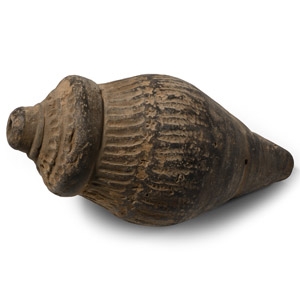
Turco-Mongol 'Greek Fire' Ceramic Fire Bomb or Hand Grenade
13th-15th century A.D.Sold for (Inc. bp): £78
A hollow vessel with cylindrical body, short neck and domed mouth, impressed linear decoration to the body; intended to be filled with explosive liquid and a wick, and used as a hand grenade. 630 grams, 16.4 cm
From an important specialist collection, London, UK, 1990s onwards. Academic report by Dr Raffaele D'Amato. This lot is accompanied by an illustrated lot declaration signed by the Head of the Antiquities Department, Dr Raffaele D’Amato. -
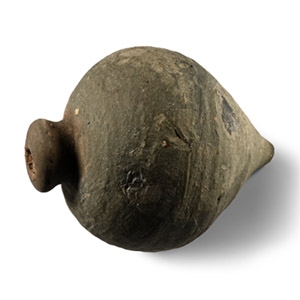
Byzantine 'Greek Fire' Ceramic Fire Bomb or Hand Grenade
9th-11th century A.D.Sold for (Inc. bp): £52
Piriform in profile with narrow point, and deep shoulder, narrow neck and domed mouth. 512 grams, 11.3 cm
From a London, UK, gentleman's collection of ancient pottery and artefacts, 1990s. Accompanied by an academic paper by military specialist Dr Raffaele D'Amato, dated 15 July 2019 and titled 'Eastern Roman Empire - Greek Fire Bomb or Hand Grenade (μεσαίον kακάβιον) 9th-11th century AD'. This lot is accompanied by an illustrated lot declaration signed by the Head of the Antiquities Department, Dr Raffaele D’Amato.
Apart from the use of siphons or manual flame-throwers called cheirosiphona, special corps of Roman soldiers employed terracotta grenades, in the form of small jars, abundantly evidenced in archaeological excavations. They were called μεσαία kακαβιά or κυτροκακάβια where the former had a bulbous shape and the latter a more cylindrical form. -
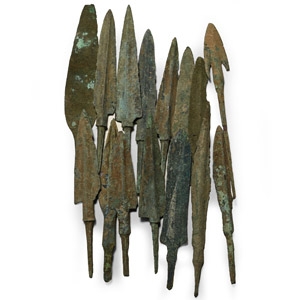
Luristan Bronze Arrowhead Group
13th-6th century B.C.Sold for (Inc. bp): £234
Including leaf-shaped, ribbed, triangular and other tanged types. 407 grams total, 11.3-15.2 cm
Acquired 1980-2015. Ex Abelita family collection. This lot is accompanied by an illustrated lot declaration signed by the Head of the Antiquities Department, Dr Raffaele D’Amato. -
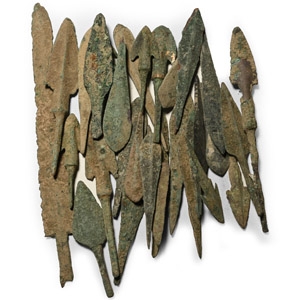
Luristan Bronze Arrowhead Group
13th-6th century B.C.Sold for (Inc. bp): £182
Including barbed-and tanged, leaf-shaped, slender triangular and other types. 286 grams total, 4.8-16 cm
Acquired 1980-2015. Ex Abelita family collection. This lot is accompanied by an illustrated lot declaration signed by the Head of the Antiquities Department, Dr Raffaele D’Amato. -
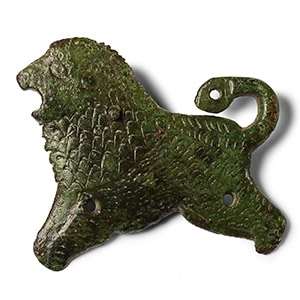
Late Roman Lion Horse Harness Mount
4th-6th century A.D.Sold for (Inc. bp): £130
The beast shown leaping with gaping jaws and raised tail, incised decoration to the body and mane; pierced for attachment with one rivet in situ. 8.14 grams, 34 mm
Ex German art market, 2000s. Acquired from an EU collector living in London. From the collection of Surrey, UK, gentleman. This lot is accompanied by an illustrated lot declaration signed by the Head of the Antiquities Department, Dr Raffaele D’Amato. -
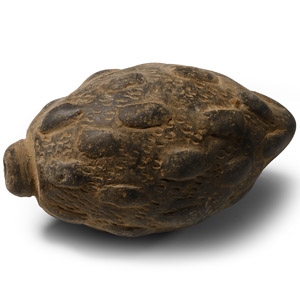
Byzantine 'Greek Fire' Ceramic Fire Bomb or Hand Grenade
9th-11th century A.D.Sold for (Inc. bp): £182
A piriform missile with raised bosses and hatching, intended to be filled with explosive liquid and wick, used as a hand grenade. 660 grams total, 15 cm
From an important specialist collection, London, UK, 1990s onwards. Accompanied by an academic paper by military specialist Dr Raffaele D'Amato, dated 15 July 2019 and titled 'Eastern Roman Empire - Greek Fire Bomb or Hand Grenade (μεσαίον kακάβιον) 9th-11th century AD'. This lot is accompanied by an illustrated lot declaration signed by the Head of the Antiquities Department, Dr Raffaele D’Amato. -
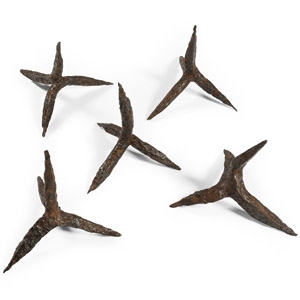
Medieval Iron Anti-Cavalry Caltrop Group
13th-14th century A.D.Sold for (Inc. bp): £98
Each hand-forged with square-section spikes, designed so that however the item falls, one spike is always vertical. 240 grams total, 74-95 mm
From the private collection of a London gentleman, from his grandfather's collection formed before the early 1970s. This lot is accompanied by an illustrated lot declaration signed by the Head of the Antiquities Department, Dr Raffaele D’Amato.

