-
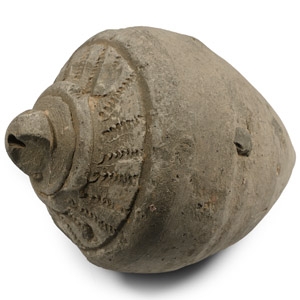
Byzantine 'Greek Fire' Ceramic Fire Bomb or Hand Grenade
9th-11th century A.D.Sold for (Inc. bp): £59
Piriform in profile with stepped shoulder and domed mouth. impressed cord motifs. 826 grams, 13.5 cm
From a specialist London, UK, arms and armour collection, 1990s. Accompanied by an academic paper by military specialist Dr Raffaele D'Amato, dated 15 July 2019 and titled 'Eastern Roman Empire - Greek Fire Bomb or Hand Grenade (μεσαίον kακάβιον) 9th-11th century AD'. This lot is accompanied by an illustrated lot declaration signed by the Head of the Antiquities Department, Dr Raffaele D’Amato.
Apart from the use of siphons or manual flame-throwers called cheirosiphona, special corps of Roman soldiers employed terracotta grenades, in the form of small jars, abundantly evidenced in archaeological excavations. They were called μεσαία kακαβιά or κυτροκακάβια where the former had a bulbous shape and the latter a more cylindrical form. -
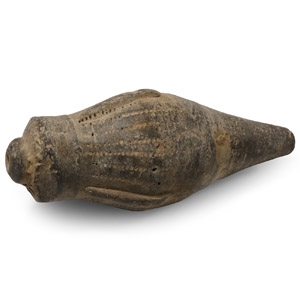
Turco-Mongol 'Greek Fire' Ceramic Fire Bomb or Hand Grenade
14th-15th century A.D.Sold for (Inc. bp): £182
Cylindrical in form with tapering foot, vertical flanges to the body with pointillé decoration between, carinated shoulder with impressed points, domed mouth. 393 grams, 16 cm
From an important specialist collection, London, UK, 1990s onwards. Accompanied by an academic paper by military specialist Dr Raffaele D'Amato, dated 15 July 2019 and titled 'Eastern Roman Empire - Greek Fire Bomb or Hand Grenade (μεσαίον kακάβιον) 9th-11th century AD'. This lot is accompanied by an illustrated lot declaration signed by the Head of the Antiquities Department, Dr Raffaele D’Amato. -
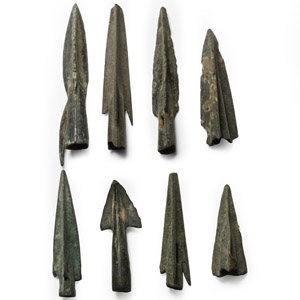
Greek Period Bronze Arrowhead Collection
5th-3rd century B.C.Sold for (Inc. bp): £111
High-quality, mainly leaf-shaped and triangular-section socketted types. 17.8 grams total, 23-42 mm
From an English collection formed before 2000. This lot is accompanied by an illustrated lot declaration signed by the Head of the Antiquities Department, Dr Raffaele D’Amato. -
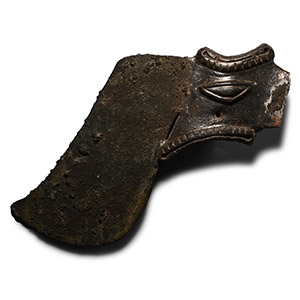
Bactrian Bronze 'Eye' Type Axehead
1st millennium B.C.Sold for (Inc. bp): £85
With a swept unsharpened blade, lentoid socket with ribbed collars and raised eye motif to each side. 154 grams, 13 cm
Acquired 1980-2015. Ex Abelita family collection. This lot is accompanied by an illustrated lot declaration signed by the Head of the Antiquities Department, Dr Raffaele D’Amato. -
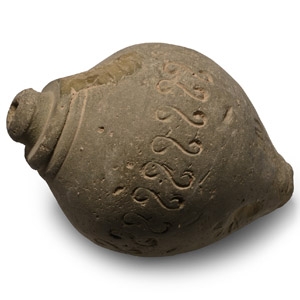
Byzantine 'Greek Fire' Ceramic Fire Bomb or Hand Grenade
9th-11th century A.D.Sold for (Inc. bp): £72
A large piriform missile with domed filler-hole, a band of stamped scroll motifs to the shoulder, intended to be filled with explosive liquid and wick, used as a hand grenade. 960 grams, 15 cm
From an important specialist collection, London, UK, 1990s onwards. Accompanied by an academic paper by military specialist Dr Raffaele D'Amato, dated 15 July 2019 and titled 'Eastern Roman Empire - Greek Fire Bomb or Hand Grenade (μεσαίον kακάβιον) 9th-11th century AD'. This lot is accompanied by an illustrated lot declaration signed by the Head of the Antiquities Department, Dr Raffaele D’Amato. -
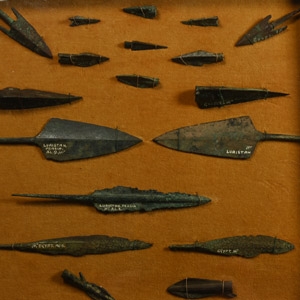
Greek, Egyptian and Luristan Bronze Arrowhead Collection in Display Case
2nd-1st millennium B.C.Sold for (Inc. bp): £845
Including triangular-section, leaf-shaped, barbed-and-tanged and other types, some with inked find spot and accession data, wired onto a velvet board in a glazed wooden frame. 965 grams total, 26.2 x 24 cm
From the collection of Dr Hugh Alderson Fawcett (1891-1982). Acquired Oxford, UK. From the private collection of Kenneth Machin (1936-2020), Buckinghamshire, UK; with collection no.BA21; his collection of antiquities and natural history was formed since 1948; thence by descent. This lot is accompanied by an illustrated lot declaration signed by the Head of the Antiquities Department, Dr Raffaele D’Amato.
Dr Hugh Alderson Fawcett (1891-1982) was a general practitioner and antiquarian who built up an important collection of ancient implements, weapons and ornaments that eventually numbered some eight thousand items. It was he who alerted the British Museum to the discovery of the fabulous Mildenhall treasure after being shown it by Sydney Ford during Easter in 1946. The bulk of his collection is now in the Bristol Museum and Art Gallery, but Fawcett previously sold or traded many pieces in order to improve his collection. -
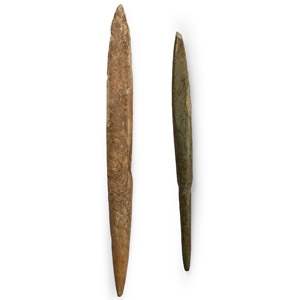
Chinese Liao Bone Arrowhead Group
Liao Dynasty, 907-1125 A.D.Sold for (Inc. bp): £7
Each sub rectangular in section with round-section tang. 17.3 grams total, 9.9-12.1 cm
Acquired on the UK art market before 2000. Property of an Essex, UK, gentleman. This lot is accompanied by an illustrated lot declaration signed by the Head of the Antiquities Department, Dr Raffaele D’Amato. -
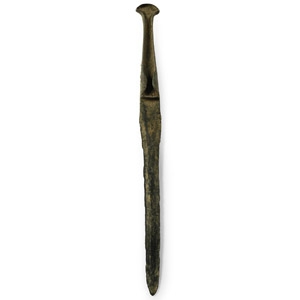
Luristan Bronze Dagger
13th century B.C.Sold for (Inc. bp): £208
With lentoid-section blade, tongue-shaped in plan, with integral tapering hilt with flared finial, lateral flanges to accept a panel of bone to each face forming the grip. 88 grams, 27 cm
Acquired 1980-2015. Ex Abelita family collection. This lot is accompanied by an illustrated lot declaration signed by the Head of the Antiquities Department, Dr Raffaele D’Amato.
The art of Luristan can be described as the art of nomadic herdsmen and horsemen with an emphasis on the crafting of small, easily portable objects, among these a great number of bronze weapons. The rich and noble aristocrats of the Luristan, Elamites, Hurrians, Lullubians, Kutians, and Kassites, went to battle splendidly equipped and wore magnificent bronze armour, using maces, spears and daggers as offensive weapons, alongside spears, bows and arrows. -
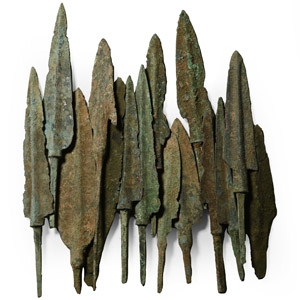
Luristan Bronze Arrowhead Group
13th-6th century B.C.Sold for (Inc. bp): £234
Comprising triangular types with thick midrib, leaf-shaped and other types. 400 grams total, 9.7-16.2 cm
Acquired 1980-2015. Ex Abelita family collection. This lot is accompanied by an illustrated lot declaration signed by the Head of the Antiquities Department, Dr Raffaele D’Amato. -
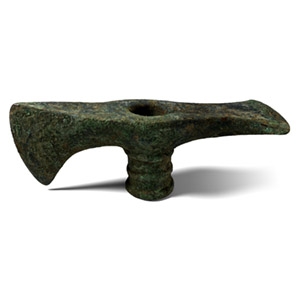
Luristan Socketted Axehead
2nd-1st millennium B.C.Sold for (Inc. bp): £169
An adze-axe head with central shaft hole and curved blades. 755 grams, 17.5 cm
Acquired 1980-2015. Ex Abelita family collection. This lot is accompanied by an illustrated lot declaration signed by the Head of the Antiquities Department, Dr Raffaele D’Amato.
The adze-axe was a fundamental axe of many Bronze Age cultures over the world. Its form was one that lends itself to dual purposes - for war and peace. As a tool, it functions in fabricating wood and as a weapon, its heavy mass and compact form make it a deadly striking and chopping weapon, even able to defeat light armour. -
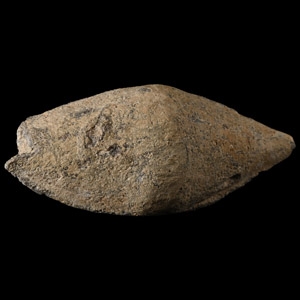
Roman Julius Caesar 'Battle of Munda' Lead Slingshot
45 B.C.Sold for (Inc. bp): £247
A biconical facetted lentoid-section lead sling shot (glans), inscription monogram a combination of letters 'C', 'A' and 'E', for 'C A E S' referring to Julius Caesar. 56.8 grams, 45 mm
Acquired on the UK art market. Property of a gentleman collector. Accompanied by an academic paper by military specialist Dr Raffaele D'Amato, dated 4th May 2022 and titled 'Roman Res Publica - Lead Slingshots (glandes) of Caesarian Age - 45 B.C circa'. This lot is accompanied by an illustrated lot declaration signed by the Head of the Antiquities Department, Dr Raffaele D’Amato.
The shot (type IIb of the Völling classification) is marked with the abbreviated name of Julius Caesar; it was used in quantity at the Battle of Monda (or Munda) against the last followers of Pompey, the leaders of the Optimates, on the 17th March 45 BC. Similar shots were used in Caesar's wars, and slingers of Caesar's age were part of the light infantry. Caesar speaks of his Balearic slingers during the conquest of Gaul. They wore a short tunic, with leather or rope sandals to the feet, and a warm overcoat which could also have been used to store projectiles. They also used a satchel to carry very deadly lead-like stones or bullets. -
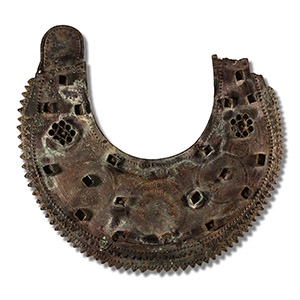
Western Asiatic Decorated Bronze Pectoral Collar
12th-14th century A.D.Sold for (Inc. bp): £1,430
Broad sheet-bronze halter-shaped collar with dentilled outer edge, in two offset overlapped layers; bands of repoussé domed pellets to the outer and inner edges, rectangular cells to accept glass or organic inserts, two clusters of circular cells surrounding rectangular ones; the surface with dense hatching and reserved tendril and leaf motifs; attachment loops to reverse. 638 grams, 34.5 cm
German art market. European private collection, 1970s-early 2000s. Acquired from the above; thence by descent. Private collection, London. This lot has been checked against the Interpol Database of stolen works of art and is accompanied by a search certificate number no.12282-221445. This lot has been cleared against the Art Loss Register database, and is accompanied by an illustrated lot declaration signed by the Head of the Antiquities Department, Dr Raffaele D’Amato.

