-
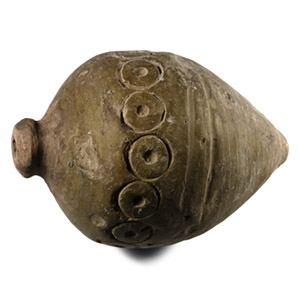
Byzantine 'Greek Fire' Ceramic Fire Bomb or Hand Grenade
9th-11th century A.D.Sold for (Inc. bp): £91
Piriform in profile with narrow point, and deep shoulder and domed mouth; incised circumferential band to the equator, band of impressed ring-and-dot motifs to the shoulder. 836 grams, 14.8 cm
From a London, UK, gentleman's collection of ancient pottery and artefacts, 1990s. Accompanied by an academic paper by military specialist Dr Raffaele D'Amato, dated 15 July 2019 and titled 'Eastern Roman Empire - Greek Fire Bomb or Hand Grenade (μεσαίον kακάβιον) 9th-11th century AD'. This lot is accompanied by an illustrated lot declaration signed by the Head of the Antiquities Department, Dr Raffaele D’Amato.
Apart from the use of siphons or manual flame-throwers called cheirosiphona, special corps of Roman soldiers employed terracotta grenades, in the form of small jars, abundantly evidenced in archaeological excavations. They were called μεσαία kακαβιά or κυτροκακάβια where the former had a bulbous shape and the latter a more cylindrical form. -
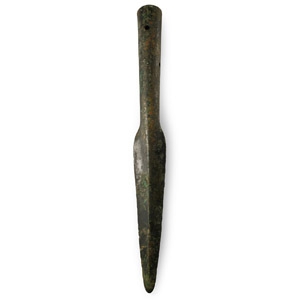
Massive Amlash Bronze Spearhead Blade
9th-7th century B.C.Sold for (Inc. bp): £260
With ovate blade, strong midrib and socketted shaft with fastening holes. 729 grams, 38.5 cm
Acquired 1980-2015. Ex Abelita family collection. This lot is accompanied by an illustrated lot declaration signed by the Head of the Antiquities Department, Dr Raffaele D’Amato.
The massive spear was used by chariot fighters to strike each other, or strike the enemy infantry from above. Similar specimens with longer sockets were excavated by Negahban in Amlash area. According to Moorey, sockets as long, if not longer than the blade, are a characteristic of Iranian spearheads in the late 2nd and early 1st millennium B.C. A similar spearhead from the Tappeh Sialk has been dated 9th-7th century B.C. -
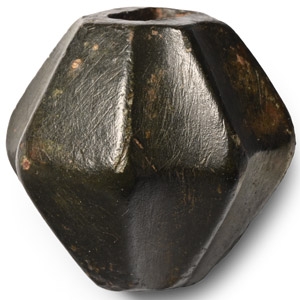
Medieval Bronze Octagonal Dagger Pommel
14th-15th century A.D.Sold for (Inc. bp): £39
Biconical with rectangular-section socket and raised ridges to the body. 39.8 grams, 27 mm
From the collection of a Gloucestershire, UK, gentleman. Property of a private collector, West London, UK. This lot is accompanied by an illustrated lot declaration signed by the Head of the Antiquities Department, Dr Raffaele D’Amato. -
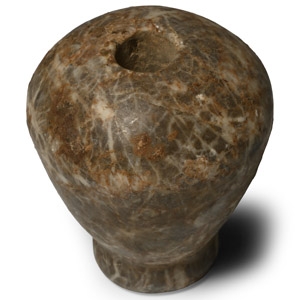
Western Asiatic Stone Macehead
3rd-2nd millennium B.C.Sold for (Inc. bp): £117
Tubular in form with tapering profile and balustered socket. 342 grams, 75 mm
From the collection of a London, UK, gentleman, 1990s. This lot is accompanied by an illustrated lot declaration signed by the Head of the Antiquities Department, Dr Raffaele D’Amato. -
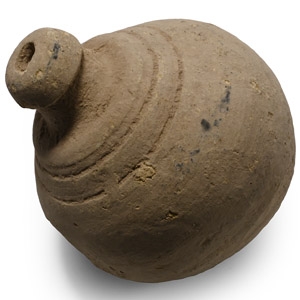
Byzantine 'Greek Fire' Ceramic Fire Bomb or Hand Grenade
9th-11th century A.D.Sold for (Inc. bp): £65
A bulbous missile with dome filler-hole and long neck, intended to be filled with explosive liquid and wick, used as a hand grenade. 337 grams, 10 cm
From an important specialist collection, London, UK, 1990s onwards. Accompanied by an academic paper by military specialist Dr Raffaele D'Amato, dated 15 July 2019 and titled 'Eastern Roman Empire - Greek Fire Bomb or Hand Grenade (μεσαίον kακάβιον) 9th-11th century AD'. This lot is accompanied by an illustrated lot declaration signed by the Head of the Antiquities Department, Dr Raffaele D’Amato. -
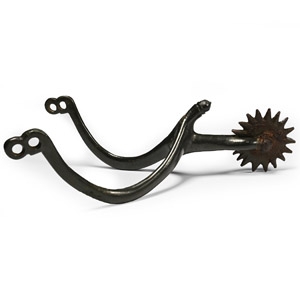
Medieval Bronze Spur with Rowel
12th-14th century A.D.Sold for (Inc. bp): £455
With D-section curved arms with figure-of-eight finials, long spur with a rowel and a shorter spur below. 126 grams, 15.4 cm
From the private collection of a London gentleman, from his grandfather's collection formed before the early 1970s. This lot is accompanied by an illustrated lot declaration signed by the Head of the Antiquities Department, Dr Raffaele D’Amato. -
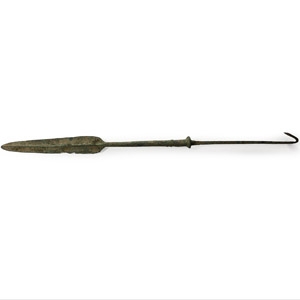
Amlash Bronze Lancehead
Late 2nd millennium B.C.Sold for (Inc. bp): £117
With ovate blade, central rib and curved shoulders, the round-section long shaft tapering towards the flared collar, rectangular-section tang with bent tip. 190 grams, 48 cm
Acquired on the UK art market before 2000. Property of an Essex, UK, gentleman. This lot is accompanied by an illustrated lot declaration signed by the Head of the Antiquities Department, Dr Raffaele D’Amato.
Similar spearheads were excavated in Marlik. Negahban stated that based upon the evidence on archaeological finds from West-North Iran, this type of spearhead may be dated to the final centuries of 2nd millennium B.C. -
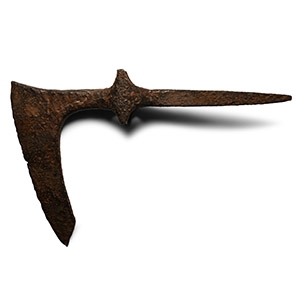
Byzantine Iron Bearded Axehead with Spike
9th-11th century A.D.Sold for (Inc. bp): £312
Double-edged battle axe with broad trapezoidal blade elongated towards the bottom, with rhomboidal and blunt fixing hole shaft, the opposite end formed by a long and thick spike. 411 grams, 22.7 cm
Ex USA private collection, 1970s-1990s. This lot is accompanied by an illustrated lot declaration signed by the Head of the Antiquities Department, Dr Raffaele D’Amato.
The double-edged axe was used by the Roman cavalry between the 9th and 11th centuries. The correspondence of this example with the types described by Emperor Leo VI the Wise, is surprising: it is clear that this typology was not a working tool but a war axe, suitable for breaking helmets, breastplates, shields and skulls since it inflicted devastating blows to the head and arms by damaging the protective equipment. -
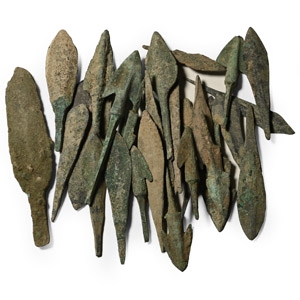
Luristan Bronze Arrowhead Group
13th-6th century B.C.Sold for (Inc. bp): £182
Including barbed-and tanged, leaf-shaped, lozengiform and other types. 232 grams total, 41-91 mm
Acquired 1980-2015. Ex Abelita family collection. This lot is accompanied by an illustrated lot declaration signed by the Head of the Antiquities Department, Dr Raffaele D’Amato. -
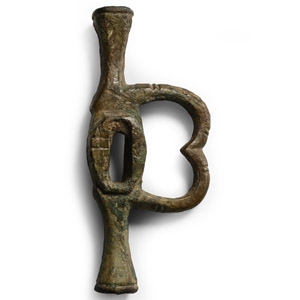
Medieval Bronze Dagger Quillon
Circa 15th century A.D.Sold for (Inc. bp): £65
Comprising flaring arms with engraved X-motif to each finial, large kidney-shaped loop to the side. 56.7 grams, 77 mm
From the collection of a Norfolk, UK, gentleman. Property of a private collector, West London, UK. This lot is accompanied by an illustrated lot declaration signed by the Head of the Antiquities Department, Dr Raffaele D’Amato. -
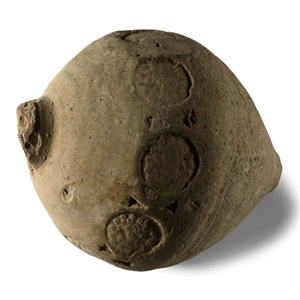
Byzantine 'Greek Fire' Ceramic Fire Bomb or Hand Grenade
9th-11th century A.D.Sold for (Inc. bp): £52
Piriform in profile with band of impressed rosettes to the shoulder, mouth chipped and partly absent. 539 grams, 11.8 cm
From a specialist London, UK, arms and armour collection, 1990s. Accompanied by an academic paper by military specialist Dr Raffaele D'Amato, dated 15 July 2019 and titled 'Eastern Roman Empire - Greek Fire Bomb or Hand Grenade (μεσαίον kακάβιον) 9th-11th century AD'. This lot is accompanied by an illustrated lot declaration signed by the Head of the Antiquities Department, Dr Raffaele D’Amato.
Apart from the use of siphons or manual flame-throwers called cheirosiphona, special corps of Roman soldiers employed terracotta grenades, in the form of small jars, abundantly evidenced in archaeological excavations. They were called μεσαία kακαβιά or κυτροκακάβια where the former had a bulbous shape and the latter a more cylindrical form. -
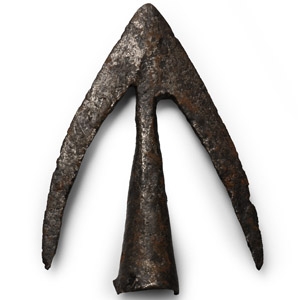
Medieval Iron Swallow-Tailed Arrowhead
14th century A.D.Sold for (Inc. bp): £104
With narrow curved edges and tapering socket. 8.08 grams, 52 mm
Acquired from Coincraft, London, UK. From the private collection of Kenneth Machin (1936-2020), Buckinghamshire, UK; with collection no.M36; his collection of antiquities and natural history was formed since 1948; thence by descent. Accompanied by an original certificate of authenticity from Coincraft. This lot is accompanied by an illustrated lot declaration signed by the Head of the Antiquities Department, Dr Raffaele D’Amato.

