-
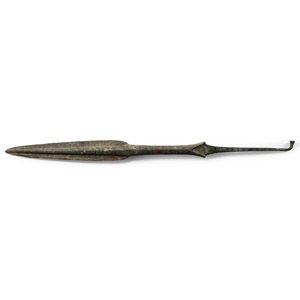
Luristan Bronze Spearhead
Late 2nd millennium B.C.Sold for (Inc. bp): £117
With ovate blade, central round rib and curved shoulders, the cylindrical long shaft widening towards the end, encasing a rectangular tang with bent tip. 351 grams, 44 cm
Acquired 1980-2015. Ex Abelita family collection. This lot is accompanied by an illustrated lot declaration signed by the Head of the Antiquities Department, Dr Raffaele D’Amato.
Similar spearheads were excavated in Marlik. Negahban stated that based upon the evidence on archaeological finds from West-North Iran, this type of spearhead may be dated to the final centuries of 2nd millennium B.C. -
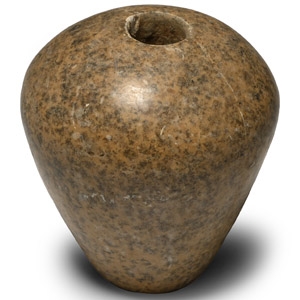
Western Asiatic Stone Macehead
3rd-2nd millennium B.C.Sold for (Inc. bp): £195
Tubular in form with tapering profile and domed upper face; socket chipped. 386 grams, 74 mm
From the collection of a London, UK, gentleman, 1990s. This lot is accompanied by an illustrated lot declaration signed by the Head of the Antiquities Department, Dr Raffaele D’Amato. -
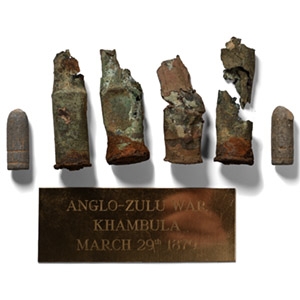
Anglo-Zulu War 'Battle of Khambula' Artefact Collection
29 March 1879 A.D.Sold for (Inc. bp): £98
Comprising: a Martini-Henry brass ‘boxer’ cartridge cases, one with firing mark to the base; two lead heads of bullets fired from the Martini-Henry rifle; supplied with brass nameplate 'Anglo-Zulu War / Khambula / March 29th 1879'. 120 grams total, 3-10.1 cm
Found by Zulu natives, Khambula, South Africa, 1990s-early 2000s. Ian Wilkinson collection, Nottinghamshire, UK, formed since 1985. This lot is accompanied by an illustrated lot declaration signed by the Head of the Antiquities Department, Dr Raffaele D’Amato.
Following defeats by the Zulu army at Isandlwana and Hiobane, the British were desperate for a victory, which they secured at Khambula. -
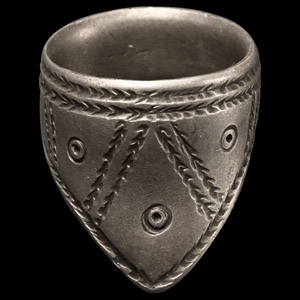
Large Medieval Silver Archer's Thumb Ring
15th century A.D.Sold for (Inc. bp): £208
With barrel-shaped hoop and triangular spur, impressed ropework bands and ring-and-dot motifs. 17.36 grams, 27.91 mm overall, 20.93 mm internal diameter (approximate size British W, USA 11, Europe 25, Japan 24)
Ex German art market, 2000s. Acquired from an EU collector living in London. From the collection of Surrey, UK, gentleman. This lot is accompanied by an illustrated lot declaration signed by the Head of the Antiquities Department, Dr Raffaele D’Amato. -
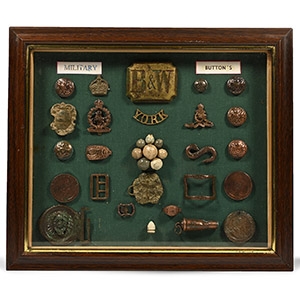
Post Medieval Cased 'Manchester Area' Militaria and Other Artefact Collection
18th-20th century A.D.Sold for (Inc. bp): £33
Including cap badges, cartwheel pennies, snake-buckle, buttons and other items, mounted in a glazed wooden frame. 1.1 kg, 29.5 x 35 cm
From the private collection of a Manchester, UK, detectorist, 1990s. This lot is accompanied by an illustrated lot declaration signed by the Head of the Antiquities Department, Dr Raffaele D’Amato. -
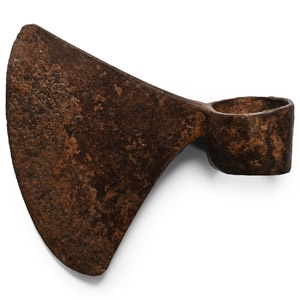
Tudor Age Iron Triangular Axehead
Circa 16th-17th century A.D.Sold for (Inc. bp): £52
With a curving blade with rounded edges, circular socket and a stamped maker's mark to the blade. 193 grams, 12.2 cm
Ex North American private collection, 1970s-1990s. This lot is accompanied by an illustrated lot declaration signed by the Head of the Antiquities Department, Dr Raffaele D’Amato. -
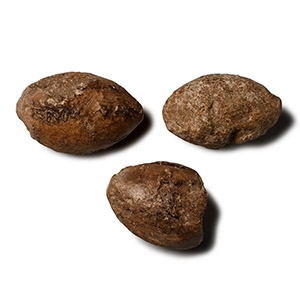
Greek Lead Impacted Slingshot Group
3rd-1st century B.C.Sold for (Inc. bp): £156
Three lentoid-section lead slingshots (glandae), each deformed due to impact, one with the Greek letters 'ΓΕΜ…ΔΑ' (Ghemonidas?). 118 grams total, 25-31 mm
Ex German art market, 2000s. Acquired from an EU collector living in London. From the collection of Surrey, UK, gentleman. This lot is accompanied by an illustrated lot declaration signed by the Head of the Antiquities Department, Dr Raffaele D’Amato.
The use of lead slingshots in battle is attested in Greece as early as the 5th century B.C. Numerous finds were excavated in Olynthus, usually olive or plump-almond-shape. The type continued to be used in the Italian peninsula, and similar specimens, bearing the title ‘Commander of the Units of Slingers’ have been attested from the period of the Punic Wars. -
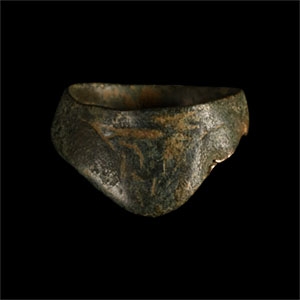
Medieval Bronze Archer's Thumb Ring
14th-15th century A.D.Sold for (Inc. bp): £52
With a D-section hoop, triangular extension with incised decoration. 2.99 grams, 24.04 mm overall, 19.35 mm internal diameter (approximate size British R, USA 8 1/2, Europe 18 3/4, Japan 18)
From an English collection formed before 2000. This lot is accompanied by an illustrated lot declaration signed by the Head of the Antiquities Department, Dr Raffaele D’Amato. -
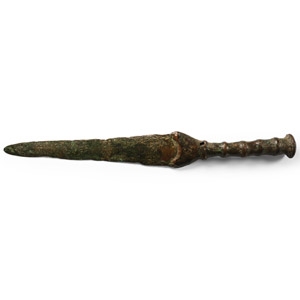
Luristan Bronze Dagger
13th-7th century B.C.Sold for (Inc. bp): £260
Comprising a two-edged leaf-shaped lentoid-section blade, crescentic lower guard, ribbed hilt and domed finial. 93 grams, 20.1 cm
Acquired before 1983. Ex London gallery, 1990s. This lot is accompanied by an illustrated lot declaration signed by the Head of the Antiquities Department, Dr Raffaele D’Amato. -
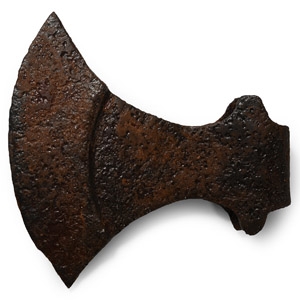
Viking Age Iron Broad Axehead
Circa 9th-12th century A.D.Sold for (Inc. bp): £182
With a curving reinforced blade, narrow socket with lateral spurs. 303 grams, 13 cm
Ex North American private collection, 1970s-1990s. This lot is accompanied by an illustrated lot declaration signed by the Head of the Antiquities Department, Dr Raffaele D’Amato. -
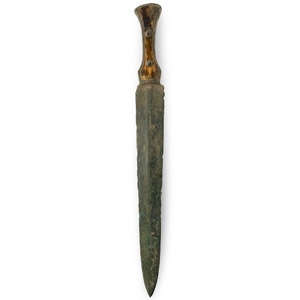
Luristan Bronze Dirk
10th century B.C.Sold for (Inc. bp): £390
A short sword with lentoid-section triangular blade, rhomboid guard, hilt with later organic filling to each face. 228 grams, 34 cm
Acquired 1980-2015. Ex Abelita family collection. This lot is accompanied by an illustrated lot declaration signed by the Head of the Antiquities Department, Dr Raffaele D’Amato.
The type Dirk I according to the classification of Medvedskaya is common among dirks and daggers attributed to Luristan. The hilt is flanged and accepts inlays remnants of organic material on the handle. There are also two angular indentations on each side of the guard. -
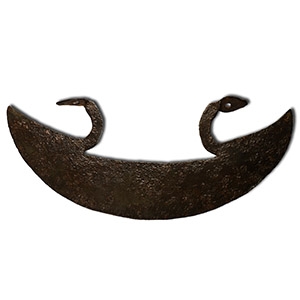
Ethiopian Coptic Iron Halberd
15th-17th century A.D.Sold for (Inc. bp): £364
Single-edged crescent-shaped blade equipped with two curved pins with holes for attachment to a wooden shaft. 308 grams, 23.2 cm
Ex USA private collection, 1970s-1990s. This lot is accompanied by an illustrated lot declaration signed by the Head of the Antiquities Department, Dr Raffaele D’Amato.
The blade belongs to the category of crock-backed blades, as classified by Flinders Petrie. More ancient fine Coptic examples are engraved with zigzag lines, a cross, fishes, and vine pattern. The iron halberd, viii, may be of some later date. The iconography of the medieval churches in Ethiopia suggest that these weapons were used as ceremonial halberds, and worn by guardsmen of rulers and bishops. A form similar to these halberds was used as a hoe in South Africa.

