-
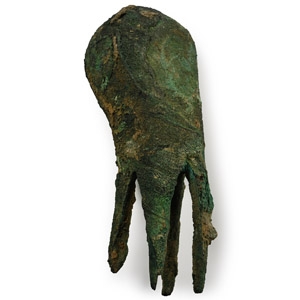
Bactrian Bronze Claw Axehead-Mace
2nd-1st millennium B.C.Sold for (Inc. bp): £117
Egg-shaped with spiked sleeves or prongs, the top of the weapon with a narrow edge. 190 grams, 10.9 cm
Acquired on the UK art market before 2000. Property of an Essex, UK, gentleman. This lot is accompanied by an illustrated lot declaration signed by the Head of the Antiquities Department, Dr Raffaele D’Amato.
The 'claw mace' was an enigmatic ancient bronze weapon from the Bronze Age Near East. The hollow bulbous head was trailed by tines of varying lengths. It is believed that it was affixed over a wooden shaft and used like a club in combat, and not necessarily used as ceremonial weapon. The knife edge bulb end could have broken bones and proven to be a formidable striking weapon requiring no skill to wield. The tines would have not only been decorative, but have served to add strength below the striking end to prevent breakage. In battle, maces were often used by commanders to display rank when giving orders in battle and leading soldiers, inspiring leadership and power. Egg-shaped with spiked sleeves or prongs, the top of the weapon with a narrow edge, the sleeves with small internal tangs for mounting. -
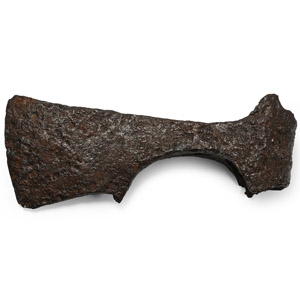
Viking Age Iron Bearded Axehead
9th-11th century A.D.Sold for (Inc. bp): £182
Comprising a gently curving blade, long neck with a spur, round socket with lateral flanges. 633 grams, 19 cm
From the private collection of a London gentleman, from his grandfather's collection formed before the early 1970s. This lot is accompanied by an illustrated lot declaration signed by the Head of the Antiquities Department, Dr Raffaele D’Amato. -
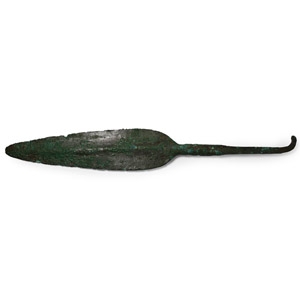
Large Marlik Bronze Spearhead
Early 1st millennium B.C.Sold for (Inc. bp): £52
With a leaf-shaped blade and raised midrib extending to a rectangular section tang with a right angle turn. 528 grams, 41.5 cm
Acquired 1980-2015. Ex Abelita family collection. This lot is accompanied by an illustrated lot declaration signed by the Head of the Antiquities Department, Dr Raffaele D’Amato. -
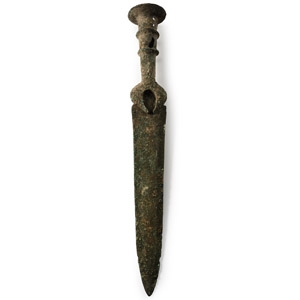
North-Western Persian Bronze Dagger
Late 2nd-early 1st millennium B.C.Sold for (Inc. bp): £1,170
The blade with shallow midrib, hilt cast with two horizontal grooves and crescentic guard. 354 grams, 31.5 cm
Acquired 1980-2015. Ex Abelita family collection. This lot is accompanied by an illustrated lot declaration signed by the Head of the Antiquities Department, Dr Raffaele D’Amato.
Moorey, Gordon and Khorasani created a classification of bladed weapons, according to which daggers are edged weapons not greater than 36cm in length, dirks (short swords) are between 36cm and 50cm in length, and swords are edged weapons greater than 50cm in length. -
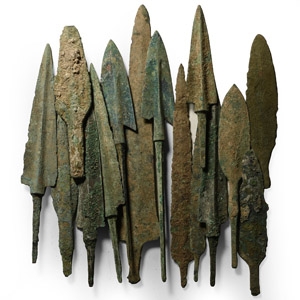
Luristan Bronze Arrowhead Group
13th-6th century B.C.Sold for (Inc. bp): £260
Including leaf-shaped, triangular and other tanged types. 370 grams total, 9.6-19 cm
Acquired 1980-2015. Ex Abelita family collection. This lot is accompanied by an illustrated lot declaration signed by the Head of the Antiquities Department, Dr Raffaele D’Amato. -
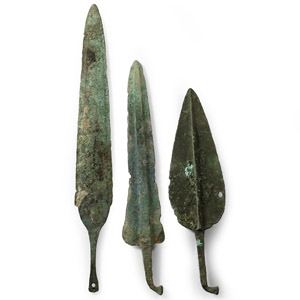
Luristan Bronze Blade Group
14th-10th century B.C.Sold for (Inc. bp): £117
Tanged spearheads with foliate blades, one with accentuated midrib and bent tang, another with squared shoulders and bent tang, the third with slender blade and narrow tang with fastening hole. 342 grams total, 18.7-27 cm
Acquired 1980-2015. Ex Abelita family collection. This lot is accompanied by an illustrated lot declaration signed by the Head of the Antiquities Department, Dr Raffaele D’Amato.
Spearheads with large foliate blades and bent tangs were excavated in the Marlik Royal cemetery by Dr Negahban, see for example in tomb 47, Trench XXIIE. They were the evolution of a typology which began much earlier in Mesopotamia and the fertile crescent, the type 4 of the Stronach classification, with straight tang and square section, usually thickened at the base with a button tang. The foliate blade was wide and exaggerated in some specimens excavated at Marlik. -
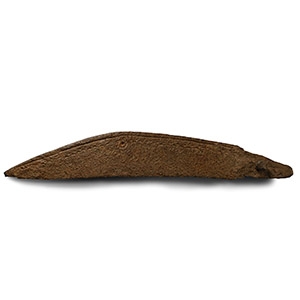
Viking Decorated Iron Broken-Backed Knife 'Seax' Blade
Circa 9th-11th century A.D.Sold for (Inc. bp): £364
With scooped forward edge, straight single edge, punched detailing and rope-work to back; transverse mounting pin. 51 grams, 16.7 cm
Found North-West of York, Yorkshire, UK. Acquired circa 2005. This lot is accompanied by an illustrated lot declaration signed by the Head of the Antiquities Department, Dr Raffaele D’Amato. -
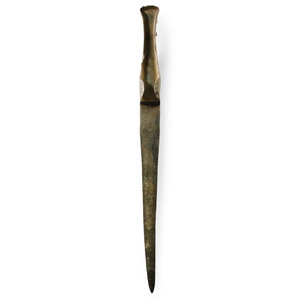
Luristan Bronze Blade
12th century B.C.Sold for (Inc. bp): £260
With lentoid-section blade, tongue-shaped in plan, with integral tapering hilt with flared finial, lateral flanges to accept an organic panel forming the grip. 245 grams, 41 cm
Acquired 1980-2015. Ex Abelita family collection. This lot is accompanied by an illustrated lot declaration signed by the Head of the Antiquities Department, Dr Raffaele D’Amato.
The art of Luristan can be described as the art of nomadic herdsmen and horsemen with an emphasis on the crafting of small, easily portable objects, among these a great number of bronze weapons. The rich and noble aristocrats of the Luristan, Elamites, Hurrians, Lullubians, Kutians, and Kassites, went to battle splendidly equipped and wore magnificent bronze armour, using maces, spears and daggers as offensive weapons, alongside spears, bows and arrows. -
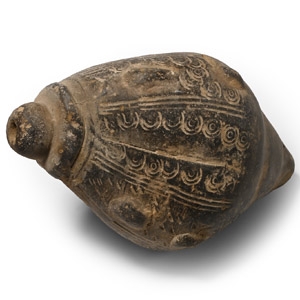
Turco-Mongol 'Greek Fire' Ceramic Fire Bomb or Hand Grenade
13th-15th century A.D.Sold for (Inc. bp): £143
A piriform missile with raised lugs arranged in pairs, impressed lines and concentric circles in between, domed filler hole, intended to be filled with explosive liquid and wick, used as a hand grenade. 590 grams, 15 cm
From an important specialist collection, London, UK, 1990s onwards. This lot is accompanied by an illustrated lot declaration signed by the Head of the Antiquities Department, Dr Raffaele D’Amato. -
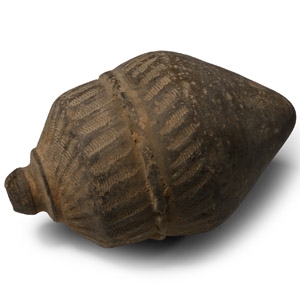
Turco-Mongol 'Greek Fire' Ceramic Fire Bomb or Hand Grenade
14th-15th century A.D.Sold for (Inc. bp): £78
A hollow vessel with cylindrical body, short neck and domed mouth, impressed decorative bands to the upper body; intended to be filled with explosive liquid and a wick, and used as a hand grenade. 750 grams, 15.5 cm
From an important specialist collection, London, UK, 1990s onwards. Accompanied by an academic paper by military specialist Dr Raffaele D'Amato, dated 15 July 2019 and titled 'Eastern Roman Empire - Greek Fire Bomb or Hand Grenade (μεσαίον kακάβιον) 9th-11th century AD'. This lot is accompanied by an illustrated lot declaration signed by the Head of the Antiquities Department, Dr Raffaele D’Amato. -
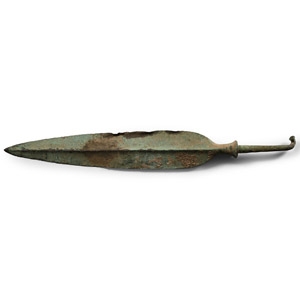
Western Asiatic Bronze Spearhead
2nd millennium B.C.Sold for (Inc. bp): £130
With foliate blade, rhomboidal in section, raised mid-rib, medium length stem widening at its base and forming a small stop, rectangular-section tang with bent terminal. 595 grams, 41.5 cm
Acquired 1980-2015. Ex Abelita family collection. This lot is accompanied by an illustrated lot declaration signed by the Head of the Antiquities Department, Dr Raffaele D’Amato.
The specimen belongs to the category of tripartite spears with long pointed biconvex blade and single bevelled tang. They seem to be a Mesopotamian and Susian (Elamite) variant, and this type also includes decorated blades, like the spear from Tello with the inscription 'King of Kish'. Various specimens have been found in the layers of Tepe Hissar III site. -
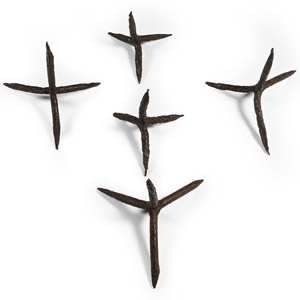
Medieval Iron Anti-Cavalry Caltrop Group
13th-14th century A.D.Sold for (Inc. bp): £91
Each hand-forged with square-section spikes, designed so that however the item falls, one spike is always vertical. 196 grams total, 7.0-10.2 cm
From the private collection of a London gentleman, from his grandfather's collection formed before the early 1970s. This lot is accompanied by an illustrated lot declaration signed by the Head of the Antiquities Department, Dr Raffaele D’Amato.

