-
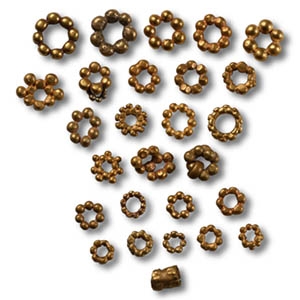
Western Asiatic Mixed Gold Bead Group
1st millennium B.C.Sold for (Inc. bp): £442
Mainly granule clusters in rings. 4.94 grams total, 3-6 mm
Ex property of a late Japanese collector, 1970-2000s. This lot has been cleared against the Art Loss Register database, and is accompanied by an illustrated lot declaration signed by the Head of the Antiquities Department, Dr Raffaele D'Amato. -
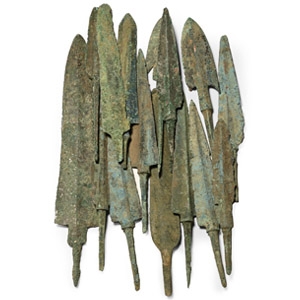
Luristan Bronze Arrowhead Group
13th-6th century B.C.Sold for (Inc. bp): £234
Including barbed, triangular, heater-shaped and other tanged types. 442 grams total, 11.3-19.5 cm
Acquired 1980-2015. Ex Abelita family collection. This lot is accompanied by an illustrated lot declaration signed by the Head of the Antiquities Department, Dr Raffaele D’Amato. -
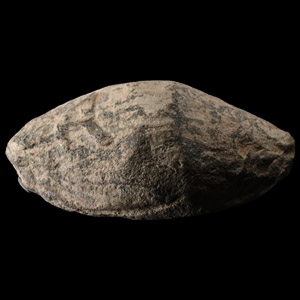
Roman Julius Caesar 'Battle of Munda' Lead Slingshot
45 B.C.Sold for (Inc. bp): £338
A biconical facetted lentoid-section lead sling shot (glans), inscription monogram a combination of letters 'C', 'A' and 'E', for 'C A E S' referring to Julius Caesar. 45.7 grams, 37 mm
Acquired on the UK art market. Property of a gentleman collector. Accompanied by an academic paper by military specialist Dr Raffaele D'Amato, dated 4th May 2022 and titled 'Roman Res Publica - Lead Slingshots (glandes) of Caesarian Age - 45 B.C circa'. This lot is accompanied by an illustrated lot declaration signed by the Head of the Antiquities Department, Dr Raffaele D’Amato.
The shot (type IIb of the Völling classification) is marked with the abbreviated name of Julius Caesar; it was used in quantity at the Battle of Monda (or Munda) against the last fellows of Pompey, the leaders of the Optimates, on the 17th March 45 BC. Similar shots were used in the Caesar's wars; slingers of Caesar's age were part of the light infantry. Caesar speaks of his Balearic slingers during the conquest of Gaul. They wore a short tunic, with leather or rope sandals to the feet, and a warm overcoat which could also have been used to store projectiles. They also used a satchel to carry very deadly lead-like stones or bullets. -
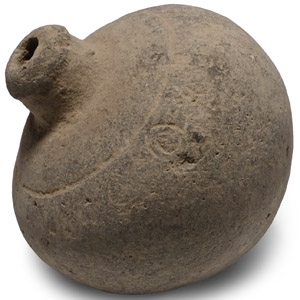
Byzantine 'Greek Fire' Ceramic Fire Bomb or Hand Grenade
9th-11th century A.D.Sold for (Inc. bp): £65
A piriform missile with domed filler-hole, intended to be filled with explosive liquid and wick, used as a hand grenade. 281 grams, 92 mm
From an important specialist collection, London, UK, 1990s onwards. Accompanied by an academic paper by military specialist Dr Raffaele D'Amato, dated 15 July 2019 and titled 'Eastern Roman Empire - Greek Fire Bomb or Hand Grenade (μεσαίον kακάβιον) 9th-11th century AD'. This lot is accompanied by an illustrated lot declaration signed by the Head of the Antiquities Department, Dr Raffaele D’Amato. -
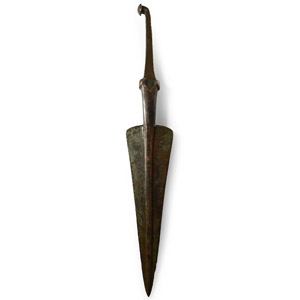
Luristan Bronze Spearhead
12th-11th century B.C.Sold for (Inc. bp): £234
With broad leaf-shaped blade and tapering square-section tang, flanged neck. 285 grams, 33.5 cm
Acquired 1980-2015. Ex Abelita family collection. This lot is accompanied by an illustrated lot declaration signed by the Head of the Antiquities Department, Dr Raffaele D’Amato.
The weapon belongs to type I of the Khorasani classification. Similar weapons have been excavated in Marlilk by Professor Negahban and dated by Stutzinger to the late 13th-early 12th century B.C. -
.jpg)
Mesopotamian Bronze Javelin Head
3rd-2nd millennium B.C.Sold for (Inc. bp): £234
With foliate blade, raised mid-rib, medium length stem widening at its base and forming a small stop, rectangular-section tang with bent terminal. 184 grams, 46.7 cm
Acquired 1980-2015. Ex Abelita family collection. This lot is accompanied by an illustrated lot declaration signed by the Head of the Antiquities Department, Dr Raffaele D’Amato.
The specimen belongs to the category of tripartite spears with long pointed biconvex blade and single bevelled tang. They seem to be a Mesopotamian and Susian (Elamite) variant, and this type also includes decorated blades, like the spear from Tello with the inscription 'King of Kish'. -
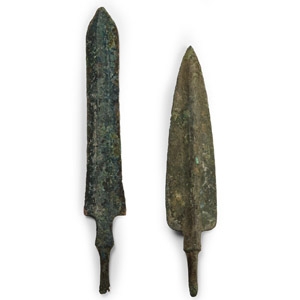
Large Luristan Bronze Arrowhead Group
13th-7th century B.C.Sold for (Inc. bp): £26
Comprising two arrowheads, each with a raised midrib and short tang. 48 grams total, 10.7-12.2 cm
Acquired on the UK art market before 2000. Property of an Essex, UK, gentleman. This lot is accompanied by an illustrated lot declaration signed by the Head of the Antiquities Department, Dr Raffaele D’Amato. -
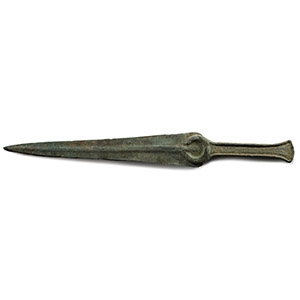
Luristan Bronze Dagger
14th-10th century B.C.Sold for (Inc. bp): £338
A short dagger with slender triangular blade, low round shallow midrib with flat upper face, annular guard and round shoulders, columnar grip with open sides to receive organic hilt, crescent pommel. 154 grams, 34 cm
Acquired 1980-2015. Ex Abelita family collection. This lot is accompanied by an illustrated lot declaration signed by the Head of the Antiquities Department, Dr Raffaele D’Amato.
Moorey, Gordon and Khorasani created a classification of bladed weapons, according to which daggers are edged weapons no greater than 36cm in length, dirks (short swords) are between 36cm and 50cm in length, and swords are edged weapons greater than 50cm in length. -
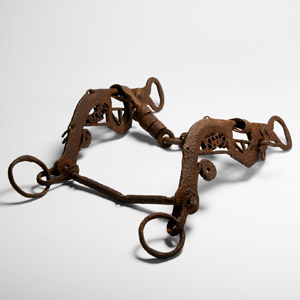
Byzantine Iron Horse Bit
14th-15th century A.D.Sold for (Inc. bp): £117
Composed of arched openwork shanks with looped terminals; one end fitted with large hoops and bar between; one end with a tripartite mouthpiece comprising two collared bars connected by a central hoop; Byzantine or early Ottoman. 340 grams, 19.5 cm
Collection of Dr Hanns-Ulrich Haedeke (1928-2017), author of ‘Schmuck Aus Drei Jahrtausenden’ and who became the director of the Museum of Klingenmuseum in Solingen, Germany, in 1968; the collection was formed in the early 1960s. From an important private Dutch collection. This lot is accompanied by an illustrated lot declaration signed by the Head of the Antiquities Department, Dr Raffaele D’Amato.
This type of horse bit is visible on one of the most important equestrian artworks of the 15th century - the Cappella dei Magi by Benozzo Gozzoli, a painting representing the Three Kings visiting Christ, depicted in costumes belonging to the early quarter of the 15th century. All the cavalrymen in the artwork had heavy curb-bits (with short and curved shanks, as in our specimen) and heavy, single reins. -
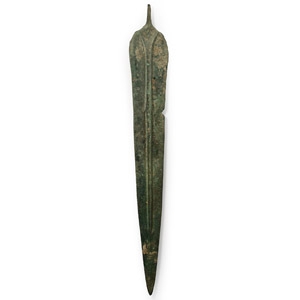
Luristan Bronze Short Sword with Blood Channels
2nd-1st millennium B.C.Sold for (Inc. bp): £390
A two-edged leaf-shaped blade with short rectangular tang, corrugated midrib extending almost to the tip and flared at the shoulder. 342 grams, 48 cm
Acquired 1980-2015. Ex Abelita family collection. This lot is accompanied by an illustrated lot declaration signed by the Head of the Antiquities Department, Dr Raffaele D’Amato.
Luristan was hardly an ethnic or political entity, but the people of Luri had relations through warfare and trade with Sumerians, Lullubi, Assyrians, Babylonians and Elamites in a large time period, spanning from the 3rd to the 2nd millennium B.C. The ruling elites of warrior horsemen were buried in the graves with their weapons and horses. -
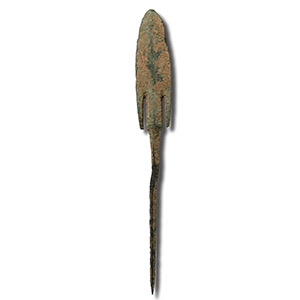
Luristan Barbed Bronze Arrowhead
13th-6th century B.C.Sold for (Inc. bp): £33
Comprising a paddle-shaped blade with long barbs, circular-section socket and a tapering square-section tang. 16.2 grams, 12.9 cm
Acquired 1980-2015. Ex Abelita family collection. This lot is accompanied by an illustrated lot declaration signed by the Head of the Antiquities Department, Dr Raffaele D’Amato. -
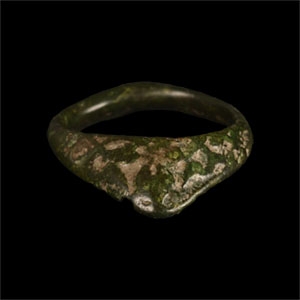
Medieval Bronze Archer's Thumb Ring
14th-15th century A.D.Sold for (Inc. bp): £124
Comprising a D-section hoop with raised boss to the base, triangular extension with incised decoration. 3.62 grams, 29.21 mm overall, 18.83 mm internal diameter (approximate size British P, USA 7 1/2, Europe 16.23, Japan 15)
From an English collection formed before 2000. This lot is accompanied by an illustrated lot declaration signed by the Head of the Antiquities Department, Dr Raffaele D’Amato.

