-
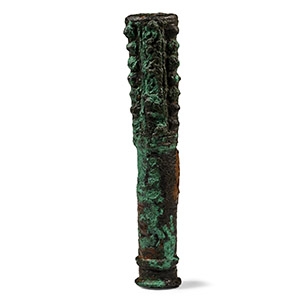
Luristan Mace Head
13th-7th century B.C.Sold for (Inc. bp): £85
Of cylindrical shape, the upper section with alternating rectangular panels and vertical rows of three prominent spikes, short cylindrical shaft edged at top and bottom. 294 grams, 17 cm
Acquired 1980-2015. Ex Abelita family collection. -
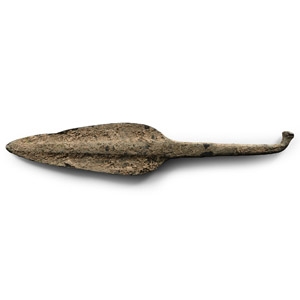
Luristan Bronze Spearhead
Early 1st millennium B.C.Sold for (Inc. bp): £26
With foliate blade and raised mid-rib with the tang bent at the tip. 233 grams, 26.7 cm
Acquired 1980-2015. Ex Abelita family collection.
Similar spearheads were excavated in the Marlik Royal cemetery by Dr Negahban, see for example in tomb 47, Trench XXIIE. They were the evolution of a typology which began much earlier in Mesopotamia and the fertile crescent, the type 4 of the Stronach classification, with straight tang and square section, usually thickened at the base with a button tang. The foliate blade was wide and exaggerated in some specimens excavated at Marlik. -
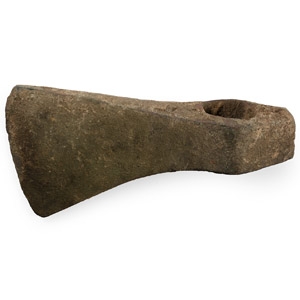
Luristan Heavy Bronze Axehead
13th-7th century B.C.Sold for (Inc. bp): £156
With broad tapering blade and curved edge, wide socket, hammer-face to rear. 1.28 kg, 19.5 cm
Acquired on the UK art market before 2000. Property of an Essex, UK, gentleman. -
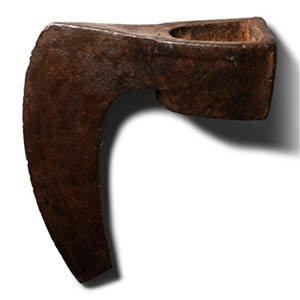
Medieval Iron Bearded Axehead
Circa 14th-16th century A.D. or laterSold for (Inc. bp): £46
With broad curved blade and square chin, narrow neck, deep socket with square-section hammer to the reverse. 899 grams, 15.7 cm
Ex North American collection, 1970s-1990s. -
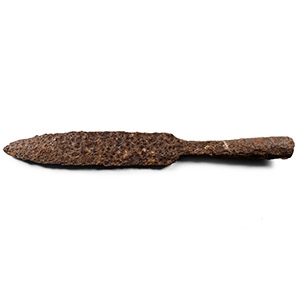
Medieval Iron Spearhead
14th-16th century A.D.Sold for (Inc. bp): £46
Long blade with shallow point and parallel sides, sturdy neck and narrow split socket. 380 grams, 35 cm
From a private Barnsley, UK, family collection. -
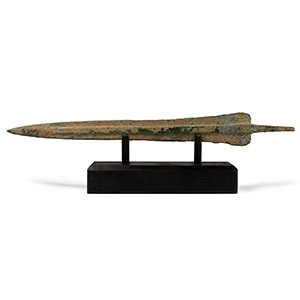
Luristan Bronze Dagger Blade
Circa 1st millennium B.C.Sold for (Inc. bp): £221
Comprising a slender blade with a raised midrib extending towards the short tang, broad rounded shoulders; mounted on a custom-made stand. 420 grams total, blade: 39 cm long
From the private collection of H. Norry, 1980s-1990s.
The Luri people produced a quantity of fine metalwork, which according to Dr. Khorasani, could be due to a settled period which arose as a result of the defeat of the Elamites by the Babylonians, leaving the Luristani people in relative peace for a period of time after 1200 B.C. According to Khorasani 'A culture of innovation and experimentation flourished, and the repertoire of the Luristan smiths expanded in the period between 1150–1050 BC.' -
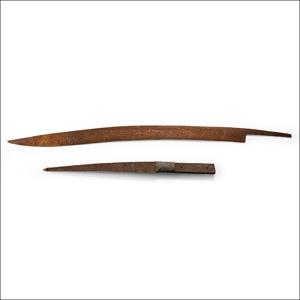
Iron Dagger and Sabre Group
Circa 19th century A.D.Sold for (Inc. bp): £20
Comprising: long, narrow single-edged blade with swept profile and long tip; short, sturdy single-edged blade with applied bronze bolster. 563 grams total, 36-61 cm
From a collection acquired on the UK art market from various auction houses and collections mostly before 2000. From an important Cambridgeshire estate; thence by descent. -
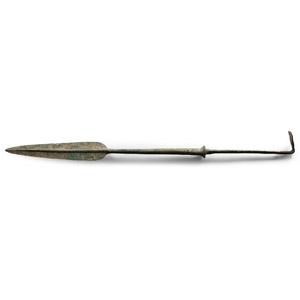
Mesopotamian Bronze Javelin Head
13th-7th century B.C.Sold for (Inc. bp): £124
With foliate blade, rhomboidal in section, raised mid-rib, medium length stem widening at its base and forming a small stop, quadrangular section tang with bent terminal. 191 grams, 45.5 cm
Acquired 1980-2015. Ex Abelita family collection.
The specimen belongs to the category of tripartite spears with long pointed biconvex blade and single bevelled tang. They seem to be a Mesopotamian and Susian (Elamite) variant, and this type also includes decorated blades, like the spear from Tello with the inscription 'King of Kish'. -
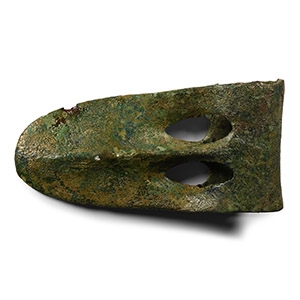
Old Babylonian Bronze Duckbilled Axehead
Early 2nd millennium B.C.Sold for (Inc. bp): £208
With a curved, beak-shaped blade and two pierced eyes flanking a raised median ridge ellipsoid-section socket; repaired. 147 grams, 10.5 cm
From the private collection of Kenneth Machin (1936-2020), Buckinghamshire, UK; with collection no.BA27; his collection of antiquities and natural history was formed since 1948; thence by descent.
This axe corresponds to the type H4B of the Gernez classification. Several of these models, with their moulds, are known from the Levant, like those in Byblos, Ras Shamra, and Tell Arqa. On the other hand, a workshop level II of the Kültepe karum delivered two moulds, showing a local production of arms intended either for export or for the inhabitants originating from Mesopotamia or the Levant. This sub-type of eye-axes is characteristic of the Middle Bronze Age 1 (2050-1750 B.C.). -
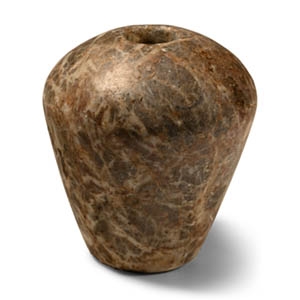
Western Asiatic White Flecked Grey Stone Mace Head
3rd-2nd millennium B.C.Sold for (Inc. bp): £338
Piriform in profile with vertical socket expanding towards the base. 351 grams, 70 mm
Ex London gentleman's collection, 1990s. -
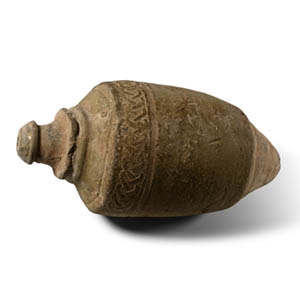
Turco-Mongol 'Greek Fire' Ceramic Fire Bomb or Hand Grenade
14th-15th century A.D.Sold for (Inc. bp): £85
A hollow vessel with cylindrical body, short neck and domed mouth, band of latticework to the shoulder; intended to be filled with explosive liquid and a wick, and used as a hand grenade. 623 grams, 16.5 cm
From a specialist London, UK, arms and armour collection, 1990s.
This was a type of ceramic fire grenade, similar to the ones used by the Eastern Romans but of Turco-Mongol type. Apart from the use of manual flame-throwers, special corps of soldiers employed terracotta grenades, in the form of small jars, abundantly evidenced in archaeological excavations. -
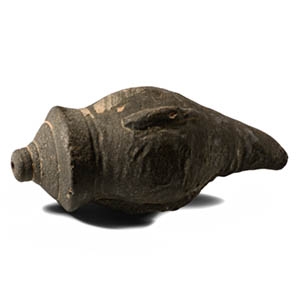
Turco-Mongol 'Greek Fire' Ceramic Fire Bomb or Hand Grenade
13th-15th century A.D.Sold for (Inc. bp): £78
A hollow vessel with cylindrical body, short neck and domed mouth, four raised lugs to the body; intended to be filled with explosive liquid and a wick, and used as a hand grenade. 427 grams, 16.2 cm
From a specialist London, UK, arms and armour collection, 1990s.
This was a type of ceramic fire grenade, similar to the ones used by the Eastern Romans but of Turco-Mongol type. Apart from the use of manual flame-throwers, special corps of soldiers employed terracotta grenades, in the form of small jars, abundantly evidenced in archaeological excavations.

