-
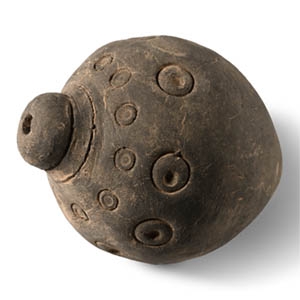
Byzantine 'Greek Fire' Ceramic Fire Bomb or Hand Grenade
9th-11th century A.D.Sold for (Inc. bp): £111
Piriform missile with domed filler-hole, two rows of ring-and-dot decoration to the upper body, intended to be filled with explosive liquid and wick, used as a hand grenade. 422 grams, 11.2 cm
From a specialist London, UK, arms and armour collection, 1990s. Accompanied by an academic paper by military specialist Dr Raffaele D'Amato, dated 15 July 2019 and titled 'Eastern Roman Empire - Greek Fire Bomb or Hand Grenade (μεσαίον kακάβιον) 9th-11th century AD'.
Apart from the use of siphons or manual flame-throwers called cheirosiphona, special corps of Roman soldiers employed terracotta grenades, in the form of small jars, abundantly evidenced in archaeological excavations. They were called μεσαία kακαβιά or κυτροκακάβια where the former had a bulbous shape and the latter a more cylindrical form. -
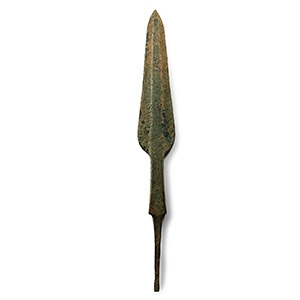
Amlash Type Spearhead
12th-11th century B.C.Sold for (Inc. bp): £65
With heavily ridged and tapered leaf-shaped blade, long slightly flared neck and square section tapered tang. 287 grams, 33.5 cm
From the private collection of H. Norry, 1980s-1990s.
The weapon belongs to the type 1 of the spear-head classification of Khorasani, mainly from Marlik or Amlash areas. Similar pieces have been dated by Stutzinger to 1200-1100 B.C. -
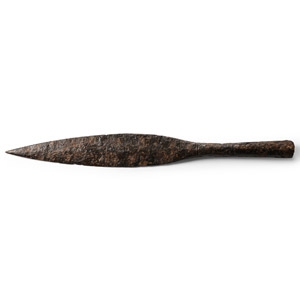
Iron Age Celtic Iron Spearhead
Europe, circa 4th century B.C.Sold for (Inc. bp): £98
With lentoid-section two-edged blade, sturdy neck and short tubular socket; incised gusset detailing to neck. 180 grams, 28.5 cm
Acquired from Coincraft, London, UK. From the private collection of Kenneth Machin (1936-2020), Buckinghamshire, UK; with collection no.IA26; his collection of antiquities and natural history was formed since 1948; thence by descent. -
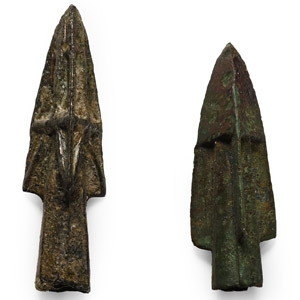
Greek Bronze Arrowhead Group
5th-3rd century B.C.Sold for (Inc. bp): £65
Each a small socketted arrowhead. triangular in section with shallow point; one with ribbing to the barbs. 6.75 grams total, 29-33 mm
UK private collection before 2000. Acquired on the UK art market. Property of a London gentleman. -
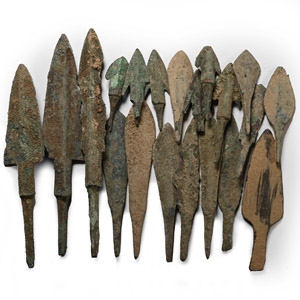
Luristan and Phoenician Bronze Arrowheads
13th-7th century B.C.Sold for (Inc. bp): £260
Mixed group of socketted, tanged and other arrowheads. 202 grams total, 3.3-11.5 cm
Ex London, UK, collection, 1990s. -
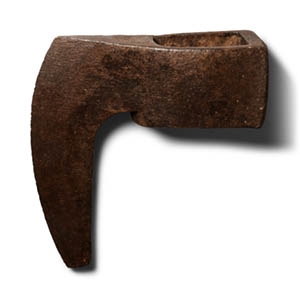
Medieval Iron Bearded Axehead
Circa 14th-16th century A.D. or laterSold for (Inc. bp): £39
With broad curved blade and square chin, broad neck, deep socket with square-section hammer to the reverse. 766 grams, 13.2 cm
Ex North American collection, 1970s-1990s. -
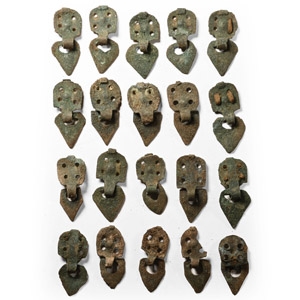
Viking Age Bronze Horse Harness Pendant Set
9th-11th century A.D.Sold for (Inc. bp): £468
Mainly comprising square bronze appliqué panels with four piercings, loop to one edge and ovoid dangle. 57 grams total, 20-41 mm
Acquired on the European art market since the early 2000s. From the private Northern Ireland collection of R.M. -
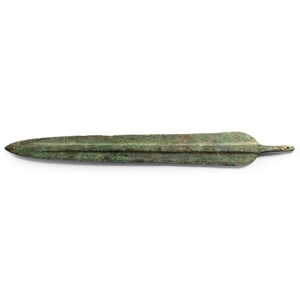
Western Asiatic Bronze Blade
1st millennium B.C.Sold for (Inc. bp): £124
With rounded shoulders and square-sectioned mid-rib running to the blade tip; short tang with fastening hole. 319 grams, 42.5 cm
Acquired 1980-2015. Ex Abelita family collection.
The Luri people produced a quantity of fine metalwork, which according to Dr Khorasani, could be due to a settled period which arose as a result of the defeat of the Elamites by the Babylonians, leaving the Luristani people in relative peace for a period of time after 1200 BC. According to Khorasani 'A culture of innovation and experimentation flourished, and the repertoire of the Luristan smiths expanded in the period between 1150–1050 BC.' -
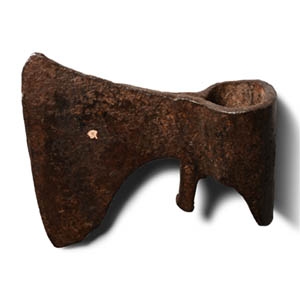
Medieval Iron Broad Axehead
Circa 14th-16th century A.D. or laterSold for (Inc. bp): £59
With D-shaped socket broad edge with chin below and languet. 230 grams, 97 mm
Ex North American collection, 1970s-1990s. -
.jpg)
Luristan Bronze Short Sword
13th-7th century B.C.Sold for (Inc. bp): £221
With lentoid-section blade, tongue-shaped in plan with integral tapering hilt with flared finial, lateral flanges to accept a panel of bone to each face forming the grip, mounting pegs at neck. 279 grams, 35.7 cm
Ex British private collection, Buckinghamshire, UK. From the private collection of Kenneth Machin (1936-2020), Buckinghamshire, UK; with collection no.BA22; his collection of antiquities and natural history was formed since 1948; thence by descent. -
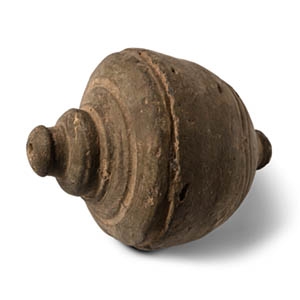
Byzantine 'Greek Fire' Ceramic Fire Bomb or Hand Grenade
9th-11th century A.D.Sold for (Inc. bp): £98
Piriform ceramic missile with domed filler-hole, concentric circle decoration to the body, intended to be filled with explosive liquid and wick, used as a hand grenade. 788 grams, 13.8 cm
From a specialist London, UK, arms and armour collection, 1990s. Accompanied by an academic paper by military specialist Dr Raffaele D'Amato, dated 15 July 2019 and titled 'Eastern Roman Empire - Greek Fire Bomb or Hand Grenade (μεσαίον kακάβιον) 9th-11th century AD'.
Apart from the use of siphons or manual flame-throwers called cheirosiphona, special corps of Roman soldiers employed terracotta grenades, in the form of small jars, abundantly evidenced in archaeological excavations. They were called μεσαία kακαβιά or κυτροκακάβια where the former had a bulbous shape and the latter a more cylindrical form. -
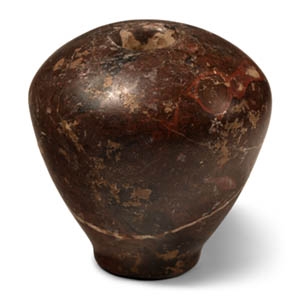
Western Asiatic White-Veined Red Marble Mace Head
3rd-2nd millennium B.C.Sold for (Inc. bp): £182
Onion-shaped in profile with raised rim to the socket. 444 grams, 71 mm
Ex London gentleman's collection, 1990s.

