-
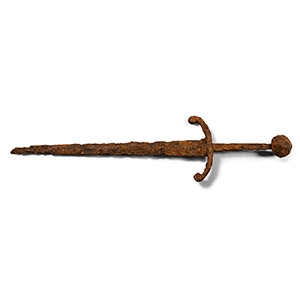
Medieval Iron Dagger Relic
14th-15th century A.D.Sold for (Inc. bp): £403
Comprising a slender lozenge-section blade, drooping quillons, long tang and large spherical pommel. 221 grams, 36.5 cm
Acquired on the UK art market circa 2005. From an old North Country, UK, collection. -
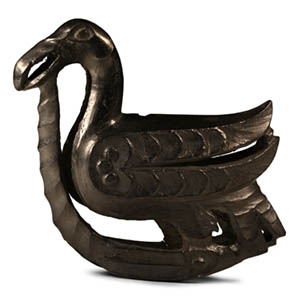
Eurasian Tinned Bronze Sword Chape
12th century A.D.Sold for (Inc. bp): £59
Modelled as an openwork duck perching with wings folded and bill open; integral feather and other detailing; broken. 110 grams total, 84-89 mm
UK gallery, early 2000s. -
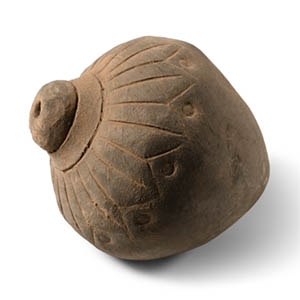
Byzantine 'Greek Fire' Ceramic Fire Bomb or Hand Grenade
9th-11th century A.D.Sold for (Inc. bp): £117
Piriform missile with domed filler-hole, petal-motifs radiating from the filler hole with annulets below, intended to be filled with explosive liquid and wick, used as a hand grenade. 509 grams, 10.7 cm
From a specialist London, UK, arms and armour collection, 1990s. Accompanied by an academic paper by military specialist Dr Raffaele D'Amato, dated 15 July 2019 and titled 'Eastern Roman Empire - Greek Fire Bomb or Hand Grenade (μεσαίον kακάβιον) 9th-11th century AD'.
Apart from the use of siphons or manual flame-throwers called cheirosiphona, special corps of Roman soldiers employed terracotta grenades, in the form of small jars, abundantly evidenced in archaeological excavations. They were called μεσαία kακαβιά or κυτροκακάβια where the former had a bulbous shape and the latter a more cylindrical form. -
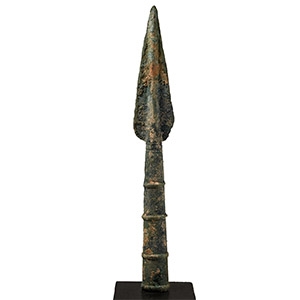
Luristan Bronze Spearhead with Circumferential Rings
9th-6th century B.C.Sold for (Inc. bp): £130
With broad leaf-shaped blade and tapering tubular socket, four graduated horizontal rings securing the split socket. 199 grams total, 26.2 cm including stand
Ex property of a North London, UK, gentleman, 1990s.
The spear belongs to the type VIII classified by Khorasani (spearheads with well-projecting midribs and long folded sockets) and more specifically to subtype C (with leaf-shaped blade and short hollow socket). Usually the willow-leaf blade has an almost straight shoulder base and a wide, flat midrib tapering towards the point. -
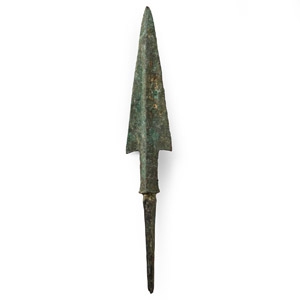
Luristan Bronze Arrowhead
13th-6th century B.C.Sold for (Inc. bp): £33
Lozengiform in section, triangular in profile with slight barbs to lower edge, stepped neck and short tang. 28.5 grams, 13.2 cm
From the private collection of Kenneth Machin (1936-2020), Buckinghamshire, UK; with collection no.BA27; his collection of antiquities and natural history was formed since 1948; thence by descent. -
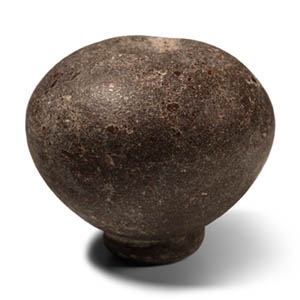
Western Asiatic Grey Stone Mace Head
3rd-2nd millennium B.C.Sold for (Inc. bp): £117
Piriform in profile with vertical socket expanding towards the base, short rounded neck. 410 grams, 72 mm
Ex London gentleman's collection, 1990s. -
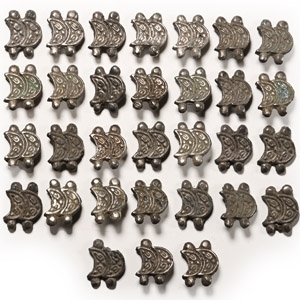
Viking Age High Tinned Bronze Horse Harness Rein Mount Group
Khazar, 9th-10th century A.D.Sold for (Inc. bp): £624
Mainly heater-shaped and crescentic plaque mounts with comma and pellet ornament, lateral lugs, mounting pins to reverse. 66 grams total, 17-18 mm
Acquired on the European art market since the early 2000s. From the private Northern Ireland collection of R.M. -
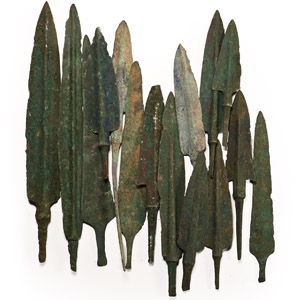
Luristan Bronze Arrow and Blade Group
13th-7th century B.C.Sold for (Inc. bp): £247
Comprising mainly two-edged narrow blades with thick midrib. 431 grams total, 9.5-19.5 cm
Ex London, UK, collection, 1990s. -
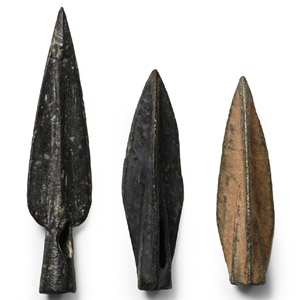
Greek Bronze Arrowhead Group
5th-3rd century B.C.Sold for (Inc. bp): £104
Two triangular in section with broad flange edges, the third slender and leaf-shaped; each with a tapering socket. 9.02 grams total, 32-44 mm
From the collection of a London antiquarian, formed since the 1980s. -
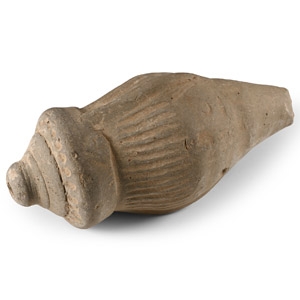
Turco-Mongol 'Greek Fire' Ceramic Fire Bomb or Hand Grenade
14th-15th century A.D.Sold for (Inc. bp): £85
Cylindrical in form with tapering foot, three radiating vertical flanges to the body with ribbing between, carinated shoulder with impressed points, domed mouth. 587 grams, 17 cm
From a specialist collection of militaria, London, UK, collected 1990s onwards. Accompanied by an academic paper by military specialist Dr Raffaele D'Amato, dated 15 July 2019 and titled 'Eastern Roman Empire - Greek Fire Bomb or Hand Grenade (μεσαίον kακάβιον) 9th-11th century AD'.
Apart from the use of siphons or manual flame-throwers called cheirosiphona, special corps of Roman soldiers employed terracotta grenades, in the form of small jars, abundantly evidenced in archaeological excavations. They were called μεσαία kακαβιά or κυτροκακάβια where the former had a bulbous shape and the latter a more cylindrical form. -
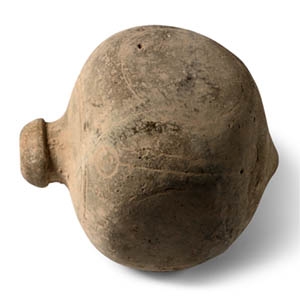
Byzantine 'Greek Fire' Ceramic Fire Bomb or Hand Grenade
9th-11th century A.D.Sold for (Inc. bp): £52
The missile with a rounded body flattened on four sides, the flat faces separated by two vertical lines with an annulet above and below, concentric circles surrounding the pointed base, domed filler-hole, intended to be filled with explosive liquid and wick, used as a hand grenade. 660 grams, 11.8 cm
From a specialist London, UK, arms and armour collection, 1990s. Accompanied by an academic paper by military specialist Dr Raffaele D'Amato, dated 15 July 2019 and titled 'Eastern Roman Empire - Greek Fire Bomb or Hand Grenade (μεσαίον kακάβιον) 9th-11th century AD'.
Apart from the use of siphons or manual flame-throwers called cheirosiphona, special corps of Roman soldiers employed terracotta grenades, in the form of small jars, abundantly evidenced in archaeological excavations. They were called μεσαία kακαβιά or κυτροκακάβια where the former had a bulbous shape and the latter a more cylindrical form. -
.jpg)
Luristan Bronze Dagger
13th-7th century B.C.Sold for (Inc. bp): £442
With ogival blade featuring a square sectioned mid-rib, tubular handle with two horizontal grooves of circular shape and disc pommel. 338 grams, 31.5 cm
Acquired 1980-2015. Ex Abelita family collection.
The dagger represents an uncommon type with its disk pommel and short grip but with a foliate blade of a spearhead. Similar types were already visible in the Mesopotamian reliefs of early 19th century, but pommel disc daggers and foliate blades are a combination that was archaeologically documented on Caucasian daggers until the 9th century B.C., employed by the Urartian warriors.

