-
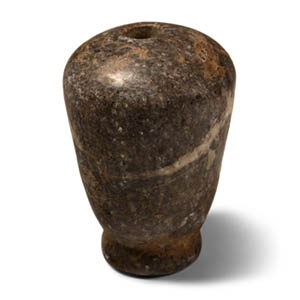
Western Asiatic White Veined Grey Stone Mace Head
3rd-2nd millennium B.C.Sold for (Inc. bp): £117
Barrel-shaped in profile with vertical socket expanding towards the base, rounded neck. 356 grams, 83 mm
Ex London gentleman's collection, 1990s. -
.jpg)
Smith and Wesson Old Model No 2 Revolver
1861-1874 A.D.Sold for (Inc. bp): £520
Also known as 'Model No 2 Army' with hinged frame, six shot .32 calibre rimfire cylinder with 'PATENTED APRIL 3 1855 JULY 5 1859 & DEC 18 1860' and 15cm (6") octagonal barrel marked 'SMITH & WESSON SPRINGFIELD MASS' to top with fixed extractor pin and spur trigger; serial number 47946 to butt strap with plain wood grip scales; action working. 690 grams, 27 cm
Acquired from Bolk Antique Arms, Netherlands, 2016. Ex Kusmirek Collection, UK. Accompanied by an original Bolk invoice (1,075.00 Euros).
Sold as an exempt item under Section 58 (2) of the Firearms Act, 1968, to be held as a curiosity or ornament. No license required but buyer must be over 18 years of age. Overseas bidders should note that, due to UK regulations governing export of all firearms, overseas buyers will need to make arrangements for shipping this lot out of the UK directly, by air freight, with a specialist company or agent. -
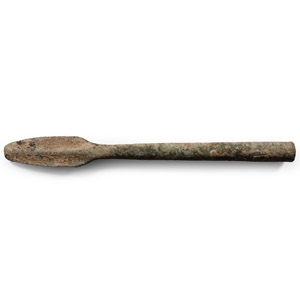
Luristan Bronze Spearhead
Circa 1000 B.C.Sold for (Inc. bp): £26
With short foliate blade, shallow midrib and long socketted shaft with fastening holes. 112 grams, 22.8 cm
Acquired 1980-2015. Ex Abelita family collection. -
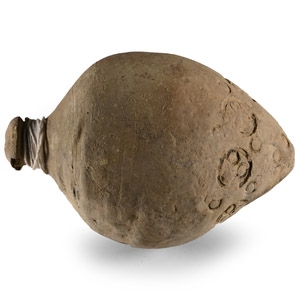
Byzantine 'Greek Fire' Ceramic Fire Bomb or Hand Grenade
9th-11th century A.D.Sold for (Inc. bp): £59
Piriform in profile with domed neck, impressed roundels to the foot. 755 grams, 15.5 cm
From a specialist collection of militaria, London, UK, collected 1990s onwards. Accompanied by an academic paper by military specialist Dr Raffaele D'Amato, dated 15 July 2019 and titled 'Eastern Roman Empire - Greek Fire Bomb or Hand Grenade (μεσαίον kακάβιον) 9th-11th century AD'.
Apart from the use of siphons or manual flame-throwers called cheirosiphona, special corps of Roman soldiers employed terracotta grenades, in the form of small jars, abundantly evidenced in archaeological excavations. They were called μεσαία kακαβιά or κυτροκακάβια where the former had a bulbous shape and the latter a more cylindrical form. -
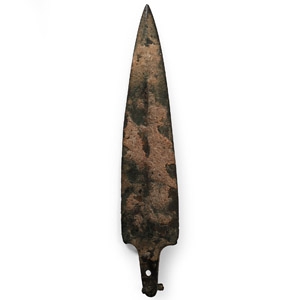
Luristan Bronze Rivetted Dagger
13th-7th century B.C.Sold for (Inc. bp): £46
Leaf-shaped blade with slight midrib, slightly recurved shoulders, stub tang pierced to accept attachment rivets, two in situ. 68 grams, 16.6 cm
Acquired in Oxford, UK. From the private collection of Kenneth Machin (1936-2020), Buckinghamshire, UK; with collection no.BA20; his collection of antiquities and natural history was formed since 1948; thence by descent. -
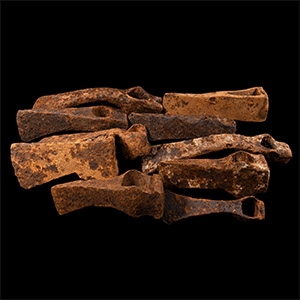
Viking Age and Later Axehead Group
Circa 10th-18th century A.D.Sold for (Inc. bp): £52
Comprising socketted axeheads of various types; some possibly stamped with maker's marks. 7 kg total, 16-24.5 cm
Acquired 1990s-early 2000s. East Anglian private collection.
An axe similar to those of our group was found in the fortified camp of Péran, in Brittany, among the objects that emerged from a conflagration due to the attack of Alain Barbetorte's Bretons on a Viking camp, in 936 A.D. These axes were certainly work tools, although in case of necessity they could also serve as improvised weapons -
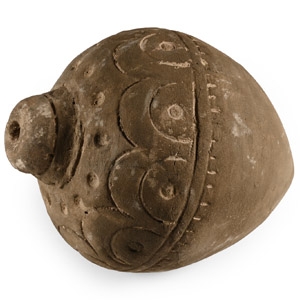
Byzantine 'Greek Fire' Ceramic Fire Bomb or Hand Grenade
9th-11th century A.D.Sold for (Inc. bp): £124
Piriform in profile with domed mouth, circumferential band of impressed arcading to the shoulder. 380 grams, 11.5 cm
From a specialist collection of militaria, London, UK, collected 1990s onwards. Accompanied by an academic paper by military specialist Dr Raffaele D'Amato, dated 15 July 2019 and titled 'Eastern Roman Empire - Greek Fire Bomb or Hand Grenade (μεσαίον kακάβιον) 9th-11th century AD'.
Apart from the use of siphons or manual flame-throwers called cheirosiphona, special corps of Roman soldiers employed terracotta grenades, in the form of small jars, abundantly evidenced in archaeological excavations. They were called μεσαία kακαβιά or κυτροκακάβια where the former had a bulbous shape and the latter a more cylindrical form. -
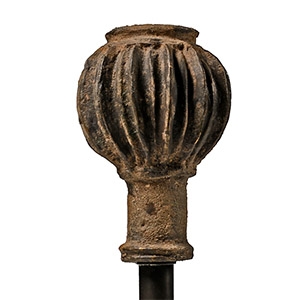
Luristan Bronze Ribbed Macehead
13th-7th century B.C.Sold for (Inc. bp): £260
Of Sara Gorz type with cylindrical shaft extended over the top, rounded knobs around the swollen head, flanked by horizontal grooved bands; mounted on a custom-made stand. 367 grams, 83 mm (633 grams total, 19 cm high including stand)
English private collection. with ArtAncient Ltd, 2013. Private collection, London. -
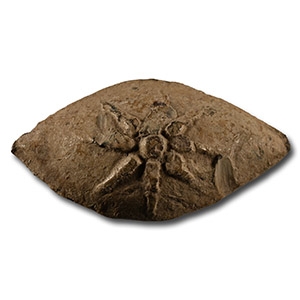
Greek Macedonian Lead Sling Shot
4th-3rd century B.C.Sold for (Inc. bp): £143
Scaphoid in plan and lentoid in section with reserved starburst motif to one face. 18.7 grams, 34 mm
Acquired in the 1980s. From the collection of a London antiquarian. -
.jpg)
Western Asiatic Iron Axehead
Circa 14th-16th century A.D.Sold for (Inc. bp): £33
With swept blade and triangular socket with extension to the rear; accompanied by a custom-made display stand. 659 grams total including stand, axehead: 24.5 cm
Acquired 1980-2015. Ex Abelita family collection. -
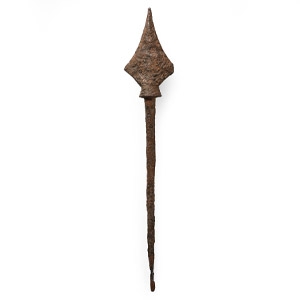
Norman Period Iron Arrowhead
11th-12th century A.D.Sold for (Inc. bp): £72
Tapering tang with collar and scooped edges to the blade. 8.5 grams, 10.4 cm
UK private collection before 2000. Acquired on the UK art market. Property of a London gentleman. -
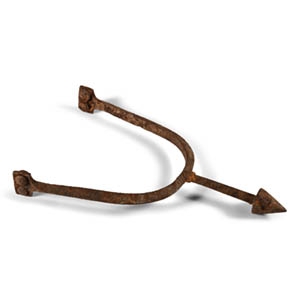
Post Medieval Iron Prick Spur
20th century A.D. or earlierSold for (Inc. bp): £39
With rectangular finials, D-section frame and conical prick. 67 grams, 15.5 cm
From a private Barnsley, UK, family collection.

