-
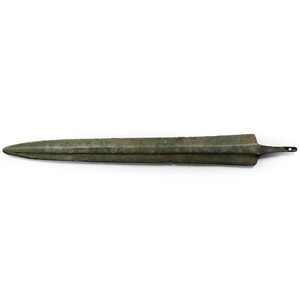
Western Asiatic Bronze Blade
1st millennium B.C.Sold for (Inc. bp): £117
With rounded shoulders and square-sectioned mid-rib running to the blade tip; short tang with fastening hole. 255 grams, 38 cm
Acquired 1980-2015. Ex Abelita family collection.
The Luri people produced a quantity of fine metalwork, which according to Dr. Khorasani, could be due to a settled period which arose as a result of the defeat of the Elamites by the Babylonians, leaving the Luristani people in relative peace for a period of time after 1200 BC. According to Khorasani 'A culture of innovation and experimentation flourished, and the repertoire of the Luristan smiths expanded in the period between 1150–1050 BC.' -
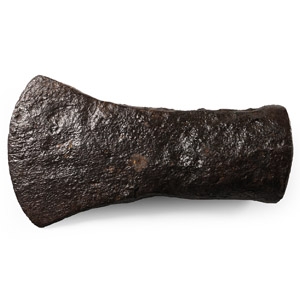
Iron Age Celtic Iron Axehead
Britain, circa 4th century B.C.Sold for (Inc. bp): £286
With lateral flanges curved inwards to form an open socket, long neck, broad flared blade. 278 grams, 11.5 cm
Found South East England. From the private collection of Kenneth Acquired Coincraft, London, UK. Machin (1936-2020), Buckinghamshire, UK; with collection no.IA25; his collection of antiquities and natural history was formed since 1948; thence by descent. -
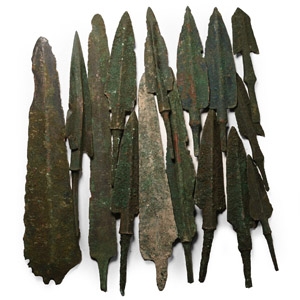
Luristan Bronze Arrows and Blades Group
13th-7th century B.C.Sold for (Inc. bp): £221
Comprising mainly narrow two-edged blades, barbed-and-tanged arrowheads and other types. 503 grams total, 9-20.7 cm
Ex London, UK, collection, 1990s. -
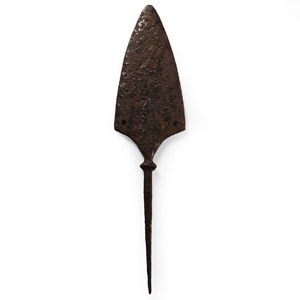
Medieval Pierced Incendiary Fire Arrowhead
Circa 12th-14th century A.D.Sold for (Inc. bp): £59
With heater-shaped profile and holes to the trailing edge, baluster to the neck, square-section tang. 100 grams, 21.5 cm
Private Buckingham, UK, collection, formed before 2000. -
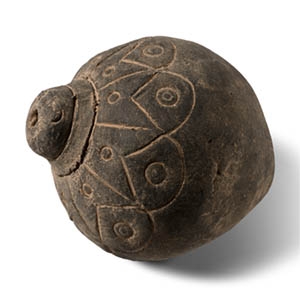
Byzantine 'Greek Fire' Ceramic Fire Bomb or Hand Grenade
9th-11th century A.D.Sold for (Inc. bp): £208
Piriform missile with domed filler-hole, tongue-shaped petals radiating from the filler-hole, each with an annulet and a ring-and-dot motif, intended to be filled with explosive liquid and wick, used as a hand grenade. 448 grams, 10.7 cm
From a specialist London, UK, arms and armour collection, 1990s. Accompanied by an academic paper by military specialist Dr Raffaele D'Amato, dated 15 July 2019 and titled 'Eastern Roman Empire - Greek Fire Bomb or Hand Grenade (μεσαίον kακάβιον) 9th-11th century AD'.
Apart from the use of siphons or manual flame-throwers called cheirosiphona, special corps of Roman soldiers employed terracotta grenades, in the form of small jars, abundantly evidenced in archaeological excavations. They were called μεσαία kακαβιά or κυτροκακάβια where the former had a bulbous shape and the latter a more cylindrical form. -
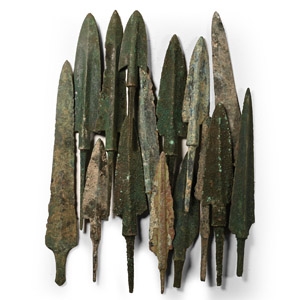
Luristan Bronze Arrows and Blades Group
13th-7th century B.C.Sold for (Inc. bp): £416
Including barbed, leaf-shaped, ribbed and other types. 422 grams total, 10.3-16.9 cm
Ex London, UK, collection, 1990s. -
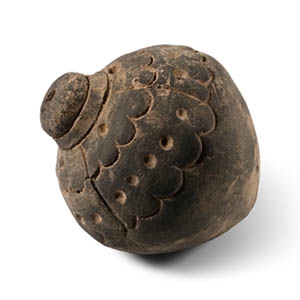
Byzantine 'Greek Fire' Ceramic Fire Bomb or Hand Grenade
9th-11th century A.D.Sold for (Inc. bp): £124
Piriform missile with domed filler-hole, petalled decoration to the upper body with pellets, intended to be filled with explosive liquid and wick, used as a hand grenade. 431 grams, 10.7 cm
From a specialist London, UK, arms and armour collection, 1990s. Accompanied by an academic paper by military specialist Dr Raffaele D'Amato, dated 15 July 2019 and titled 'Eastern Roman Empire - Greek Fire Bomb or Hand Grenade (μεσαίον kακάβιον) 9th-11th century AD'.
Apart from the use of siphons or manual flame-throwers called cheirosiphona, special corps of Roman soldiers employed terracotta grenades, in the form of small jars, abundantly evidenced in archaeological excavations. They were called μεσαία kακαβιά or κυτροκακάβια where the former had a bulbous shape and the latter a more cylindrical form. -
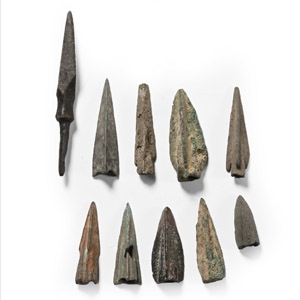
Greek Bronze Arrowhead Collection
Circa 5th-3rd century B.C.Sold for (Inc. bp): £52
Mainly socketted and triangular in section. 23 grams total, 15-49 mm
From a private Barnsley, UK, family collection. -
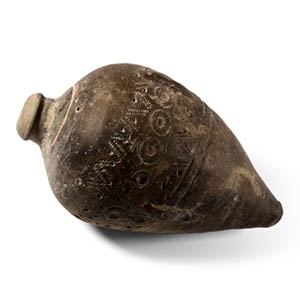
Large Byzantine 'Greek Fire' Ceramic Fire Bomb or Hand Grenade
9th-11th century A.D.Sold for (Inc. bp): £208
Piriform missile with domed filler-hole, three raised lugs to the body and a circumferential decorative band composed of chevrons and ring-and-dot motifs; intended to be filled with explosive liquid and wick, used as a hand grenade. 1.2 kg, 20.2 cm
From a specialist London, UK, arms and armour collection, 1990s. Accompanied by an academic paper by military specialist Dr Raffaele D'Amato, dated 15 July 2019 and titled 'Eastern Roman Empire - Greek Fire Bomb or Hand Grenade (μεσαίον kακάβιον) 9th-11th century AD'.
Apart from the use of siphons or manual flame-throwers called cheirosiphona, special corps of Roman soldiers employed terracotta grenades, in the form of small jars, abundantly evidenced in archaeological excavations. They were called μεσαία kακαβιά or κυτροκακάβια where the former had a bulbous shape and the latter a more cylindrical form. -
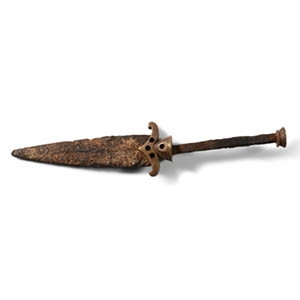
Medieval Iron Dagger with Bronze Fittings
14th-16th century A.D.Sold for (Inc. bp): £117
With triangular iron blade and tang, bronze quillons with cupped bolster and gusseted pommel. 34 grams, 14.5 cm
From a private Barnsley, UK, family collection. -

Medieval Iron Broad Axehead
Circa 14th-16th century A.D. or laterSold for (Inc. bp): £52
With short neck and broad curved blade. 286 grams, 12.3 cm
Ex North American collection, 1970s-1990s. -
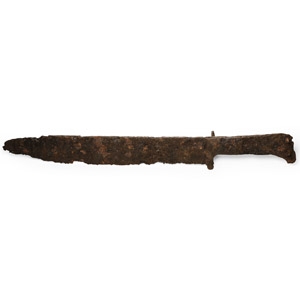
Medieval Iron Dagger
15th-16th century A.D.Sold for (Inc. bp): £65
Comprising a single-edge blade with swept point, thick bolster with lateral spur, rivets for lateral organic scales. 244 grams, 33.5 cm
Acquired on the UK art market before 2000. Property of an Essex, UK, gentleman.

