-
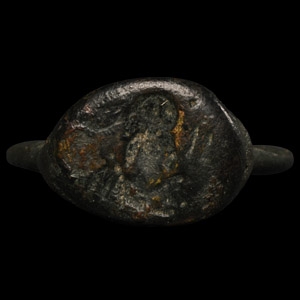
Parthian Ring with Bust of a King
2nd-3rd century A.D.Sold for (Inc. bp): £33
Ellipsoid bezel with incuse bearded bust. 2.75 grams, 21.11 mm overall, 14.03 mm internal diameter (approximate size British F 1/2, USA 3, Europe 4.3, Japan 4)
Acquired 1980-2015. Ex Abelita family collection. -
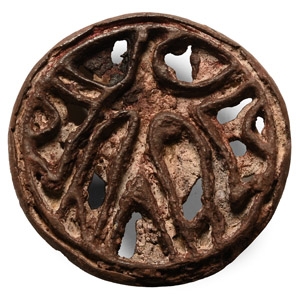
West Central Asian Bronze Stamp Seal with Human Figure
23rd-19th century B.C.Sold for (Inc. bp): £257
Openwork discoid seal with anthropomorphic motif; accompanied by an old scholarly note, typed and signed by W.G. Lambert, late Professor of Assyriology, University of Birmingham, 1970-1993, which states: 'Stamp Seal of Bronze. 57x59x17 mm. This is round, with flat compartmented and open-work face. The back has a stout suspension loop. The design on the face is of a standing creature -- human with bird's head -- and filling shapes. This comes from West Central Asia and dates to c. 2300-1900 B.C. It is a rare design and the seal is in fair condition: some of the edge of the plain outer band is lost.' 53 grams, 58 mm
Ex Signo collection, the property of a West London businessman, formed in the late 1980s-early 1990s; collection number Y-905, academically researched and catalogued by the late Professor Lambert in the early 1990s. -
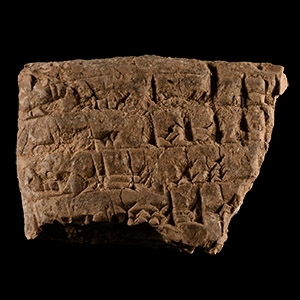
Mesopotamian Cuneiform Tablet Fragment
2nd millennium B.C.Sold for (Inc. bp): £260
Pillow-shaped fragment with cuneiform text to both broad faces and one short edge. 48.7 grams, 58 mm
From specialised collection of cuneiform texts, formed in the 1950s-1990s. The property of a London gentleman and housed in London, thence by descent to family members. Examined by Professor Wilfrid George Lambert FBA (1926-2011), historian, archaeologist, and specialist in Assyriology and Near Eastern archaeology, in the late 1980s and 1990s. The collection is exceptional for the variety of types, including some very rare and well preserved examples. -
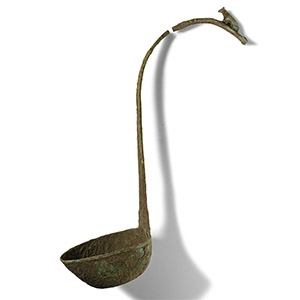
Western Asiatic Bronze Ladle
1st millennium B.C. or laterSold for (Inc. bp): £52
Comprising a deep D-shaped bowl. slender handle with ribbed detailing, curved finial with transverse segmentation and standing bovine figure finial detached. 289 grams total, 9.5-32 cm
UK gallery, early 2000s. -
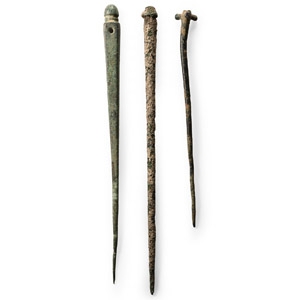
Luristan Bronze Dress Pin Group
13th-7th century B.C.Sold for (Inc. bp): £46
Comprising: one square in section with domed knop finial; one similar, cylindrical in section; one a tapering cylinder with three radiating lugs. 149 grams total, 16-21 cm
Acquired on the UK art market before 2000. Property of an Essex, UK, gentleman. -
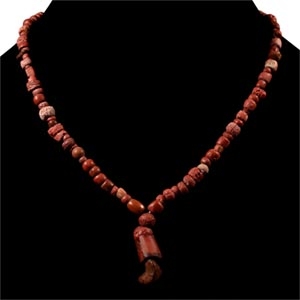
Western Asiatic Glass Bead Necklace String
1st millennium B.C. and laterSold for (Inc. bp): £39
Composed of mainly annular and oblate beads, central feature comprising a cylindrical and an irregular bead, restrung. 20 grams, 34.5 cm
Ex property of a late Japanese collector, 1970-2000s. -
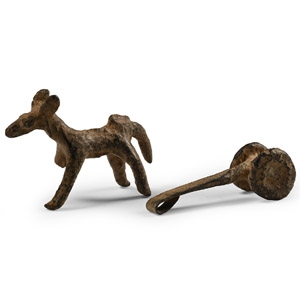
Luristan Bronze Horse and Chariot
13th-7th century B.C.Sold for (Inc. bp): £104
Amuletic figure of a standing beast with raised tag to the rump; separate chariot with lateral disc wheels and yoke with recurved end. 20.7 grams total, 38-41 mm
Ex London collection of a deceased collector, 1990s. -
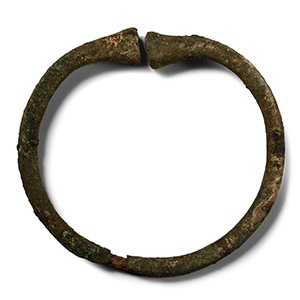
Western Asiatic Bronze Bracelet
Late Bronze Age, 1st millennium B.C.Sold for (Inc. bp): £13
Round-section shank with opposed trumpet-shaped finials. 37 grams, 72 mm
Acquired 1980-2015. Ex Abelita family collection. -
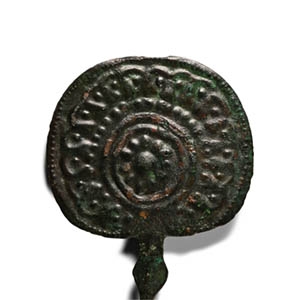
Luristan Decorated Pinhead
13th-6th century B.C.Sold for (Inc. bp): £117
38 grams, 26.7 cm
From the private collection of Mr K.A., acquired in the 1990s-early 2000s. -
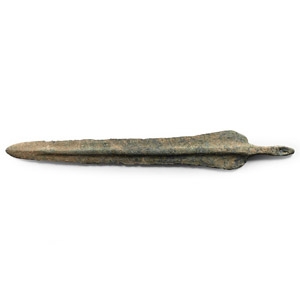
Western Asiatic Bronze Sword Blade
Circa 1000 B.C.Sold for (Inc. bp): £117
With rounded shoulders and square-sectioned mid-rib running to the blade tip; short tang with fastening hole. 254 grams, 34 cm
Acquired 1980-2015. Ex Abelita family collection.
The Luri people produced a quantity of fine metalwork, which according to Dr Khorasani, could be due to a settled period which arose as a result of the defeat of the Elamites by the Babylonians, leaving the Luristani people in relative peace for a period of time after 1200 BC. According to Khorasani 'A culture of innovation and experimentation flourished, and the repertoire of the Luristan smiths expanded in the period between 1150–1050 BC.' -
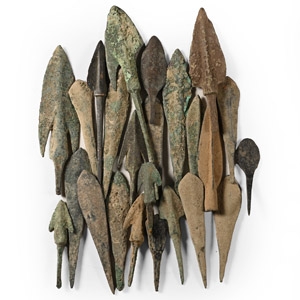
Luristan and Phoenician Bronze Arrowhead Group
13th-7th century B.C.Sold for (Inc. bp): £468
Including socketted, tanged and other types. 220 grams total, 4.3-11 mm
Ex London, UK, collection, 1990s. -
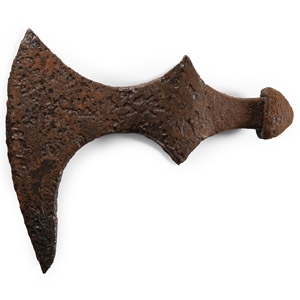
Viking Age Iron Bearded Axe-Hammer
Circa 9th-11th century A.D.Sold for (Inc. bp): £338
With a curved blade and swept chin, narrow neck, flanged socket and hammer extension to the rear with domed head. 310 grams, 15 cm
Ex North American collection, 1970s-1990s.

