-
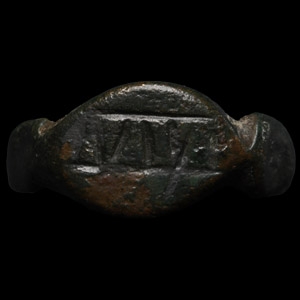
Roman Bronze Ring with 'may he live' Inscription
2nd-3rd century A.D.Sold for (Inc. bp): £52
With scrolled shoulders, ellipsoid bezel, low-relief inscription 'VIVA[T]' (may he live). 2.73 grams, 19.43 mm overall, 15.22 mm internal diameter (approximate size British I 1/2, USA 4 1/2, Europe 8.07, Japan 7)
UK private collection before 2000. Acquired on the UK art market. Property of a London gentleman. -
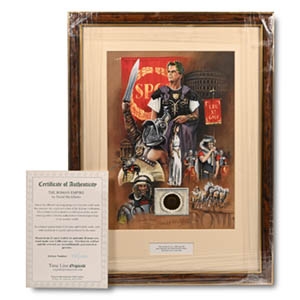
Bronze Roman Coin and Framed Limited Edition Print
3rd century A.D. and laterSold for (Inc. bp): £33
The coin of Constantine the Great (272-337 A.D.) mounted on 22 carat gold foil, framed with an art print signed by the artist David McAllister, depicting scenes of Roman military activity; limited edition number 192/1150. 1.26 kg, 49.5 x 37.5 cm
UK gallery, early 2000s. Accompanied by a previous certificate of authenticity.
David McAllister's exciting design is a 'one of a kind' work that portrays the might and riches of the Roman civilisation. This limited edition print is a celebration of the award winning artist's lifetime dedication to historical paintings of the ancient world. To enhance appreciation of this rare and historic work, each individual print is signed and numbered by the artist. -
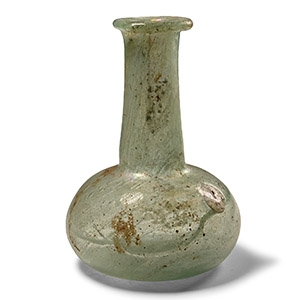
Roman Glass Bottle with Elongated Neck
1st-2nd century A.D.Sold for (Inc. bp): £124
Toilet bottle with dimple base, flared neck and carination below the mouth, rounded rim. 95 grams, 12.1 cm
From a family collection mostly formed in the 1940s-1950s, thence by descent. -
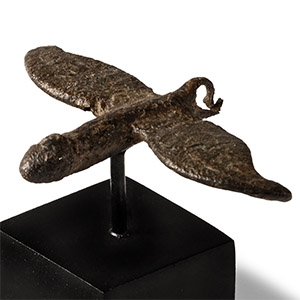
Roman Bronze Flying Phallus Pendent
1st-2nd century A.D.Sold for (Inc. bp): £208
Model phallus with spread wings and suspension loop at the tail; mounted on a custom-made stand. 25.2 grams total, 35 mm including stand
From a collection acquired on the UK art market from various auction houses and collections mostly before 2000. From an important Cambridgeshire estate; thence by descent. -
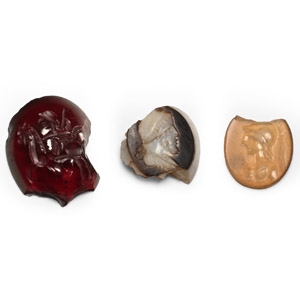
Roman Gemstone Group
1st-2nd century A.D.Sold for (Inc. bp): £234
Comprising: ellipsoid type with profile bust; plano-convex type with horseman; flat ellipsoid with bust of Minerva; chipped. 2.8 grams total, 10-16 mm
From the private collection of Mr K.A., acquired in the 1990s-early 2000s. -
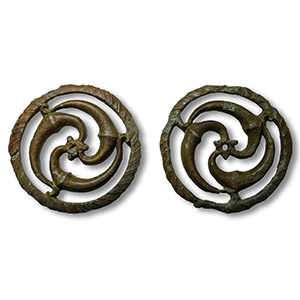
Large Roman Harness Mount Bronze Trumpet Whorl Mount Pair
2nd-3rd century A.D.Sold for (Inc. bp): £104
Each a D-section disc with central triskele and coiled arms, segmented detailing to the outer face. 340 grams total, 10-10.2 cm
From a collection acquired on the UK art market from various auction houses and collections mostly before 2000. From an important Cambridgeshire estate; thence by descent.
The two mounts are elements of horse harness decorating the antilena and postilena of the horse, as intersection fittings of the main straps. According to Alfoldi, these horse harnesses were the product of a metallurgy that was the fruit of a Gallo-Roman revival, and not exclusively of military nature. The military adopted similar elements fruit of the revival of this Celtic-Roman decorative art, since such harnesses have also been discovered in border fortresses. But the large industrial centers, which worked for export, manufactured objects primarily for the Danubian regions where both the soldiers and the civilian population, without distinction of class, used them as habitual objects. -
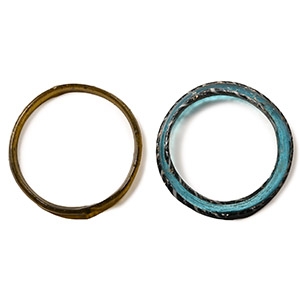
Roman Glass Bangle Group
2nd-4th century A.D.Sold for (Inc. bp): £143
Comprising: triangular-section blue glass bangle with applied twisted bichrome trails; olive-green D-section bangle. 59 grams total, 89-90 mm
From a family collection mostly formed in the 1940s-1950s, thence by descent. -
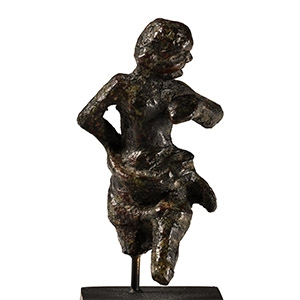
Roman Bronze Dancing Woman Statuette
Circa 2nd century A.D.Sold for (Inc. bp): £72
Modelled in dynamic pose with her peplos slipping loose from her shoulders and held at her waist by her right hand; head turned and left hand held at the breast; possibly a Maenad; mounted on a custom-made stand. 40.3 grams total, 63 mm including stand
From a collection acquired on the UK art market from various auction houses and collections mostly before 2000. From an important Cambridgeshire estate; thence by descent.
Maenads were followers of Dionysus whose rites were characterised by vigorous dancing to loud music and crashing cymbals, in which the revellers whirled and became drunk, and incited each another to greater abandon. -
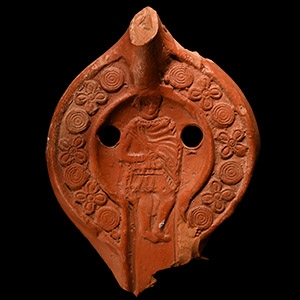
Late Roman Redware Lamp Face with Military Officer
Late 5th-early 6th century A.DSold for (Inc. bp): £156
Comprising the upper part of an oil lamp with part of the handle in situ; band of concentric circles and floral motifs to the shoulder; discus with low-relief figure seated with flexed knees, wearing a thigh-length tunic and cingulum military belt over bracae, and a short sagum clasped at the right shoulder; with short hair and beard; right arm folded across the body holding the hem of the sagum; modern suspension ring to reverse. 101 grams, 11.4 cm
Acquired 1960s-1990s. From the late Alison Barker collection, a retired London barrister.
The lamp belongs to the type Atlante X or Hayes II A. The so-called Christian lamps in Terra Sigillata Africana have been classified by Hayes into two major types, I and II. He has distinguished two classes in his type II, according to geographic place of manufacture or origin. Subtype II A group lamps from central Tunisia are characterised by the use of fine clay, glossy light orange slip, and carefully executed decoration using a great number of neatly drawn shoulder motifs. The image of this military officer is unusual, and it can represent an imperial primikerios of the African army after the reconquest of Belisarius in 533 A.D. -
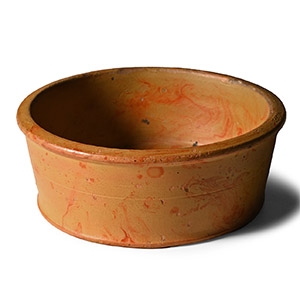
Early Roman Marbled Pottery Dish
1st century B.C.-1st century A.D.Sold for (Inc. bp): £780
With raised rim to base and fared sidewall, carination to the rim. 79 grams, 82 mm
Ex West Country specialist collection of Roman pottery, UK, 1990s. -
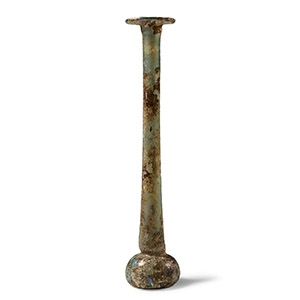
Roman Glass Vessel
1st-2nd century A.D.Sold for (Inc. bp): £130
With piriform body and flat base, tall neck and everted rim. 24.6 grams, 17 cm
From a London, UK, collection, 1990s. -
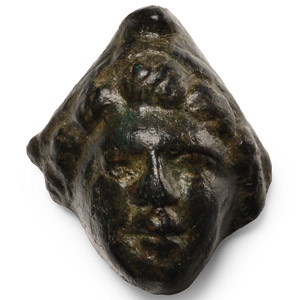
Roman Bronze Attis Head Mount
1st-2nd century A.D.Sold for (Inc. bp): £52
Depicted with a clean shaven face, short curls showing from underneath the peaked cap; hollow reverse. 7.3 grams, 22 mm
Ex German art market, 2000s. Acquired from an EU collector living in London. From the collection of Surrey, UK, gentleman.

