-
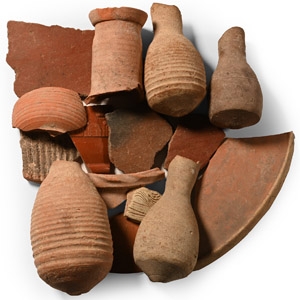
Roman Ceramic Vessel and Sherd Group
Mainly 1st-2nd century A.D.Sold for (Inc. bp): £46
Including ribbed ceramic bottle, fragments of sidewall with ribbing, applied swirl detailing and other types. 324 grams total, 2.4-11.7 cm
From a family collection mostly formed in the 1940s-1950s, thence by descent. -
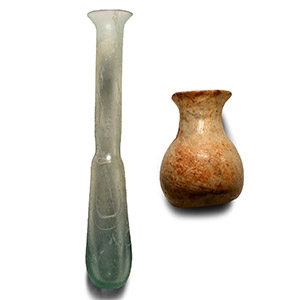
Roman Glass Vessel Group
3rd-4th century A.D.Sold for (Inc. bp): £104
Comprising: a slender pale blue unguentarium with flared mouth; squat piriform jar with dimple base. 24 grams total, 4.5-11 cm
Francesc Cambó i Batlle (1876-1947) a prominent Spanish politician, art patron and philanthropist. Gifted to his friend, the archaeologist Josep Gilbert i Buch. Acquired from Gilbert's family by the present owner's grandfather in the early 1980s. Private collection of a European noble.
Francesco Cambó i Batlle was a notable figure in early 20th-century Spain, best known for his role in politics as a leader of the Catalan nationalist movement and as a patron of the arts. He was a key benefactor of the Museo del Prado and left a significant legacy through his art collections. His deep connection to the cultural and artistic life of Spain makes items from his collection particularly valuable and historically significant. -
.jpg)
Roman Iridescent Glass Unguentarium
1st-4th century A.D.Sold for (Inc. bp): £52
Tall and slender iridescent vessel with bulb to the base and flared rim. 7.47 grams, 10.5 cm
Acquired 1980-2015. Ex Abelita family collection. -
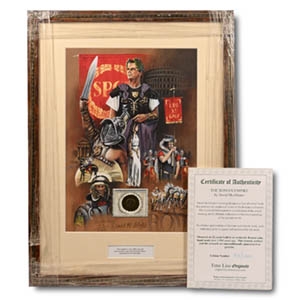
Bronze Roman Coin and Framed Limited Edition Print
3rd century A.D. and laterSold for (Inc. bp): £85
The coin of Constantine the Great (272-337 A.D.) mounted on 22 carat gold foil, framed with an art print signed by the artist David McAllister, depicting scenes of Roman military activity; limited edition number 53/1150. 1.26 kg, 49.5 x 37.5 cm
UK gallery, early 2000s. Accompanied by a previous certificate of authenticity.
David McAllister's exciting design is a 'one of a kind' work that portrays the might and riches of the Roman civilisation. This limited edition print is a celebration of the award winning artist's lifetime dedication to historical paintings of the ancient world. To enhance appreciation of this rare and historic work, each individual print is signed and numbered by the artist. -
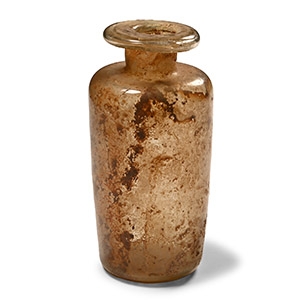
Roman Glass Bottle with Short Neck
3rd-4th century A.D.Sold for (Inc. bp): £104
Mould-blown bottle comprising a flat-based tubular body and bell-shaped neck with applied flange rim. 46 grams, 95 mm
From a family collection mostly formed in the 1940s-1950s, thence by descent. -
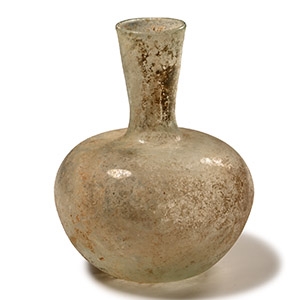
Roman Glass Bottle with Tapering Neck
4th century A.D.Sold for (Inc. bp): £111
Flask with squat bulbous body and broad shoulder, slender cylindrical neck with flared rim, dimpled base; iridescent surfaces. 44 grams, 11.2 cm
From a family collection mostly formed in the 1940s-1950s, thence by descent. -
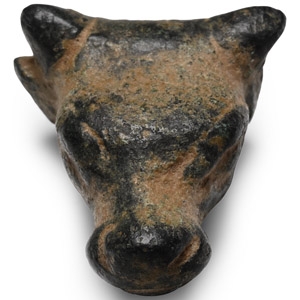
Roman Bronze Bull Weight
1st-4th century A.D.Sold for (Inc. bp): £156
Model head of a bull with flat base. 16.6 grams, 21 mm
From the collection of a gentleman, acquired on the London art market in the 1990s. -
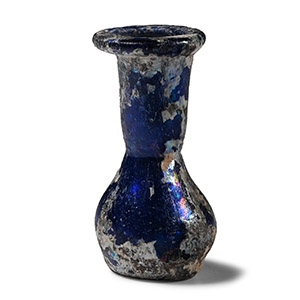
Roman Brilliant Blue Glass Unguentarium
1st century A.D.Sold for (Inc. bp): £234
Miniature unguentarium with bulbous body and flared neck, in-turned rim; iridescent surface. 11.47 grams, 46 mm
From a London, UK, collection, 1990s. -
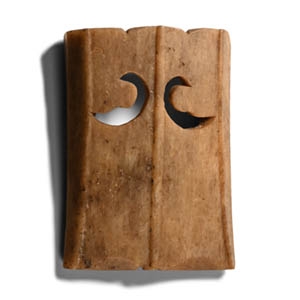
Roman Bone Scabbard Attachment
3rd century A.D.Sold for (Inc. bp): £390
Carved with dentilled edge above and scooped base, lateral fluting, median rib and comma-shaped voids; to reverse, lateral slots to accept the case of the scabbard. 19.2 grams, 64 mm
From a London, UK, collection, 1990s.
The box chapes were a clear category of scabbard closures for the 3rd century Roman swords. The shape of the chape was that of a high rectangle laterally closed by a flat border remembering a box; the sides enlarge in a bow shape on the lower part. Miks has divided the category in three variants, A-B-C, each of them divided into two sub-variants. They were mainly made of bone, although specimens in bronze (Corbridge, Aquincum) and iron (Kunzing, Dura Europos? This last very corroded) and even in silver (Hortbágy) survive. -
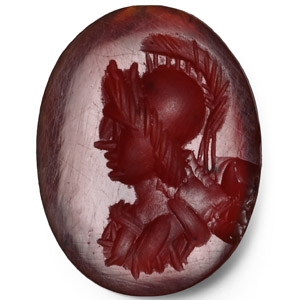
Roman Gemstone with Head of Minerva
2nd-3rd century A.D.Sold for (Inc. bp): £169
Carnelian with intaglio profile bust wearing a helmet; supplied with a museum-quality impression. 0.64 grams, 15 cm
Acquired 1980-2015. Ex Abelita family collection. -
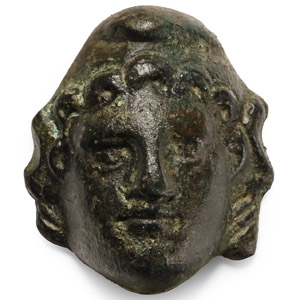
Roman Bronze Head of Attis Mount
1st-2nd century A.D.Sold for (Inc. bp): £117
Depicted with a clean shaven rounded face, short curls emerging from underneath the peaked cap; hollow to the reverse. 12.1 grams, 28 mm
Ex German art market, 2000s. Acquired from an EU collector living in London. From the collection of Surrey, UK, gentleman. -
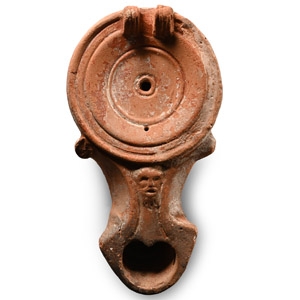
Roman Republican Oil Lamp
2nd-1st century B.C.Sold for (Inc. bp): £195
Drum-shaped in profile with long volute nozzle, concentric rings to the discus; fitting for a hinged reflector to the rear; rare. 86 grams, 13 cm
From a private German collection.

