-
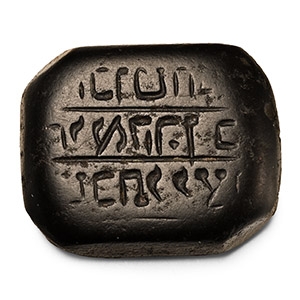
Cabochon with Hebrew Text
Roman, 1st-3rd century A.D. or laterSold for (Inc. bp): £312
Octagonal in plan and plano-convex in profile, glass cabochon with three lines of calligraphic Hebrew text, possibly a personal seal for someone called Aaron. 2.12 grams, 18 mm
Acquired in the 1980s. From the collection of a London antiquarian. -
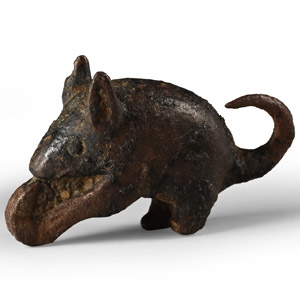
Roman Bronze Mouse with Nut
2nd-3rd century A.D.Sold for (Inc. bp): £221
In a crouching posture, eating a nut held in its front paws, the tail curving upwards. 15.4 grams, 33 mm
Ex German art market, 2000s. Acquired from an EU collector living in London. From the collection of Surrey, UK, gentleman. -
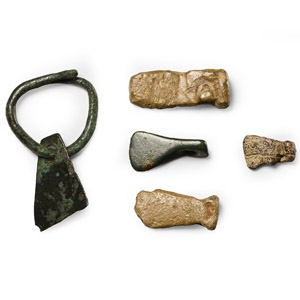
Roman Bronze and Lead Votive Axehead Collection
1st-4th century A.D.Sold for (Inc. bp): £65
Comprising: three lead axes; one bronze with rounded blade; one sheet-bronze with round-section loop. 15.8 grams total, 11-35 mm
Ex German art market, 2000s. Acquired from an EU collector living in London. From the collection of Surrey, UK, gentleman. -
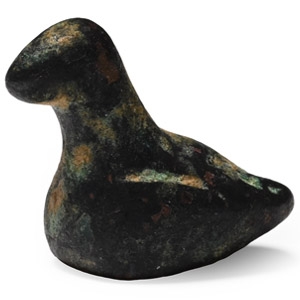
Roman Bronze Bird Weight
1st-4th century A.D.Sold for (Inc. bp): £59
Modelled in the round with slot to the underside. 5.7 grams, 19 mm wide
From the collection of a gentleman, acquired on the London art market in the 1990s. -
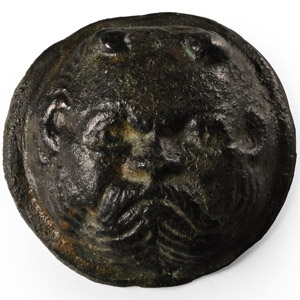
Roman Bronze Silenus Mount
1st-2nd century A.D.Sold for (Inc. bp): £91
Domed mount with a bearded satyr face to the centre, short horns projecting from his head; hollow to the reverse. 7.68 grams, 26 mm
Ex German art market, 2000s. Acquired from an EU collector living in London. From the collection of Surrey, UK, gentleman. -
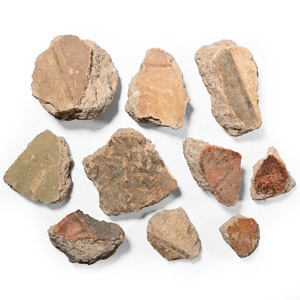
Roman Fresco Wall Plaster Collection
1st century A.D.Sold for (Inc. bp): £33
Fragments of wall plaster with rendered surface painted red with brown detailing to the edge; some with impression of timber laths to the reverse. 845 grams total, 39-94 mm
Acquired in the 19th century. Ex Jeger collection, Switzerland. UK gallery, early 2000s.
These small fragments, for analogies with the fragments of Pompeii, seems to belong to the second style of Roman painting, red panels representing highlight and shadow, decorated with vegetal interlaces. Some panels were probably framed by a red grenade fillet. A fragment shows alternate blue and red colour over a cream background, maybe pertinent to a socle. -
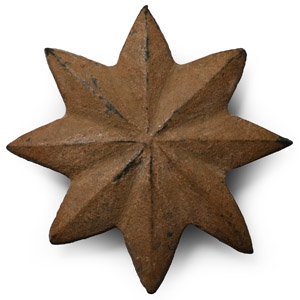
Roman Bronze Mount in the Shape of a Star
3rd-4th century A.D.Sold for (Inc. bp): £117
Modelled as an eight-pointed star, rectangular loop and two studs to the reverse. 21.8 grams, 51 mm
Acquired in the mid 1980s-1990s. Private collection, Switzerland, thence by descent. Private collection, since the late 1990s. -
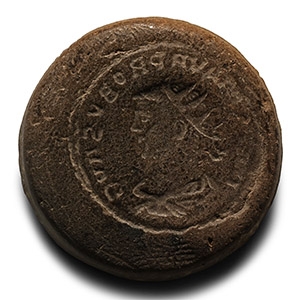
Roman Bifacial Terracotta Forger's Coin Mould
1st-4th century A.D.Sold for (Inc. bp): £520
Discoid in plan, both sides with a radiate profile bust of an emperor, legend surrounding. 4.9 grams, 27 mm
From the collection of a gentleman, acquired on the London art market in the 1990s. -
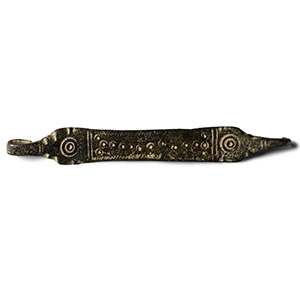
Roman Bronze Decorated Armour Clasp
1st-4th century A.D.Sold for (Inc. bp): £52
Formed of a rectangular plaque with punched decoration, hook to one end and an open loop to the other. 5.28 grams, 68 mm
Ex Californian collection, USA, 1980s. -
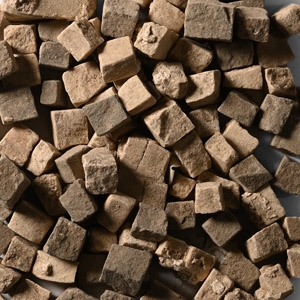
Roman Floor Mosaic Tesserae Group
1st-4th century A.D.Sold for (Inc. bp): £46
Mainly cuboid in form, some embedded in concrete matrix. 182 grams total, 8-29 mm
From the collection of a late East Anglian teacher and antiquarian who retired to the Isle of Wight in Hampshire, UK. He amassed a large collection of objects between the 1960s-1980s. -
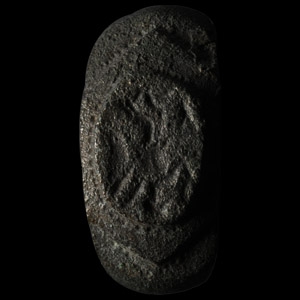
Roman Bronze Ring with Nike
1st-2nd century A.D.Sold for (Inc. bp): £20
With stepped bezel, intaglio figure of Nike or Victory with wings spread. 4.53 grams, 21.65 mm overall, 17.36 mm internal diameter (approximate size British J, USA 4 3/4, Europe 8.69, Japan 8)
Acquired 1980-2015. Ex Abelita family collection. -
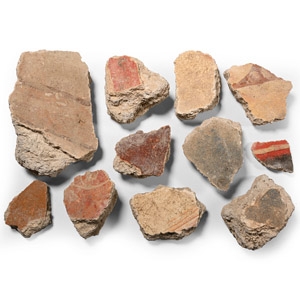
Roman Fresco Wall Plaster Collection
1st century A.D.Sold for (Inc. bp): £98
Fragments of wall plaster with rendered surface painted with mainly red and brown detailing; some with impression of timber laths to the reverse. 1.01 kg total, 3.8-12.6 cm
Acquired in the 19th century. Ex Jeger collection, Switzerland. UK gallery, early 2000s.
These small fragments, for analogies with the fragments of Pompeii, seems to belong to the second style of Roman painting, red panels representing highlight and shadow, decorated with vegetal interlaces. Some panels were probably framed by a red grenade fillet. A fragment shows alternate blue and red colour over a cream background, maybe pertinent to a socle.

