-
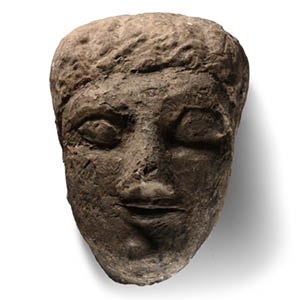
Cypriot Limestone Head
Iron Age, 600-400 B.C.Sold for (Inc. bp): £598
Carved in the half-round with nemes headdress. 3.2 kg, 22.5 cm
From a collection acquired on the UK art market from various auction houses and collections mostly before 2000. From an important Cambridgeshire estate; thence by descent. -
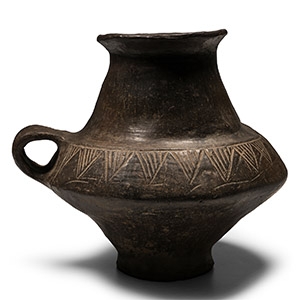
Etruscan Impasto Single-Handled Vase
Circa 6th century B.C.Sold for (Inc. bp): £416
Bucchero olpe with a glossy black slip to surface, trumpet-shaped neck and mouth, loop handle to the shoulder and discoid foot, circumferential band of hatched triangles to the shoulder. 854 grams, 16.3 cm
Property from the Upper East Side estate of M.H., New York, USA; a Slovak refugee who collected in the early 1980s. -
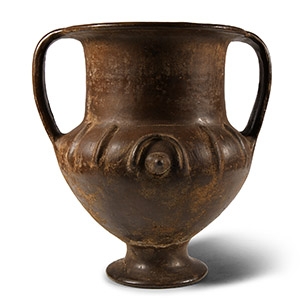
Villanovan Impasto Handled Amphora
Circa 750-700 B.C.Sold for (Inc. bp): £494
Comprising a wide foot beneath a squat stem with a bulbous body, a sloped shoulder beneath a columnar neck, a flared rim, and a pair of applied strap handles arching between rim and shoulder; body decorated with eight slender, vertical ribs surrounded by pecked stippling; two lateral bosses beneath a parabolic arch; surface burnished throughout; foot restored. 1.29 kg, 22.1 cm
From the collection of Eleanor Hilowitz (1913-2007), an abstract expressionist painter and sculptor, New York, USA; acquired between 1956 and 1975. Acquired by Randall Hixenbaugh of Hixenbaugh Ancient Art, New York, USA, in 2007. with Artemis Gallery, 26 September 2019, lot 54 (US$2,000-3,000). Property of a South Australian private collector, with collection reference 20.03. Accompanied by detailed collector's catalogue pages including description and photograph. -
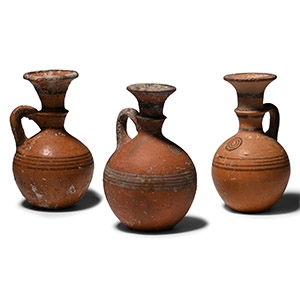
Cypriot Terracotta Miniature Jug Group
800-600 B.C.Sold for (Inc. bp): £520
Comprising three vessels with bulbous bodies decorated with painted circumferential bands and concentric circles; single loop handle to the rear; tall neck with a central ridge and painted bands, wide trumpet mouth. 174 grams total, 83-87 mm
Acquired in 2000. Private collection, Europe. -
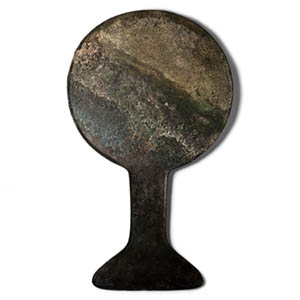
Massive Graeco-Parthian Bronze Mirror
Late 3rd-1st century B.C.Sold for (Inc. bp): £247
Discoid in plan with short T-shaped handle, obverse with deep flange to edges, reverse similar but less prominent; some surface accretion. 1.14 kg, 35.5 cm
UK private collection before 2000. Acquired on the UK art market. Property of a London gentleman. -
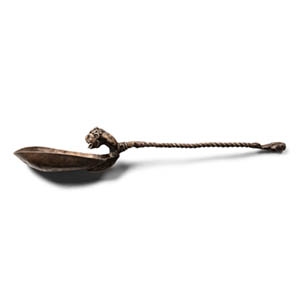
Graeco-Roman Silver Spoon with Lion Head
1st century B.C.-1st century A.D.Sold for (Inc. bp): £1,040
Deep piriform bowl with scooped repoussé rear, baluster formed as a lioness's head with applied rosette to the brow, twisted handle with knop finial. 9.42 grams, 15.2 cm
From the collection of a gentleman, acquired on the London art market in the 1990s. -
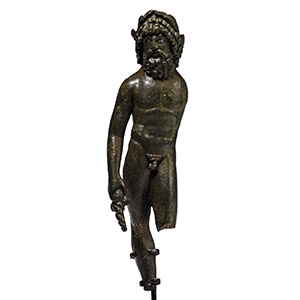
Hellenistic Bronze Statuette of Zeus
2nd-1st century B.C.Sold for (Inc. bp): £2,080
Standing nude with a wreath to his hair, segmented beard, right hand holding a thunderbolt; mounted on a custom-made stand. 142 grams, 10.3 cm (200 grams total, 11.6 cm including stand)
From the collection of Mr. F.U., Bavaria, acquired prior to 2000. with Gorny & Mosch, 17 June 2015, no.303. Accompanied by an academic report by Dr Raffaele D'Amato. This lot has been checked against the Interpol Database of stolen works of art and is accompanied by a search certificate number no.12380-226601. -
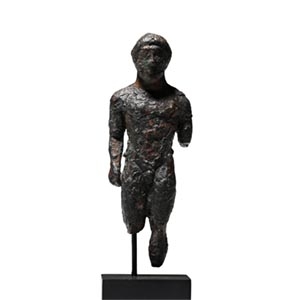
Greek Bronze Kouros Statuette
7th-6th century B.C.Sold for (Inc. bp): £520
Standing nude with arms held straight at the sides, hair curled up at the edge; probably a monumental fitting; mounted on a custom-made stand. 158 grams total, 11.2 cm including stand
From a collection acquired on the UK art market from various auction houses and collections mostly before 2000. From an important Cambridgeshire estate; thence by descent.
The small statuette is that of a naked youth, the so-called kouros, typical of archaic Greek sculpture of the 7th century B.C. Such representations underwent simplification in the early years of the 6th century B.C. with the Archaic smile transformed into something more akin to a grimace -
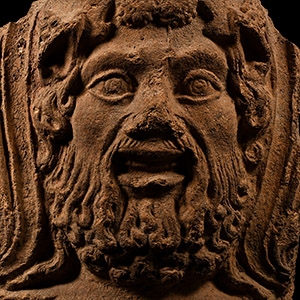
Etruscan Terracotta Satyr Antefix
4th century B.C.Sold for (Inc. bp): £3,250
D-shaped in profile with high-relief mask of a satyr within a looped frame; hanks of curling hair to the brow and temples with berries to the fillet, lentoid eyes, broad nose, curling moustache and beard; ledge below and arched ridge to the reverse; mounted on a custom-made stand. 6.77 kg total, 30 cm including stand
Acquired from Faustus Ancient Art Ltd, London, 1990. Private American collection. with Christie’s, London, 27 October 2009, no 9. Accompanied by copies of the relevant Christie's catalogue pages. Accompanied by an academic report by Dr Raffaele D’Amato. This lot has been checked against the Interpol Database of stolen works of art and is accompanied by a search certificate number no.12062-217441.
The antefix belongs to the typical decorative scheme of alternating maenad and satyr head antefixes that were mainly produced in Cerveteri. Heads were often placed in temples and displayed identifying features such as wavy hair and large, almond-shaped lidded eyes, and were lavishly painted. These typologies of antefixes generally look quite similar and appear to have identical colour schemes with dark red skin, and with darker shades of red applied to the hair below the ears, on top of the head and inside the ears. -
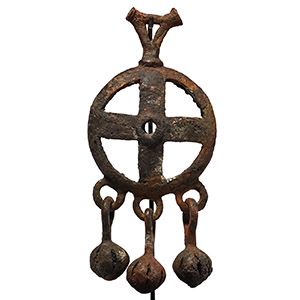
Villanovan Bronze Pendant
8th-7th century B.C.Sold for (Inc. bp): £156
Formed as a domed disc pendant with openwork cross and central hole; triangular bale above, three loops below each with a crotal bell attached; mounted on a custom-made stand. 86 grams (134 grams), 11.9 cm(14.5 cm)
From a collection acquired on the UK art market from various auction houses and collections mostly before 2000. From an important Cambridgeshire estate; thence by descent.
The round element represents the four-spoked wheel of a chariot, typical of the Bronze Age. The motif has been interpreted as solar symbolism since this period. The circularity between solar cosmologies—symbolic wheel/solar vehicle/functional chariot—was deeply ingrained since at least the 15th century from North Europe to Aegeaum, and continued in the early Iron Age. -
.jpg)
Greek Terracotta Female Bust
Circa 6th century B.C.Sold for (Inc. bp): £1,040
Modelled in the round wearing a polos headdress and large disc earrings, the segmented hair retained by a diadem and falling to the shoulders; finely modelled facial features with lentoid eyes and full pouting lips; mounted on a custom-made stand. 1.4 kg total, 24.5 cm including stand
with Petit Musée, Montreal, Canada, 1995. Acquired Bonhams, London, 28 November 2017, lot 74. Private collection of Professor Kenneth Graham, London, UK. Accompanied by the original catalogue page and a copy of the original invoice. -
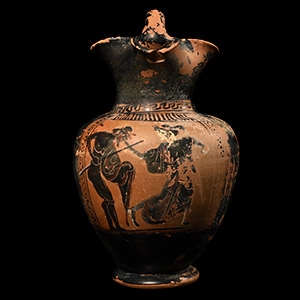
Greek Black-Figure Oinochoe
6th century B.C.Sold for (Inc. bp): £1,690
With pinched three-lobe mouth and strap handle; threads and details highlighted in purple; decorated scene in square metope comprising two dancing figures, one male and the other female, probably symposiasts; the male naked, holding a stick in his right hand and with the other arm carrying his coat; the female, a hetaera, dancing and running to the right, wearing a long chiton and a coat. 423 grams, 20.3 cm
Acquired in the mid 1980s-1990s. From the family collection of Mr S.A., Switzerland, thence by descent. Private collection since the late 1990s. This lot has been checked against the Interpol Database of stolen works of art and is accompanied by a search certificate number no.12089-218152.

