-
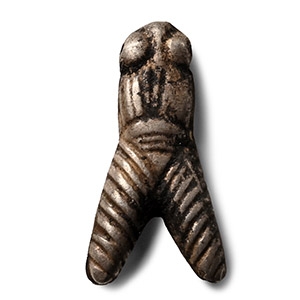
Egyptian Silver Fly Amulet
Late Period, 664-332 B.C.Sold for (Inc. bp): £117
Formed as a fly with long triangular segmented wings, segmented body and domed eyes pierced for suspension. 0.98 grams, 18 mm
From an early 20th century collection.
Small fly amulets first appeared in burials during the Naqada II Period, c. 3200 B.C. These amulets grew in popularity and the materials used to make them expanded during the New Kingdom. They are crafted from a variety of materials such as gold, silver, lapis lazuli, carnelian, amethyst, faience, and bone. These amulets were thought to protect against insect bites and to ward off troublesome flying creatures through apotropaic magic. Some believe they may have even been intended to symbolise the fly’s fecundity. Additionally, pharaohs would bestow gold fly-shaped pendants as military awards to honour the bravery and fly-like persistence of soldiers in battle. -
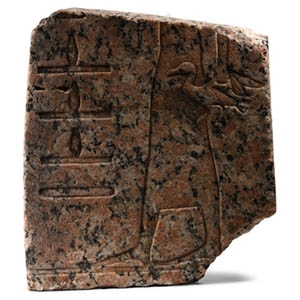
Egyptian Granite Relief
New Kingdom, 1550-1292 B.C.Sold for (Inc. bp): £1,560
Relief fragment with dressed face and three edges; the feet and lower body of a human figure in profile wearing a tight-fitting calf-length garment on a baseline; the left forearm behind with hand holding a goose by its pinions; to the left a series of ḥtp hieroglyphs. 3.57 kg, 18.7 cm
Acquired in the mid 1980s-1990s. Private collection, Switzerland, thence by descent. Private collection, since the late 1990s. This lot has been checked against the Interpol Database of stolen works of art and is accompanied by search certificate number no.12366-226937.
This likely represents part of an offering scene, showing the individual bringing a goose and the hieroglyphs writing ḥtpt, probably part of a phrase referring to 'offerings'. -
.jpg)
Hellenistic Gold Mount Pair
2nd-1st century B.C.Sold for (Inc. bp): £163
Comprising discoid cells each with shallow sidewall and flange rim, granule collar with radiating clusters. 1.62 grams total, 19 mm each
From a late Japanese specialist collector, 1970-2000s. -
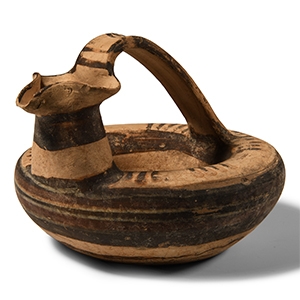
Etrusco-Corinthian Ring Askos
Circa 575 B.C.Sold for (Inc. bp): £260
With strap handle positioned over the central hole; black-figure decoration with fired umber (reddish-brown) consisting of a broad band heightened with crimson and white round the upper part of the wall, and a wavy band on the reversed area below; broad band of black (fired umber) inside the ring and around the neck below the spout; groups of transverse lines with faded petals around the top, horizontal lines across the handle; intact. 349 grams, 16.5 cm
Acquired from Charles Ede Gallery, London, in 1982. Prominent Palm Springs, California, USA, collection. with Artemis Gallery, Colorado, USA, 14 July 2012, lot 30 (US$2,500-3,000). Property of a South Australian private collector, with collection reference 14.08. Accompanied by detailed collector's catalogue pages including description and photograph.
Etrusco-Corinthian pottery is a local imitation of Corinthian pottery, made from the late seventh to the mid-sixth century B.C., with production concentrated on the southern Etruscan cities of Caere, Veii and Vulci. The forms predominately employed include various forms of jug (olpai, oinochoe) and unguent containers (aryballoi and alabastra) as well as amphorae and craters. The askos is the name given in modern parlance to a type of Greek pottery vessel used to pour small quantities of liquids such as oil. It is recognisable from its flat shape and a spout at one or both ends that could also be used as a handle; they were usually painted decoratively like vases and were mainly used for storing oil and refilling oil lamps. They were extensively traded in and around the Mediterranean, and local types emerge in Italy from the early Iron Age in Italy (cf. CVA Taranto – Museo Nazionale I, pl. 1.1 (Inv. 2400) – refer photo at 14.08 – 3); also CVA British Museum 7, pl. 4.4). The original meaning of ἀσκός is “wineskin” which can be seen in the shapes of early askoi. This askos has unique painted decoration for which a parallel has not been found to date. For an earlier variant of this type, see CVA Tarquinia – Museo Archeologico Nazionale III, pl. 27.7-8 (Inv. RC. 1892). Described as 'Italo- Geometric' and dated to third quarter of the seventh century. Neck is longer than on Inv.14.08, and with different decorations, but otherwise it is an early parallel. Another variant of this type can be seen in CVA Museo Civico d’Archeologia Ligure di Genova, I, pl. 1.2-3 (Inv. 1101). The groups of horizontal line decoration can be seen on earlier types, cf. late eighth to early seventh century footed cup in the Museo Archeologico della Maremma (CVA Grosetto Museo Archeologico I, pl. 26.3 (Inv. 24294)). -
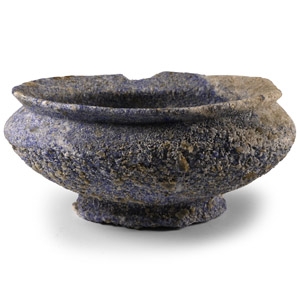
Graeco-Roman Lapis Lazuli Bowl
3rd-1st century B.C. or laterSold for (Inc. bp): £169
Ellipsoid in plan with carinated profile, broad everted rim, stepped base; chipped. 286 grams, 10.8 cm
Ex London, UK, gallery, 1971-early 2000s. London, UK, collection. -
.jpg)
Scythian Gold Animal Head Pendant
5th-4th century B.C.Sold for (Inc. bp): £234
Comprising a stylised head of a boar modelled in the round, annular eye and tall bristles above the head; loop to the rear. 0.81 grams, 12 mm
From a late Japanese specialist collector, 1970-2000s. -
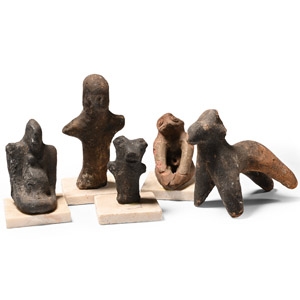
Cypriot and Other Terracotta Figure Group
2nd-1st millennium B.C.Sold for (Inc. bp): £117
Comprising anthropomorphic, zoomorphic and theriomorphic ceramic figures in various poses, some on a ceramic base. 546 grams total, 6.1-10.5 cm
From a collection acquired on the UK art market from various auction houses and collections mostly before 2000. From an important Cambridgeshire estate; thence by descent. -
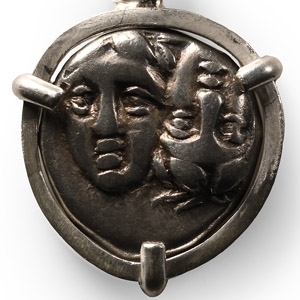
Greek Silver Istrus Drachm Pendant
2nd century B.C. and laterSold for (Inc. bp): £211
Drachm with two male heads to obverse, the left inverted, eagle and dolphin to reverse; clasp-mounted in a modern silver frame with ring and loop. 8.08 grams, 39 mm
Ex German art market, 2000s. Acquired from an EU collector living in London. From the collection of Surrey, UK, gentleman. -
.jpg)
Greek Terracotta Attic Black Figure Vessel Fragment Group
6th century B.C.Sold for (Inc. bp): £572
Comprising: carinated rim fragment from a bowl with reserved siren, panther, rosette and other ornament; bowl base with reserved advancing nude male or satyr on a red field, sgraffito detailing; skyphos rim fragment with part of the handle, reserved egg-and-dart band. 106 grams total, 7.4-13 cm
From an early 20th century collection. By descent the property of a UK lady. Ian Wilkinson collection, Nottinghamshire, UK, formed since 1985. Accompanied by a previous handwritten note including provenance.
The body of the panther resembles the style of the school of Sophilos, an Attic painter active circa 580-560 B.C. The naked image (a dancing satyr?) recalls the Attic black figure depictions of ithyphallic satyrs, with torso, arms, legs and incision for internal details in white paint, made around 500 B.C. -
.jpg)
Greek Gold Animal-Headed Earring
4th-3rd century B.C.Sold for (Inc. bp): £221
The decoratively twisted hoop tapering toward the closure, cow or bull head modelled in the round with filigree ornament to the collar. 2.91 grams, 22.69 mm
From the collection of H.N., Milton Keynes, 1980s-1990s. -
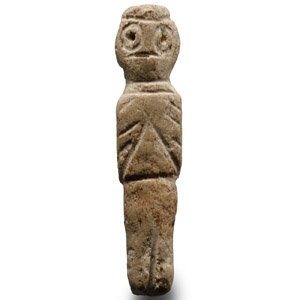
Cypriot Bone Idol
Circa 3rd millennium B.C.Sold for (Inc. bp): £117
Carved in the round with incised collar, belt and facial features, pierced at the top of the head. 2.12 grams, 47 mm
From a collection acquired on the UK art market from various auction houses and collections mostly before 2000. From an important Cambridgeshire estate; thence by descent. -
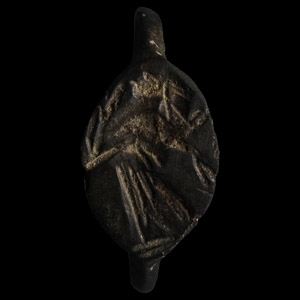
Greek Bronze Human-Headed Female Dancer
4th-3rd century B.C.Sold for (Inc. bp): £46
Comprising a narrow hoop and lentoid bezel, intaglio image of a siren in flight. 1.33 grams, 21.71 mm overall, 19.09 mm internal diameter (approximate size British Q, USA 8, Europe 17.49, Japan 16)
Ex German art market, 2000s. Acquired from an EU collector living in London. From the collection of Surrey, UK, gentleman.

