-
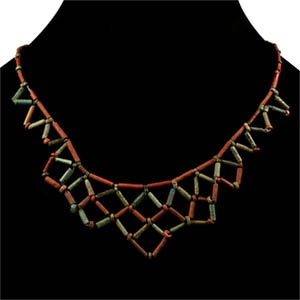
Egyptian Faience Bead Necklace
Late Period, 664-332 B.C.Sold for (Inc. bp): £140
A netted beadwork composed of red and blue tubular beads; restrung with a modern clasp. 7.93 grams, 40 cm
Ex John Moor galley, 1990s. From the H.W. collection, UK. Accompanied by a previous cataloguing card. -
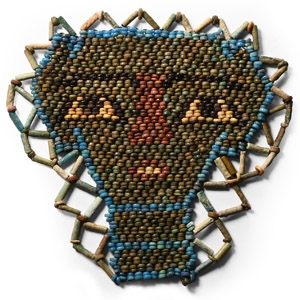
Egyptian Faience Mummy Bead Mask
Ptolemaic Period, 332-30 B.C.Sold for (Inc. bp): £130
A beadwork panel of small glazed composition beads in various colours representing a mummy face mask, with false beard with netted border; restrung with some later beads. 30.8 grams, 12 cm
Mariaud de Serres, Paris, 1990s. -
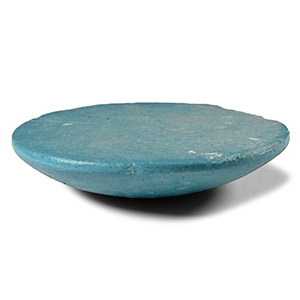
Egyptian Blue Faience Funerary Dish for Modelled Food
Middle Kingdom, 12th Dynasty, 1991–1802 B.C.Sold for (Inc. bp): £1,170
Shaped as a shallow circular dish. 252 grams, 11.1 cm
Acquired on the German art market, 1989-1995. with The Museum Gallery, 19 Bury Place, London, WC1, UK, 1998-2003. Property of a London based academic, 2003-present.
Faience food and dish simulacra replaced the wooden food preparation models of the earlier Middle Kingdom. -
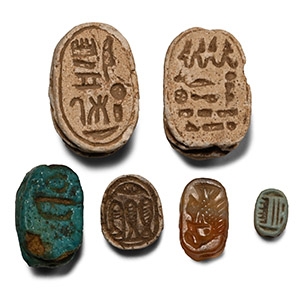
Egyptian Steatite and Faience Scarab Group
Late Period, 664-332 B.C.Sold for (Inc. bp): £208
Their bases decorated with hieroglyphs and figures, including one with the motto 'Amun lord of the Two Lands', another with the motto 'lord Ramesses beloved of Amun', and one with a detailed representation of a Nile tilapia fish. 8.68 grams total, 7-21 mm
From an early 20th century collection. -
.jpg)
Egyptian Silver Isis and Horus Amulet
Late Period, 664-332 B.C.Sold for (Inc. bp): £234
Isis enthroned wearing a cow's horn headdress with a solar disc, suckling the infant Horus on her lap; loop to rear of crown; mounted on a custom-made stand. 6.2 grams, 39 mm (20.7 grams total, 62 mm including stand)
Ex Mythes & Legend. Ex Cohen collection 2011. Property of a French collector.
In ancient Egyptian mythology, Isis was the sister-wife of Osiris and the mother of the sky god Horus. She is associated with aspects of fertility and motherhood and is often depicted in various artworks seated in a nursing pose with her son Horus on her lap, as here. -
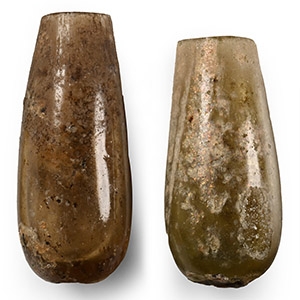
Egyptian Glass Phial Group
1st millennium B.C.Sold for (Inc. bp): £59
Each is a tapering bulb shape with a flat-cut mouth. 13.8 grams total, 35-37 mm
From the collection of Mr S.M., London, UK, formed from 1979-1999. -
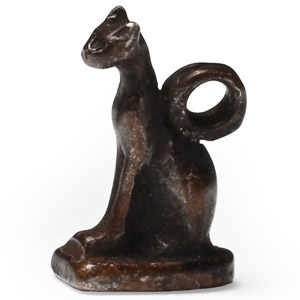
Egyptian Silver Cat Amulet
Late Period, 664-332 B.C.Sold for (Inc. bp): £416
Seated figure of a cat with deeply set eyes and pointed ears set on a rectangular base with a rounded end; suspension loop on the back. 0.33 grams, 8 mm
From an early 20th century collection.
The cat was sacred to Bastet, a protective mother goddess and the daughter of the sun god Re. Amulets provided the wearer with the goddess's protection. -
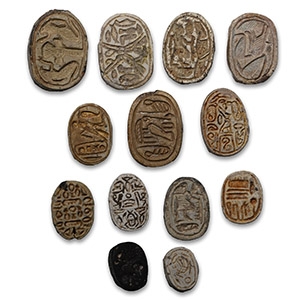
Egyptian Canaanite Limestone Scarab Group
Second Intermediate Period-New Kingdom, circa 17th-12th century B.C.Sold for (Inc. bp): £1,040
A group of thirteen scarabs with anatomical detailing to the carapace, comprising: 1) two kneeling hawk-headed figures with arms raised praise flank a central Hathoric fetish; 2) two facing falcons adorned with Red Crowns flanked by hieroglyphs, including netjer,hes-jars, and maat feathers; 3) standing human figure holding a staff atop a neb hieroglyph facing a highly stylised crocodile; 4) falcon atop a neb hieroglyph facing a striking cobra with another above; 5) the Re-Horakhty falcon standing before a hes-jar, with cartouche behind containing hieroglyphs and a verticalneb hieroglyph on the left; 6) central motif of a bird atop a neb hieroglyph with a rectangular sign above, a was- sceptre behind, flanked by stylised cobras; 7) falcon wearing the Red Crown atop a shrine with a winged sun disc above, flanked by cobras and Red Crowns; 8) central design consisting of hes-jars, a sun disc, a nub symbol (for gold), nefer signs, a kheper scarab beetle, and lotus flowers, all flanked by a border of en and ro signs; 9) central column of hes-jars, a sun disc, a kha rising sun hieroglyph, and scarab beetle, flanked by lions’ foreparts, Red Crowns, neb and hes-jar signs; 10) standing figure atop a neb hieroglyph holding a flower/branch; 11) hieroglyphs writing ‘Amun beloved of the living Ramesses’; 12) stylised bird with men hieroglyph behind; 13) scarab beetle with sun disc above. 27.1 grams total, 11-20 mm
Acquired in the mid 1980s-1990s. Private collection, Switzerland, thence by descent. Private collection, since the late 1990s.
The popularity of the scarab was so great that many of these scarab designs can be found outside Egypt at sites in the ancient Levant. -
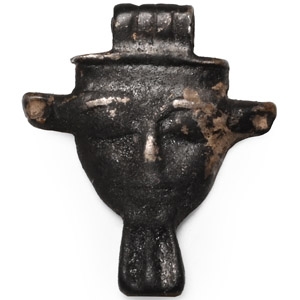
Egyptian Silver Hathor Head Amulet
Late Period, 664-332 B.C.Sold for (Inc. bp): £124
A finely detailed head of the goddess Hathor with a human face, divine beard, and cow ears, with a ribbed suspension loop on top. 0.68 grams, 11 mm
From an early 20th century collection. -
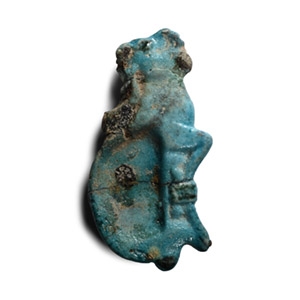
Egyptian Amulet of Trussed Ibex
Late Period, 664-332 B.C.Sold for (Inc. bp): £286
Turquoise glazed faience figure of a trussed ibex, with the remains of its large curled horn, tail, facial details, and rope tie picked out in black; damaged and repaired. 11.6 grams, 63 mm
From the private collection of the late Mrs Belinda Ellison, a long time member of the Egyptian Exploration Society, c.1940-2020.
Figurines of trussed ibexes in faience were occasionally included in foundation deposits, possibly to represent animals that were sacrificed. However, the shallow depression in the body of this animal is similar to the style of cosmetic dishes, indicating that this particular example may be a funerary object symbolising a more valuable toiletry item. -
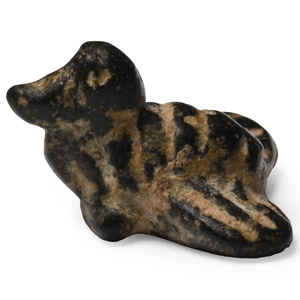
Phoenician Stone Bird-Shaped Weight
Late 1st millennium B.C.Sold for (Inc. bp): £351
Fashioned as a seated bird with partly outspread wings. 4.15 grams, 15 mm
From a London, UK, based collection, 1990s. -
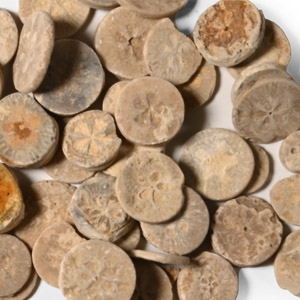
Egyptian Limestone 'Floral' Inlay Group
Roman Period, 30 B.C.-323 A.D. or earlierSold for (Inc. bp): £26
Group of discoid inlay plaques or gaming counters, crinoids with cinquefoil motif. 60 grams total, 9-20 mm
From a central London ADA dealership, 1980-1990.
Flowers were symbolic of rebirth due to the daily reopening of their petals after nightfall. As a result, they were widely used in domestic settings, religious and funerary contexts, and as adornments. Similar rosette discs, like those recovered from the Ramesside Period palace at Qantir, were used as decorative elements in royal palaces.

