-
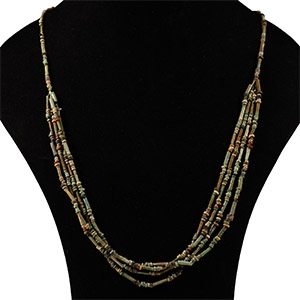
Egyptian Multi-Stranded Faience Mummy Bead Necklace
Late Period, 664-332 B.C.Sold for (Inc. bp): £234
Multi-stranded designer necklace composed of beads of mainly annular and tubular types. 23 grams, 78 cm
Acquired before 1979. From the private collection of Mr F.A., South Kensington, London, UK; thence by descent 2014.
For thousands of years, artisans in Egypt created vibrant ceramics to echo the beauty of rare jewels. These ornaments were created with almost every material, colour, and texture imaginable and they come from across Egypt and beyond: vibrant blue lapis lazuli from Afghanistan, glossy black obsidian from Turkey, and aqua-green turquoise from the Sinai. They were worn in life and, after death, they served as precious ornamentation for mummies. -
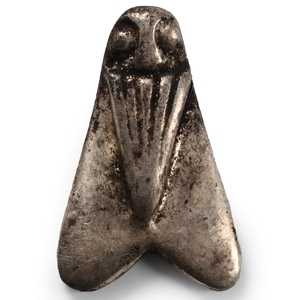
Egyptian Silver Fly Amulet
Late Period, 664-332 B.C.Sold for (Inc. bp): £98
D-shaped in section with two triangular wings and robbed body with pellet eyes. 1.07 grams, 16 mm
From an early 20th century collection.
Small fly amulets first appeared in burials during the Naqada II Period, c. 3200 B.C. These amulets grew in popularity and the materials used to make them expanded during the New Kingdom. They are crafted from a variety of materials such as gold, silver, lapis lazuli, carnelian, amethyst, faience, and bone. These amulets were thought to protect against insect bites and to ward off troublesome flying creatures through apotropaic magic. Some believe they may have even been intended to symbolise the fly’s fecundity. Additionally, pharaohs would bestow gold fly-shaped pendants as military awards to honour the bravery and fly-like persistence of soldiers in battle. -
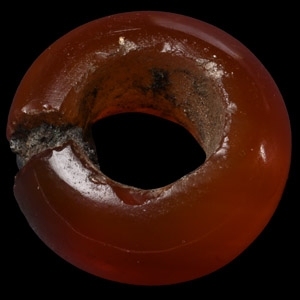
Large Egyptian Carnelian Hair Ring
New Kingdom, circa 1550-1070 B.C.Sold for (Inc. bp): £130
Circular with a semi-circular profile and an opening on one side. 3.2 grams, 17 mm
From an early 20th century collection. -
.jpg)
Egypto-Phoenician Stone Scaraboid Group
1st millennium B.C.Sold for (Inc. bp): £52
One has an incuse falcon representing the god Re-Horakhty on the underside, the other in mottled hardstone. 4.69 grams total, 13-18 mm
From a collection acquired on the UK art market from various auction houses and collections mostly before 2000. From an important Cambridgeshire estate; thence by descent. -
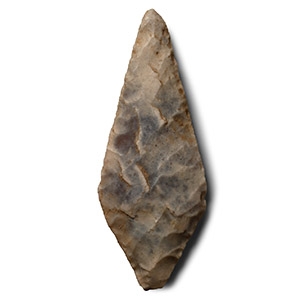
Egyptian Flaked Arrowhead
4th-2nd millennium B.C.Sold for (Inc. bp): £59
Lentoid in section and lozengiform in plan with two cutting edges. 1.48 grams, 35 mm
From the collection of Mr S.M., London, UK, formed from 1979-1999. -
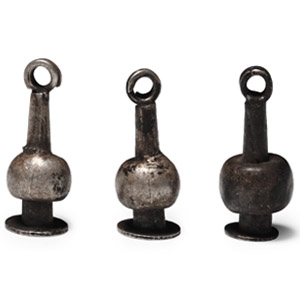
Egyptian Silver Poppy Beads
Late Period, 664-332 B.C.Sold for (Inc. bp): £124
Modelled in the shape of a poppy seed with a flat foot leading to a globular body with a tapering neck attached to a small loop at the top for suspension. 3.29 grams total, 16-17 mm
From an early 20th century collection.
Amulets in the form of poppies were used to heal and alleviate pain and to ward off death. These types of amulets were also linked to Osiris, the Egyptian deity of agriculture, death, and the afterlife. -
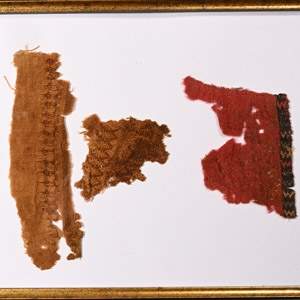
Egyptian Framed Coptic Fabric Collection
Circa 5th-7th century A.D.Sold for (Inc. bp): £85
Three fragments of tabby-weave linen fabric, two with embroidered ornament, one with a woven polychrome border; mounted in a glazed wooden frame with gilt inner border. 578 grams total, fragments: 6.5-15.5 cm (frame: 26 x 31 cm)
From the private collection of H. Norry, 1980s-1990s. -
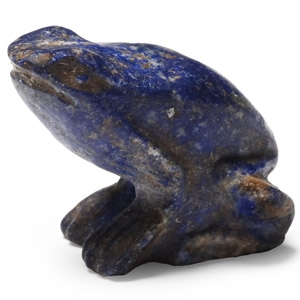
Egyptian Lapis Lazuli Frog Amulet
Late Period, 664-332 B.C.Sold for (Inc. bp): £260
Naturalistically rendered figure of a seated frog with longitudinal suspension hole through feet. 2.6 grams, 19 mm
From the collection of a gentleman, acquired on the London art market in the 1990s. -
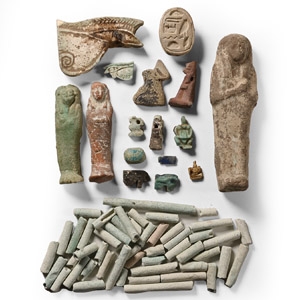
Egyptian Faience Amulet and Bead Group
Mainly Late Period, 664-332 B.C.Sold for (Inc. bp): £390
Comprising tubular beads, wedjat-eye amulets, shabtis, scarabs, and other items. 57 grams total, 8-71 mm
From the private collection of H. Norry, 1980s-1990s. -
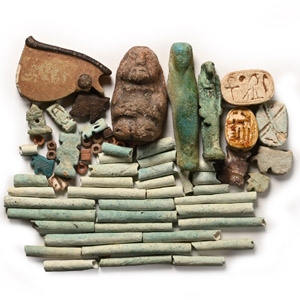
Egyptian Faience Amulet and Bead Group
Mainly Late Period, 664-332 B.C.Sold for (Inc. bp): £546
Comprising tubular and ring beads, wedjat-eye amulets, Bes amulets, scarabs, a Khnum amulet, a shabti, and others. 44 grams total, 3-47 mm
From the private collection of H. Norry, 1980s-1990s. -
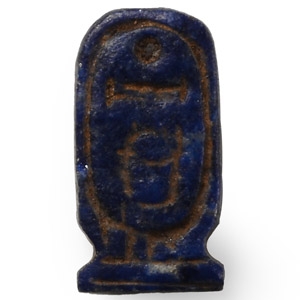
Egyptian Lapis Lazuli Amulet with Cartouche
New Kingdom, 1539-1075 B.C.Sold for (Inc. bp): £143
Rectangular in section with longitudinal piercing, hieroglyphic text. 1.38 grams, 16 mm
Acquired on the UK art market before 2000. Property of an Essex, UK, gentleman. -
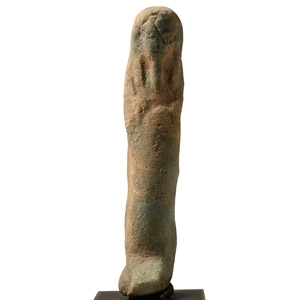
Egyptian Faience Blue Glazed Shabti
Ptolemaic Period, 323-30 B.C.Sold for (Inc. bp): £72
A typical mummiform figure with moulded facial detailing, a lappet wig, and hands holding a pick and hoe, the back with a possible hieratic inscription, mounted on a custom-made stand with label 'Ancient Egypt / (26th Dyn - Ptolem.) / circa 664-332 BC / Turquoise Faience / Ushabti Figure'. 91 grams total, 13 cm high including stand
Ex old UK collection. Acquired from Cestrian Antiques, Chester, UK, 2002. Ex Pemberton collection, Wales, UK. Accompanied by old information labels with collection reference C.234. Accompanied by the original Cestrian Antiques invoice.

