-
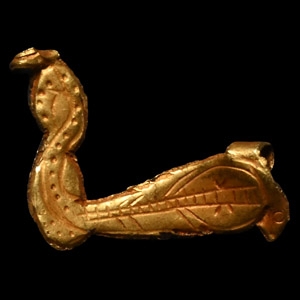
Egyptian Gold Cobra Amulet
Late Period, 664-332 B.C.Sold for (Inc. bp): £195
Depicting a rearing cobra with incised detailing and a suspension loop behind the head. 0.17 grams, 11 mm
From the private collection of the late Mrs Belinda Ellison, a long time member of the Egyptian Exploration Society, c.1940-2020. -
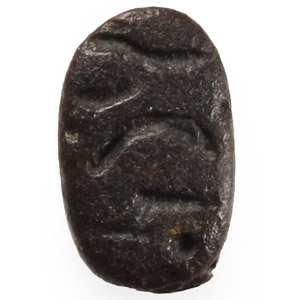
Phoenicio-Egyptian Inscribed Frog Amulet
Late 1st millennium B.C.Sold for (Inc. bp): £26
Carved in the round on an ellipsoid base with incised Phoenician characters to the underside. 1.32 grams, 10 mm
Acquired 1980-2015. Ex Abelita family collection. -
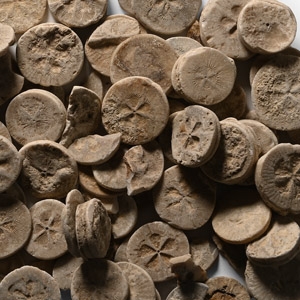
Egyptian Limestone 'Floral' Inlay Group
Roman Period, 30 B.C.-323 A.D. or earlierSold for (Inc. bp): £104
Group of discoid inlay plaques or gaming counters, crinoids with cinquefoil motif. 79 grams total, 8-18 mm
From a central London ADA dealership, 1980-1990.
Flowers were symbolic of rebirth due to the daily reopening of their petals after nightfall. As a result, they were widely used in domestic settings, religious and funerary contexts, and as adornments. Similar rosette discs, like those recovered from the Ramesside Period palace at Qantir, were used as decorative elements in royal palaces. -
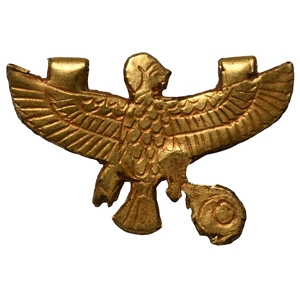
Egyptian Gold Ba-Bird Amulet
Late Period, 664-332 B.C.Sold for (Inc. bp): £247
Finely detailed depiction of a human-headed ba-bird with outspread wings and the one preserved claw holding a shen ring. 0.38 grams, 15 mm
From the private collection of the late Mrs Belinda Ellison, a long time member of the Egyptian Exploration Society, c.1940-2020.
In ancient Egyptian religion, the ba is one of the principal aspects of the human soul, along with the ka and the akh. It is often depicted in bird form, symbolising the soul's mobility after death. -
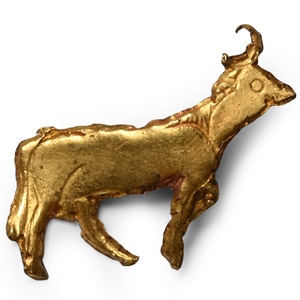
Egyptian Gold Bull Amulet
Late Period, 664-332 B.C.Sold for (Inc. bp): £117
Depicting a striding bull with a suspension loop on the back. 0.19 grams, 11 mm
From the private collection of the late Mrs Belinda Ellison, a long time member of the Egyptian Exploration Society, c.1940-2020. -
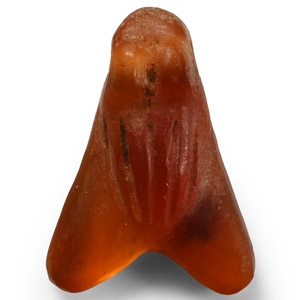
Egyptian Carnelian Fly Amulet
Late Period, 664-332 B.C.Sold for (Inc. bp): £117
Formed as a fly with long triangular wings and domed eyes. 0.42 grams, 12 mm
From an early 20th century collection.
Fly amulets first appeared in burials as early as c. 3200 B.C., but their popularity expanded during the New Kingdom. They were made from various materials such as gold, silver, lapis lazuli, carnelian, amethyst, faience, and bone. Fly amulets were thought to protect against insect bites and to ward off troublesome flying creatures through apotropaic magic. They may also have even been intended to symbolise the fly’s fecundity. Pharaohs would bestow gold fly-shaped pendants as military awards to honour the bravery and fly-like persistence of soldiers in battle. -
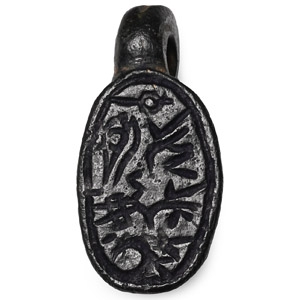
Phoenician Bronze Black Scaraboid Pendant
1st millennium B.C.Sold for (Inc. bp): £208
Smooth-fronted with a sturdy suspension loop at the top, the back incised with various signs, comprising a nefer hieroglyph, an eye, a quadruped, a standing figure with a headdress, and a sun disc. 7.7 grams, 25 mm
From the collection of a gentleman, acquired on the London art market in the 1990s. -
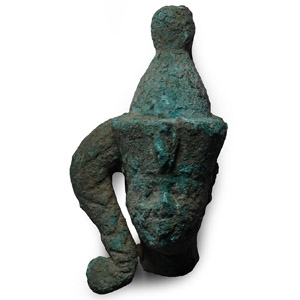
Egyptian Bronze Head of Harpocrates
Late Period, circa 664-332 B.C.Sold for (Inc. bp): £117
Head from a statuette of Harpocrates, wearing the Pschent crown fronted by uraeus, sporting the large plaited sidelock above the right ear. 86.5 grams, 60 mm
Acquired in the mid 1980s-1990s. Private collection, Switzerland, thence by descent. Private collection, since the late 1990s.
Harpocrates is the Greek rendering of the Egyptian Hor-pa-khered, meaning 'Horus the Child'. This title refers to Horus as the divine infant of Isis and Osiris. Wearing the amulet of Harpocrates was believed to offer the same protection that Isis gave her beloved son. -
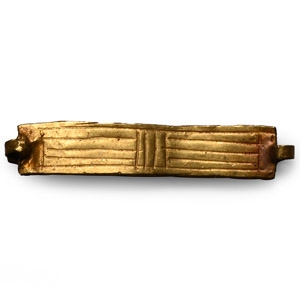
Egyptian Gold Panel
Late Period, 664-332 B.C.Sold for (Inc. bp): £85
Long rectangle with incised detailing, a suspension loop at either narrow end. 0.33 grams, 21 mm
From the private collection of the late Mrs Belinda Ellison, a long time member of the Egyptian Exploration Society, c.1940-2020. -
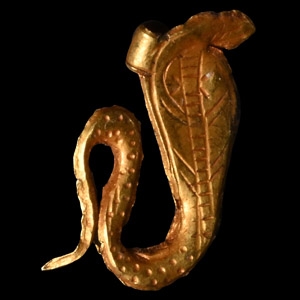
Egyptian Gold Cobra Amulet
Late Period, 664-332 B.C.Sold for (Inc. bp): £195
Depicting a rearing cobra with incised detailing and a suspension loop behind the head. 0.15 grams, 12 mm
From the private collection of the late Mrs Belinda Ellison, a long time member of the Egyptian Exploration Society, c.1940-2020. -
.jpg)
Egyptian Alabaster Cosmetic Jar
Late Period, 664-332 B.C.Sold for (Inc. bp): £130
Tapering gradually towards the top, with two small lugs at the shoulders, a collared rim, and flattened base. 77 grams, 87 mm
Private collection, Zurich, acquired in 1975 when the owners lived in Cairo (1975-1980). with Bonhams London, Antiquities, 23 July 2020, lot 119 (part). Property of a Bristol, UK, gentleman. -
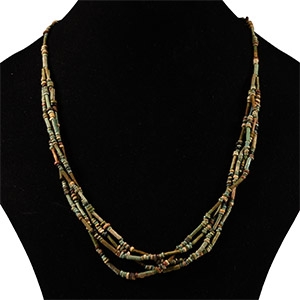
Egyptian Multi-Stranded Faience Mummy Bead Necklace
Late Period, 664-332 B.C.Sold for (Inc. bp): £234
Multi-stranded designer necklace composed of beads of mainly annular and tubular types. 21 grams, 72 cm long
Acquired before 1979. From the private collection of Mr F.A., South Kensington, London, UK; thence by descent 2014.
For thousands of years, artisans in Egypt created vibrant ceramics to echo the beauty of rare jewels. These ornaments were created with almost every material, colour, and texture imaginable and they come from across Egypt and beyond: vibrant blue lapis lazuli from Afghanistan, glossy black obsidian from Turkey, and aqua-green turquoise from the Sinai. They were worn in life and, after death, they served as precious ornamentation for mummies.

