-
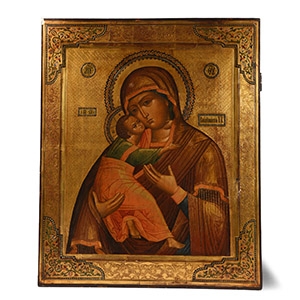
Large Russian Icon of Virgin of Vladimir
Circa 1860 A.D.Sold for (Inc. bp): £4,680
Depicting nimbate Mary Theotokos with veiled head and wearing a maphorion mantle over a dark blue robe with gold cuffs, inclined towards the infant Jesus supported by her right hand, his left arm wrapped around her neck and the right hand resting on her chest; gilt field and border with colourful enamelled detailing to the corners, roundels and rectangles with monograms and titling, on each side of her head 'ΜΡ ΘΥ' (Μήτηρ (τοῦ) Θεοῦ = Mother of God), over her left shoulder Cyrillic inscription 'Влади́мирская Б.М.' (Vladimir Mother of God), over the child inscription in Greek letters 'ΙϹ ΧϹ' (ΙΗϹΟΥϹ ΧΡΙϹΤΟϹ = Jesus Christ), three letters (only two visible) inside the nimbus of Christ representing the continuous divine self-existence of Christ as God ('O ѾN' = The Only One who always exists); Moscow School. 6.5 kg, 56.5 x 46 cm
Fine condition.
Ex property of a London lady, part of her family's collection. Accompanied by an academic report by Dr Raffaele D’Amato. This lot has been checked against the Interpol Database of stolen works of art and is accompanied by a search certificate no. 11543-196361.
This splendid specimen was probably originally housed in an aristocratic Russian home. The icon of the Virgin Mother of Vladimir with the infant Jesus (the original preserved in the Tretyakov Gallery, Moscow), probably the most famous icon of all of Russia, was thought to have been created in Constantinople in the early part of 1100s. This image is sometimes referred to as the ‘tenderness icon’, with artists attempting to show the close relationship of mother and son with their cheeks touching as they embrace. -
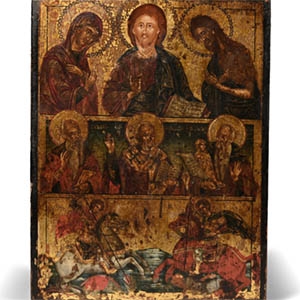
Greek Wooden Icon of Deisis with Saints George and Demetrius
Early 18th century A.D.Sold for (Inc. bp): £2,210
Painted on a wooden board with gessoed surface, tempera on wood panel with the recess executed on a gold ground in three registers: above, Deisis with Christ Pantocrator carrying the Gospel, flanked by the Virgin Mary and St John the Baptist; middle, with three bearded saints with their names written in Greek beside them: Aghios Charalambos, Aghios Nikolaos and Aghios Pantaleimon, the first two holding holy books and one the third holding a child; bottom, two mounted military saints, St George attacking a dragon with spear, and St Demetrius trampling the King of Avars. 1.8 kg, 26.8 x 35.5 cm
Ex Henry's Auction, Berlin, Germany. From an important collection of icons. Accompanied by an academic report by Dr Raffaele D’Amato. This lot has been checked against the Interpol Database of stolen works of art and is accompanied by search certificate number no.12343-224612.
Here, according to local Greek traditions, the icon is enriched with images of three important saints: among them St Pantaleimon, holding a child in his arms. According to the legend, one day the Saint found a dead child on the street who had been bitten by a snake, which was still beside the child’s body. Pantaleimon began to pray for Jesus to revive the dead child and to destroy the venomous reptile, believing that if his prayers were fulfilled he would become a follower of Christ. His prayers were fulfilled and the child rose up alive, and the snake died before Pantaleimon’s eyes. -
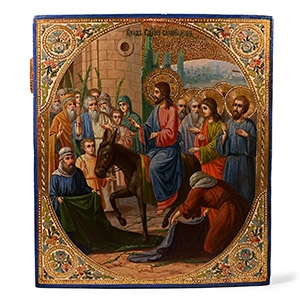
Russian Wooden Icon of Entry into Jerusalem
Russia, 19th century A.D.Sold for (Inc. bp): £1,170
Painted on a wooden board with mounting slots and panels to the reverse, gessoed surface with painting of Christ entering Jerusalem on Palm Sunday riding a donkey; crowd within the city wall waiting with palm fronds, two figures laying down cloaks for the donkey to walk on; followers of Christ in gateway, each with golden nimbus; Christ with similar and letters 'ω', 'C' reversed and 'Н'; Cyrillic script title above reciting: 'Entrance of the Lord in Jerusalem'; bands of gilt ornament to the borders and corners. 1.7 kg, 31 x 36 cm
Ed Jackson Auctions USA. From an important collection of icons.
The scene, painted in the style of 19th century romantic painters, represents a well-known part of the Gospels that describe the entry of Jesus into Jerusalem. He makes a grand entrance into the city on a donkey to fulfil the prophesy of Zechariah, “Tell the city of Zion, look, your king is coming to you! He is humble and rides on a donkey and on a colt, the foal of a donkey.” Christ is followed by his disciples and in the background citizens wave palm branches. -
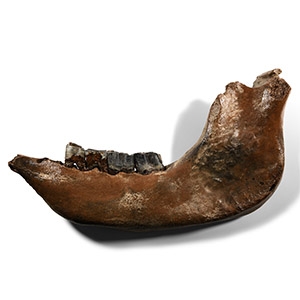
Woolly Rhinoceros Jaw
Devensian Period, circa 110,000-12,000 years B.P.Sold for (Inc. bp): £468
A well-preserved lower jaw section from Coelodonta antiquitatis with four molars. 3 kg, 52 cm
From the Northamptonshire, UK, collection of J. Shaul. Property of a Cambridgeshire, UK, gentleman.
The form of the woolly rhino’s skull and teeth had evolved to support its grazing lifestyle with its head dipped downwards towards the ground, even in its relaxed attitude. The skull is unusual in having both an extensively ossified nasal septum, probably evolved as a result of the heavy pressure on the horn and face when grazing, and a down-turned anterior region on the premaxilla that contacts the edge of the upper jaw. The shoulders were raised with a powerful hump, used to support the animal's massive front horn and also used for storing fat. -
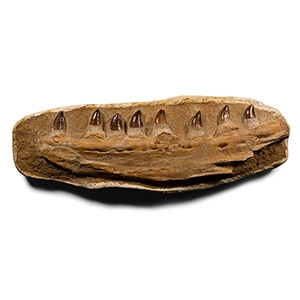
Large Mosasaur 'Marine Dinosaur' Jaw Fragment
Cretaceous Period, 145-65 million years B.P.Sold for (Inc. bp): £572
Comprising a large jaw fragment with eight teeth, mounted on a sedimentary matrix wrapped in a plaster field jacket. 7.45 kg, 59 cm
From a Cambridgeshire, UK, collection.
Mosasaurs (from the Greek for 'lizard') were aquatic dinosaurs which probably gave birth to live young. -
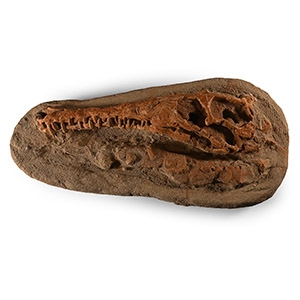
Fossil Diosaurus Skull and Bones on Composite Matrix
Paleocene Period, 66-56 million years B.P.Sold for (Inc. bp): £585
Displaying the left side of the skull and jaws with teeth, with a number of vertebrae to the side, set on a composite sandstone matrix; possibly Argochampsa krebsi. 6.66 kg, 51 cm
From a Cambridgeshire, UK, collection. -
.jpg)
Spectacular Woolly Mammoth Tusk Pair
Pleistocene Period, 2.6 million-11,700 years B.P.Sold for (Inc. bp): £9,750
A high quality pair displaying beautiful brown, green and cream colouring, from a young female Mammuthus primigenius; accompanied by custom-made display stands; some restoration. 24.85 kg total including stands, 151-159 cm long (outer edge)
From the Siberian Tundra. Ex Arctic Antiques, Germany. From the private collection of Commander Michael J Norman OBE AFC RN, Somerset, UK. Accompanied by a copy of a certificate of origin from Germany. Accompanied by a copy of the original purchase invoice (17,838.00 Euros). This lot has been checked against the Interpol Database of stolen works of art and is accompanied by a search certificate no. 12353-225019.
Both tusks were recovered from the same place in the Siberian permafrost in 2016. The left tusk weighs an impressive 6.2 kg and the right tusk 6.02 kg. The mammoth lineage branched from the Asian elephant around 6 million years ago, and later on the Woolly Mammoth, Mammuthus primigenius, evolved in eastern Siberia. Woolly mammoths, being slightly smaller than living African elephants, were foragers and ate grass, as well as small, nutritious flowering plants that flourished in the environment where they lived. They may also have used their curved tusks to dig through snow and eat plants that other foragers couldn't get to. -
.jpg)
Macrophthalmus Crab Cluster
Pliocene-Pleistocene Period, circa 5.3-2.6 million years B.P.Sold for (Inc. bp): £351
Comprising three Macrophthalmus crabs. 132 grams, 19.8 cm
From a Cambridgeshire, UK, collection. -
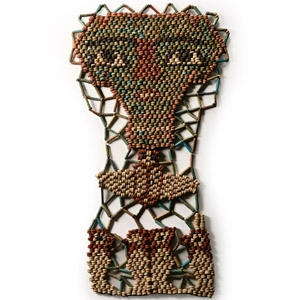
Egyptian Faience Mummy Beadwork Mask with Sons of Horus
Ptolemaic Period, 332-30 B.C.Sold for (Inc. bp): £416
A netted beadwork panel of annular and tubular glazed composition beads in blues, greens, black, cream and red-brown colours, depicting a mummy face mask with a false beard, a scarab with extended wings below, and beneath the 'Four Sons of Horus’, Duamutef, Qebehsenuef, Imsety, and Hapy joined together with areas of open netting of tubular examples; restrung with some later beads. 115 grams, 28.5 cm
Mariaud de Serres, Paris, 1990s.
Winged scarabs were often used as funerary amulets, and were believed to symbolise the rebirth and regeneration of the deceased. The Four Sons of Horus were deities responsible for protecting the deceased's internal organs. The jackal-headed Duamutef protected the stomach, the falcon-headed Qebehsenuef protected the intestines, the human-headed Imsety protected the liver, and the baboon-headed Hapy protected the lungs. These internal organs were often placed in canopic jars, each with the head of the respective Son of Horus. Amulets depicting these deities were placed within the mummy wrappings. -
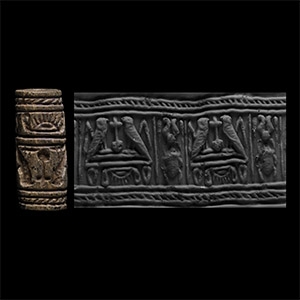
Egyptian Cylinder Seal with Hieroglyphs
Late Period, 664-332 B.C.Sold for (Inc. bp): £390
Steatite cylinder producing a decorative top and bottom border enclosing a scene depicting a nefer sign flanked by two falcons surmounting the hieroglyph for gold, nub, and another scene to the side depicting a scarab beetle with a double plumed sun disc above; with a suspension hole running through the cylinder's centre. 4.65 grams, 25 mm
From the collection of a gentleman, acquired on the London art market in the 1990s. -
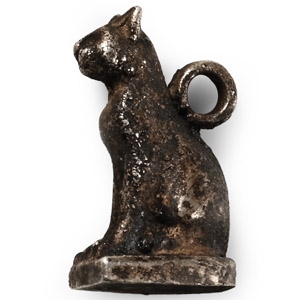
Egyptian Silver Cat Amulet
Late Period, 664-332 B.C.Sold for (Inc. bp): £390
Modelled seated on a tongue-shaped base, with facial detailing and suspension loop to the back. 1.57 grams, 12 mm
From an early 20th century collection.
The cat was sacred to Bastet, a protective mother goddess and the daughter of the sun god Re. Amulets provided the wearer with the goddess's protection. -
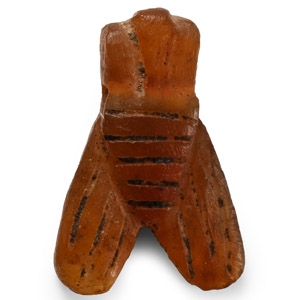
Egyptian Carnelian Fly Amulet
Late Period, 664-332 B.C.Sold for (Inc. bp): £72
Carved with ribbed body and eye detailing; drilled through the eyes for suspension. 0.37 grams, 12 mm
From the private collection of H. Norry, 1980s-1990s.

