-
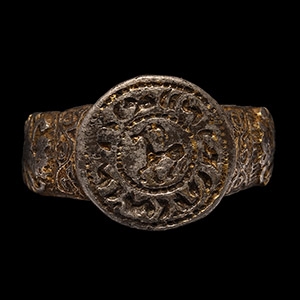
Armenian Inscribed Silver-Gilt Ibex Seal Ring
Kingdom of Cilica, circa 14th century A.D.Sold for (Inc. bp): £468
Barrel-shaped with high-relief moulding to the shank, discoid bezel with central ram/ibex and legend to the tondo. 2.66 grams, 20.31 mm overall, 16.01 mm internal diameter (approximate size British L, USA 5 3/4, Europe 11.24, Japan 10)
Acquired in the 1980s. From the collection of a London antiquarian. -
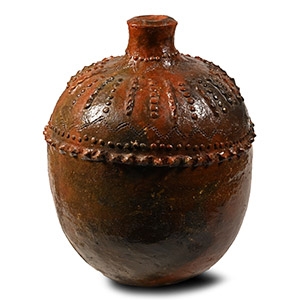
Large Medieval Glazed Red Ware Water Container
England, 15th-16th century A.D.Sold for (Inc. bp): £234
Acorn-shaped with rounded underside, ring of studs to the equator, applied pellets and pie-crust bands, pointillé zigzags to shoulder; thick mouth with incised pointillé lines. 4.2 kg, 33 cm
From a family collection mostly formed in the 1940s-1950s, thence by descent. -
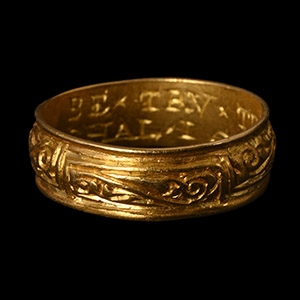
'The Burton Agnes' Tudor 'BE x TRV x TIL x DEATHE x AND x SO // SHAL x I' Gold Double Register Posy Ring
Circa 1550-1600 A.D.Sold for (Inc. bp): £3,900
Barrel-shaped hoop with scrolled panels to the outer face; inner face with legend in two tiered lines of seriffed capitals 'BE x TRV x TIL x DEATHE x AND x SO // SHAL x I' with final curlicue. 5.23 grams, 20.70 mm overall, 18.11 mm internal diameter (approximate size British O 1/2, USA 7 1/4, Europe 15.61, Japan 15)
Found whilst searching with a metal detector in a garden in Burton Agnes, East Riding of Yorkshire, UK, on 8th January 2023, by Christopher Watson. Declared as treasure and disclaimed by the crown with Treasure reference no.2023 T41. Accompanied by a copy of the British Museum's Portable Antiquities Scheme (PAS) report no.YORYM-7CD0D7. Accompanied by a copy of the report for H M Coroner no.2023 T41. This lot has been checked against the Interpol Database of stolen works of art and is accompanied by a search certificate number no.12442-225797.
The legend 'Be true til death and so shall I' is not recorded in that form in Evans's corpus (now nearly a century old), but variants such as 'Be true to me as I to thee' or Be true in heart till death depart' carry a similar sentiment. -
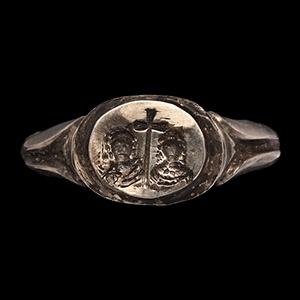
Tudor Period Silver 'Harmony' Marriage Posy Ring
16th-17th century A.D.Sold for (Inc. bp): £715
Substantial D-section segmented hoop and stepped bezel; ellipsoid plaque with two busts flanking a cross; equal-arm cross below each shoulder, mane in fede clasped hands to the centre and flanking ellipsoid panels with 'OMO' and 'NIA' legend for omonia (Greek, meaning 'agreement, harmony'). 5.93 grams, 25.94 mm overall, 19.41 mm internal diameter (approximate size British S, USA 9, Europe 20, Japan 19)
Private collection, Arundel, West Sussex, UK, 1980s. -
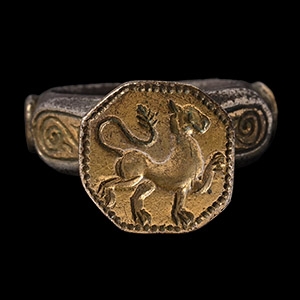
Post Medieval Silver-Gilt Ring with Lion
17th-18th century A.D.Sold for (Inc. bp): £338
Substantial D-section hoop with five radiating disc studs, each with gilt face and starburst motif; raised shoulders with gilt piriform panels, elaborate S-scroll motifs; trumpet-shaped octagonal bezel with gilt face, pelletted border and lion passant motif. 21.37 grams, 40.00 mm overall, 19.57 mm internal diameter (approximate size British T 1/2, USA 9 3/4, Europe 21.89, Japan 21)
Acquired on the London art market in the late 1980s-1990s. From the family collection of an East London, UK, gentleman. -
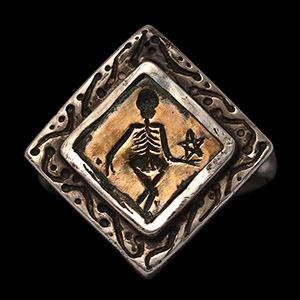
Georgian Silver 'Vive Memor Leti' Memento Mori Ring
18th century A.D.Sold for (Inc. bp): £1,235
With stepped lozengiform bezel, central gilt plaque with skeleton and star, guilloche to the shoulder; inscribed in florid italic hand to the inner face of the hoop 'Vive Memor Leti' (be mindful of death in life). 4.14 grams, 22.92 mm overall, 18.42 mm internal diameter (approximate size British Q, USA 8, Europe 17.49, Japan 16)
Private collection, Arundel, West Sussex, UK, 1980s.
The Latin phrase is taken from the work of the 1st century AD poet Aulus Persius Flaccus, Satires V 151-3: vive memor leti ! fugit hora; hoc quod loquor inde est (Live mindful of death. Time is fleeting [and] every word I speak is [borrowed] from it.). -
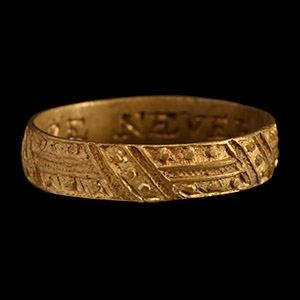
'The Framlingham Manor' Tudor Gold 'FOR EVER ORE NEVER' Wreath Posy Ring
1550-1650 A.D.Sold for (Inc. bp): £1,690
Flat-section hoop with low-relief pellets and banding to the outer face imitating a wreath; inner face with incised legend in seriffed capitals 'FOR EVER ORE NEVER'. 1.39 grams, 15.72 mm overall, 13.98 mm internal diameter (approximate size British F, USA 2 3/4, Europe 3.67, Japan 3)
Found whilst searching with a metal detector near Framlingham, Suffolk, UK, on Saturday 26th August 2023, by Mr Pepper; declared as Treasure and subsequently disclaimed. Accompanied by a copy of the British Museum’s Portable Antiquities Scheme (PAS) report no.SF-3FCA89. Accompanied by a copy of the Treasure report for H M Coroner from Framlingham, Suffolk, no.2023T946.
The find spot, Framlingham in Suffolk, is the site of Framlingham Castle which was once the stronghold of the powerful Dukes of Norfolk. The present structure dates to 1148 AD but may have replaced an earlier burh from pre-Conquest times. It has had royal associations for centuries, and Mary Tudor (the daughter of Henry VIII by his first wife, Catherine of Aragon) was proclaimed Queen of England at the castle in 1553, the first woman to accede to the throne of England in her own right. -
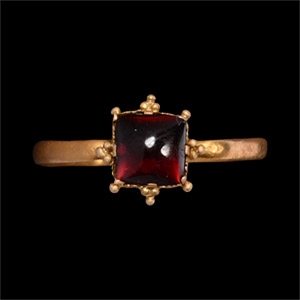
Post Medieval Gold Posy Ring with Garnet
Circa 18th century A.D.Sold for (Inc. bp): £910
Slender shank with the vestiges of a posy inscription internally, square bezel forming a cell with granule cluster to each lateral face; with a later cabochon garnet gemstone. 1.56 grams, 23.33 mm overall, 18.44 mm internal diameter (approximate size British Q, USA 8, Europe, 17.49, Japan 16)
Acquired by the previous owner's father in the early 1990s. Property of a Warwickshire, UK, collector. -
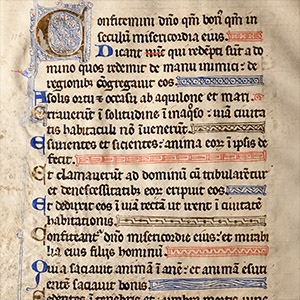
Medieval Philip Augustus Vellum Psalter Folio
13th century A.D.Sold for (Inc. bp): £1,040
With 21 lines of bastarda script text in black with blue versals and gold leaf detailing, red and blue decorative blocking, vertical bar with beast-head finial to margin; drypoint ruling visible. 5.41 grams, 23.3 x 16.7 cm
From an important collection of Christian artefacts formed by a London gentleman, 1970s-1980s. From the private collection of Mr David Barker, London, UK; thence by descent. -
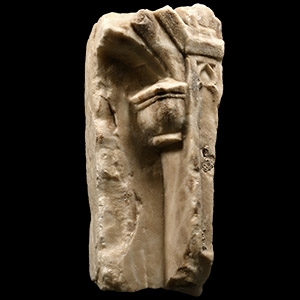
Romanesque Marble Architectural Stele Fragment
10th-11th century A.D.Sold for (Inc. bp): £351
Lateral edge fragment from an architectural panel with vertical jamb, corbel and end of an arch with cooped leading edge; jamb with recessed lancet detailing, vertical orientation. 2.1 kg, 21.5 cm
Assembled by family members in the mid 20th century. From a private West Sussex, UK, family collection. -
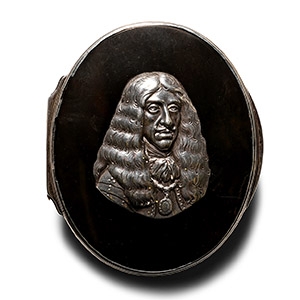
Stuart Period Silver Snuff Box with Bust of Charles II
1660-1685 A.D.Sold for (Inc. bp): £1,404
With hinged lid formed as a tortoiseshell plaque in a silver frame; applied high-relief mount bust of Charles II in three-quarter view. 203 grams, 10.2 cm
Property of a County Durham collector; acquired on the UK art market. This lot has been checked against the Interpol Database of stolen works of art and is accompanied by a search certificate number no.12443-225455. -
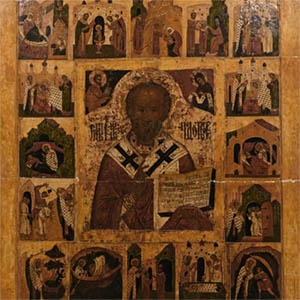
Monumental Wooden Russian Icon of Life of St. Nicolas
17th century A.D.Sold for (Inc. bp): £9,100
An icon of Saint Nicholas of Mira, tempera on wood panel, the central part of the composition depicting Saint Nicholas with an open book in his left hand showing an excerpt from the Gospel of Luke (VI.17) in which Christ is preparing for the Mount of Beatitudes sermon; Saint Nicholas shown blessing, dressed as a bishop, with a white sticharion, covered by a red omophorion, and surmounted by a white epitrachelion embroidered with black crosses; the saint flanked by Jesus and Virgin Mary, respectively on dark blue and red background; Christ holding the Gospel, Mary the bishop’s epitrachelion; in horizontal registers, left to right, and top to bottom, are depicted scenes of the saint’s life: Nicholas's birth; his baptism; Nicholas healing a woman; beginning his studies as a priest; the saint being appointed deacon; the saint invested in the priesthood; his ordination to Episcopacy; Nicholas appearing in dreams to Patriarch Ablabius and Emperor Constantine to persuade them to free three prisoners (two scenes); Nicholas saving the three prisoners from the death sentence; Nicholas rescuing three generals wrongly imprisoned; the saint chopping down a tree possessed by a demon; the saint calming a storm at sea; Nicholas rescuing the boy Basil from captivity; the Dormition of St Nicholas; the saint saving a boy from drowning in Kiev; Cyrillic inscription on the right and left side of the central image reading Никола́й Чудотво́рец = Saint Nicholas the wonderworker. 17.6 kg, 89 x 110 cm
Ex Stair Galleries, New York, USA. From an important collection of icons. Accompanied by an academic report by Dr Raffaele D’Amato. This lot has been checked against the Interpol Database of stolen works of art and is accompanied by search certificate number no. 12341-224608.
Saint Nicholas lived in 4th century A.D. and was the bishop of Myra, in the Roman Asia Minor. Because of the many miracles attributed to his work, his cult was widespread in the Orthodox world and he is known as Nicholas the wonderworker. His reputation as a secret gift-giver (such as putting coins in the shoes of those who left them outside, or the dowry given to three maidens saving them from prostitution) created a model for Santa Claus. The veneration of the saint, who participated in the Council of Nicaea of 325 A.D., began very soon after his death.

