-
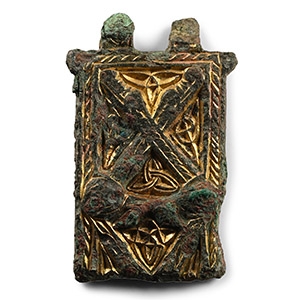
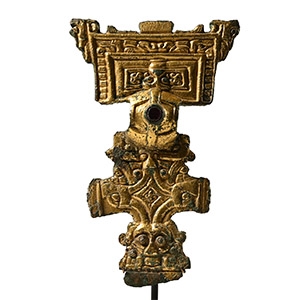
Hiberno-Saxon Gilt Bronze Buckle Plate
8th century A.D.Sold for (Inc. bp): £2,210
Rectangular in plan with hinge knuckle to one short end; ropework outer edges and raised saltires, on a field of chip-carved triskeles and other motifs; low socket to reverse. 6.62 grams, 34 mm
Found North Yorkshire, UK.
The style of decoration is typical of Hiberno-Saxon metalwork associated with the influence of Irish missionaries in England. -
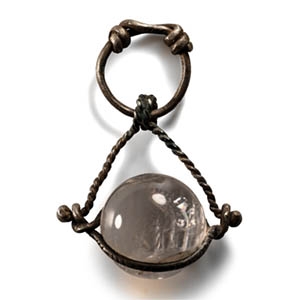
Saxon Silver Pendant with Crystal Sphere
Circa 6th-10th century A.D.Sold for (Inc. bp): £1,560
Rock crystal sphere in a sturdy silver wire frame with hinged suspension arms and loop. 32.3 grams, 66 mm
Private collection formed in Europe in the 1980s. Westminster collection, central London, UK. -
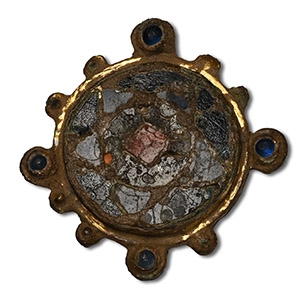
Late Saxon Enamelled Gilt Bronze Brooch
Circa 11th century A.D.Sold for (Inc. bp): £260
With circular frame enclosing a cloisonné enamel cinquefoil design in shades of blue and red, radiating lobes to the rim, each with an enamel fill. 6.29 grams, 29 mm
Acquired on the European art market since the early 2000s. From the private Northern Ireland collection of R.M. -
.jpg)
Anglo-Saxon Gilt Bronze Pin Terminal
8th-9th century A.D.Sold for (Inc. bp): £358
Lozengiform in profile with voids in the spandrels and central cross with pelta finial, overlapping scaled developing to scrolls, applied stud at the central junction; lateral lugs pierced to accept connecting chains; vesica-shaped leaves to the base above bulbous junction with the pin (absent). 10.2 grams, 46 mm
Found near Cambridge, Cambridgeshire, UK. From an old private collection of Norfolk, UK, gentleman, formed since 1998. Accompanied by a copy of UK Detector Finds Database (UKDFD) report no.57990.
Dress pins of this type were worn in sets of three connected with chains or thongs. -
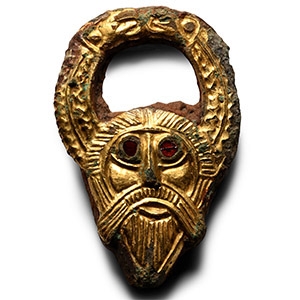
The 'Kingsworthy' Anglo-Saxon Gilt-Bronze Horned Woden's Head Appliqué
6th-7th century A.D.Sold for (Inc. bp): £14,040
A spectacular appliqué in the form of a facing male head with horned headgear; piriform face, discoid eyes with garnet (?) cloison inserts, the nose covered by the nasal of the headgear, the beard triangular and the ends of the moustache extending beyond the cheeks; hair covered by a helmet or mask with hatched texture extending around the upper face and developing to two crescent extensions from the temples which meet above the crown of the head; the terminals formed as birds' heads; possible remains of attachment stud to the reverse. 9.82 grams, 38 mm
Found Kingsworthy, Winchester, Hampshire, UK, in 2017. Accompanied by a copy of the Portable Antiquities Scheme report number BERK-DB4E15. Accompanied by a copy of the article in The Searcher magazine, number 389, January 2019, where it is featured on the front cover. This lot has been checked against the Interpol Database of stolen works of art and is accompanied by a search certificate number no.12439-225587.
The headgear with bird-head terminals is restricted to the 6th-7th centuries in England, although there are parallels from the material culture of both Anglian England and southern Scandinavia at this time. A pair of comparable bird-helmeted human faces can be found on the reconstructed frontal plates on the helmet found in Mound 1 at Sutton Hoo (Suffolk) depicting dancing warriors, and the male face shown on a foil fragment recovered from the barrow at Caenby (Lincolnshire). Similar also is the figure on one of the dies found at Torslunda (Öland, Sweden) showing a male wearing a helmet with a pair of bird-headed horns. A long, triangular male face is shown on the vandyke designs on the foil horn mounts from the barrow at Taplow (Berkshire). A male figure wearing a helmet with horns and bird-head terminals is the central design on a long triangular buckle found in grave 95 at Finglesham (Kent), and also from Finglesham (grave 138) is a mount in the form of a long, triangular human head with vertical radiating bands from the top of the head, and two crescentic horns emerging from the crown, terminating in opposed birds’ heads which meet above. A similar mount was found at Rempstone (Nottinghamshire) and privately published in Raynor (2010) while others were found more recently at Attleborough (Norfolk) and Soberton (Hampshire, PAS ref. HAMP2432). A mount depicting a similar figure, showing the upper body with hands gripping spears, was published in Hammond (2010). The significance of the headgear has not been fully explored but the coincidence of the birds and the head recall the later myths of Oðinn and his bird messengers, and suggest that these mythic characters were familiar in early Anglo-Saxon England. Kevin Leahy, National Adviser, Early Medieval Metalwork of the PAS commented: "This striking mount is Early Anglo-Saxon and dates from the 6th to 7th century. Faces like this, wearing a horned headdress (or sporting horns of their own) are well known, appearing on some of the foils decorating the Sutton Hoo helmet, where the warriors carry swords and spears and appear to be dancing. A similar foil was found in a burial at Caenby, Lincolnshire and the horned warrior carrying two spears appears on a gold buckle from Finglesham, Kent. Horned warriors are not restricted to England and appear on a die for making foils found at Torslunda, Sweden, and on a die from Ayton in the Scottish Borders region. The question is: who do these mounts represent? It has been suggested that they depict the god Woden, one of whose attributes was a spear and that the birds' heads on the ends of the horns represent the the god's two ravens. However, these birds often have hooked eagles' beaks not the pointed beaks of ravens. We also see multiple depictions of the horned warrior on the same foil suggesting that it was not the god, although it is possible that the god's image was duplicated to emphasise his power. Woden is sometimes shown with only one eye as he gave up his other eye in exchange for wisdom. The two garnet-inlaid eyes seen here do not preclude the face being that of Woden but it would have been helpful if it had only one eye. Finally, what was this mount used for? Other examples like the one from Rempstone, Notts., has mounting pins on its back as does a mount from Finglesham, Kent. Many of the other mounts, however, lack any signs of a fixing. It is clear that the mount described here was attached to an iron object but we are left guessing what it was: a helmet or a buckle? Unless you find one still attached we are going to be left to wonder. Recorded and assessed by the Secretary of State’s Expert Adviser as an object of cultural interest. The RCEWA reviewed an export application and determined that it meets the third Waverley criterion, making it currently non-exportable. -
Anglo-Saxon Gilt Great Square-Headed Brooch with Garnet
6th century A.D.Sold for (Inc. bp): £3,380
Comprising: trapezoidal headplate with beast-head spurs to the upper angles and concentric panels of Style I ornament with flanking billets; shallow bow with central cell and garnet cloison insert; short footplate with lateral lappets featuring profile masks and central lozenge; facing mask above a trapezoidal bar finial; pin-lugs and catch to the reverse; mounted on a custom-made stand. 74 grams, 11 cm (126 grams total, 13 cm high including stand)
with ArtAncient Ltd. Private collection, London. This lot has been checked against the Interpol Database of stolen works of art and is accompanied by a search certificate number no.12440-226863.
The meaning of the 'facing mask' motif on the footplate is probably related to the profile masks frequently used in Style I art, where the 'pellet' eye is enclosed by an arched frame: the 'facing mask' repeats this motif to produce a pair of eyes in a doubled 'bow'. An element of visual 'riddling' is no doubt present: the design is neither one thing nor the other, but includes elements of both. Distribution of great square-headed brooches was initially concentrated along the valleys of the Rivers Trent, Thames and Severn, though it was later confined to the East Midlands and East Anglia (Hines, 1997, figs. 101, 102). -
.jpg)
High-Status 'Ryedale' Anglo-Saxon Bronze Hanging Bowl with Enamelled Chip-Carved Mounts
Ryedale, North Yorkshire, 550-570 A.D.Sold for (Inc. bp): £15,600
An excessively rare and almost complete copper-alloy hanging bowl and associated fittings, comprising: (i) the bowl with three attached matching hooked escutcheons and suspension rings; (ii) the basal disc with separate frame; (iii) a body fragment (or repair patch); (iv) a curved bronze fragment; (iv) a curved copper-alloy strip (v) four skeletal fragments from a sheep or similar; accompanied by a high quality custom-made display stand. 303 grams, 19 cm (720 grams total, 23 cm including stand)
Found whilst searching with a metal detector in Ryedale, North Yorkshire, UK, on Sunday 5th February 2023 by Chris Ulliott. Accompanied by a copy of the British Museum's Portable Antiquities Scheme report no.YORYM-59523A. Accompanied by a handwritten signed letter from the finder explaining the circumstances of finding. Accompanied by a copy of a signed Art Loss Register declaration no.S00236559, dated 18th September 2023, and an Interpol search certificate dated 3 October 2023. This lot has been checked against the Interpol Database of stolen works of art and is accompanied by a search certificate number no.12441-225438.
Hanging-bowls are high-status vessels with origins in the Roman period which continued in use only in Britain and Ireland. They appear in burial contexts which date them to the sixth to late seventh century. The form of this example is paralleled by the bowl from Hadleigh Road, Ipswich, Suffolk (British Museum accession number 1984,0103.9) which has a similar shape and kite-shaped escutcheons secured by three rivets (Bruce-Mitford, 2005, Corpus No. 86). -
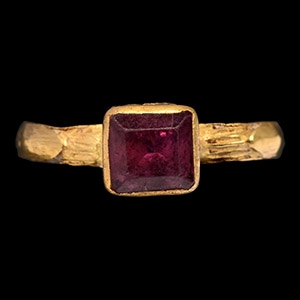
Medieval Gold Ring with Ruby
15th-16th century A.D.Sold for (Inc. bp): £2,860
Flat-section hoop with raised heart to each shoulder, square bezel with arcading to the outer face, inset table-cut ruby. 1.52 grams, 21.31 mm overall, 15.89 mm internal diameter (approximate size British K, USA 5 1/4, Europe 9.95, Japan 9)
From the late Alison Barker collection, 1970-1990. -
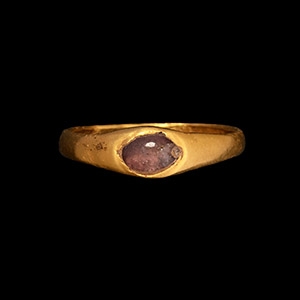
'The Oswestry' Medieval Gold Bishop's Stirrup Ring with Amethyst Cabochon
Circa 1250-1400 A.D.Sold for (Inc. bp): £2,210
Comprising a flat-section hoop with ellipsoid bezel and inset amethyst cabochon in a crimped cell. 2.84 grams, 22.59 mm overall, 17.92 mm internal diameter (approximate size British P, USA 7 1/2, Europe 16.23, Japan 15)
Found by William Barker whilst searching with a metal detector on Friday 16th December 2016 in Oswestry, Shropshire, West Midlands, UK, declared as treasure and disclaimed by the crown with treasure case no.2017T0054. Accompanied by a copy of the British Museum's Portable Antiquities Scheme (PAS) report no.HESH-5E23E3. Accompanied by the original Shropshire Museum Service object entry receipt. Accompanied by a copy of The Searcher Magazine article where it is published. -
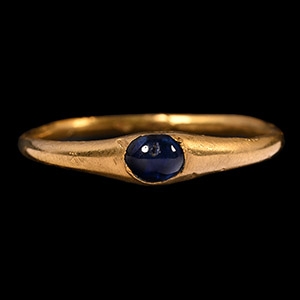
Medieval Gold Bishop's Stirrup Ring with Sapphire
13th-14th century A.D.Sold for (Inc. bp): £1,690
The bezel a low flat topped cell surmounted by a cabochon sapphire. 2.69 grams, 22.87 mm overall, 18.67 mm internal diameter (approximate size British P 1/2, USA 7 3/4, Europe 16.86, Japan 16)
From the late Alison Barker collection, 1970-1990. -
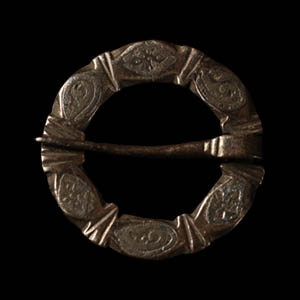
Medieval Silver and Niello Ring Brooch
13th century A.D.Sold for (Inc. bp): £195
The hoop formed flat with six bulbs separated by notched bars, each bulb with scrolled tendril or pelletted cross decoration; sturdy pin coiled about the shank. 1.5 grams, 24 mm
Acquired in the 1980s. From the collection of a London antiquarian.
An unusually fine example in silver; the bulk of these brooches are of lead-tin or copper-tin alloy. -
.jpg)
Medieval Bronze Seal Matrix of John Neiruit, Judge Serving in King John's Court
13th century A.D.Sold for (Inc. bp): £234
With oval body and suspension loop to the base, central device a running stag, bearing a legend reading '* S'Iohannis Neirnvt' for 'seal of John Neirnuit' of the the royal council. 9.34 grams, 33 mm
Found on Inhust Farm, Baughurst, Hampshire, UK. From the collection of a Caerphilly, UK, gentleman formed since 1990. Accompanied by a copy of a museum report with reference no.NMGWPA 2008 (SU 570 612).

