-
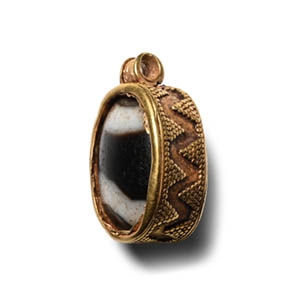
Gold Pendant with Agate Scaraboid
5th-3rd century B.C.Sold for (Inc. bp): £1,170
Banded agate scaraboid with openwork gold frame, tubular suspension loop, triangular clusters of granules to the edge; Phoenician or Achaemenid. 4.20 grams, 21 mm
Acquired in the mid 1980s-1990s. Private collection, Switzerland, thence by descent. Private collection, since the late 1990s. -
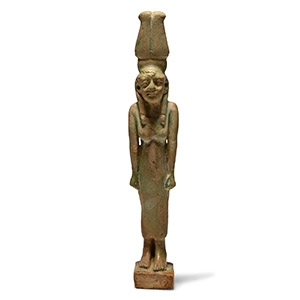
Large Egyptian Faience Amulet of the Goddess Isis
Late Period-Ptolemaic Period, 664-30 B.C.Sold for (Inc. bp): £1,170
The goddess dressed in a long tight-fitting tunic to her ankles, standing with her left leg forward, her straight arms descending to her thighs; vulture headgear surmounted two long feathers; dorsal pillar with hieroglyphic text; repaired. 50 grams, 14 cm
Private collection Mr E. Saad, Cairo, Egypt-Montreux, Switzerland, 1970s. Ex private collection of Mr S.A., acquired from Mr Saad in 1997.
In ancient Egyptian mythology, Isis was the sister-wife of Osiris and the mother of the sky god Horus. She is associated with aspects of fertility and motherhood. This amulet unusually depicts her with a two-plumed crown, which may associate her with the goddess Sothis. -
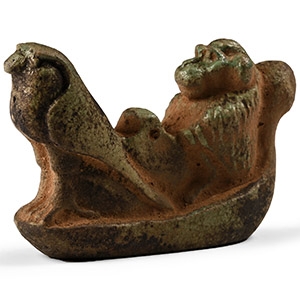
Egyptian Faience Thoth and Horus in a Boat
Late Period, 664-332 B.C.Sold for (Inc. bp): £1,235
Modelled in the round, comprising a small barque with a seated baboon and a falcon, possibly Thoth and Horus, with a slot to the underside. 35.9 grams, 64 mm
From the collection of a gentleman, acquired on the London art market in the 1990s.
In Egyptian mythology, Thoth restored the eye of Horus, suggesting that this may be the theme of the figurine's composition. Alternatively, the composition may be a condensed depiction of the funerary vignette, which shows the falcon form of the sun god Re in his solar barque flanked by baboons in an attitude of praise. The slot in the underside suggests it was once attached to a separate base. -

Egyptian Bone Ram-Headed Boat with Two Deities
Late Period, 664-332 B.C.Sold for (Inc. bp): £624
Carved in the round reed boat with ram-headed prow, altar amidships surmounted by a horned sun disc and flanked by two baboons standing in adoration; repaired. 10.4 grams, 55 mm
From the collection of a gentleman, acquired on the London art market in the 1990s.
This represents a condensed version of a two-dimensional funerary scene of the sun god Re, here represented by the horned disc, in his solar barque, flanked by baboons in an attitude of praise. The boat's ram-headed prow possibly alludes to Re's transformation into a ram during his night-time journey through the Underworld. -
.jpg)
Large Egyptian Bronze Figure of Osiris
Late Period-Ptolemaic Period, 664-30 B.C.Sold for (Inc. bp): £7,150
Bust of Osiris modelled in the round, wearing the white crown with uraeus to the brow, plaited false beard, tiered collar with counterweight to rear; the hands opposed at the chest, holding the nekhakha flail and the heka crook; the eyes with glass inserts; mounted on a custom-made stand. 850 grams total, 35 cm high including stand
Ex R. Liechti (1934-2010) collection, Geneva, Switzerland. Private collection, Europe. This lot has been checked against the Interpol Database of stolen works of art and is accompanied by search certificate number no.12365-226680.
Osiris is a deity who represents death and fertility and is commonly regarded as the quintessential god of rebirth. Though he was once a mortal ruler, as a deceased entity, his domain was the Underworld. Abydos was the primary centre of Osiris’ cult, where a renowned yearly celebration of the god was held. The proliferation of bronze statues of the god indicates his widespread popularity. R. Liechti was a distinguished collector of Egyptian antiquities, known for his discerning eye and passion for ancient artefacts. Active during the mid-20th century, Liechti's collection featured a wide range of objects that showcased the rich cultural heritage of ancient Egypt, from intricately carved statuettes to rare amulets and jewellery. His dedication to preserving and studying these relics earned him a respected reputation among scholars and collectors alike. Many pieces from his collection have since found their way into prominent museum collections and auction houses, further solidifying his legacy in the world of antiquities. -
.jpg)
Egyptian Bronze Figure of Harpocrates
Late Period, 664-332 B.C.Sold for (Inc. bp): £3,250
Seated nude statuette of Harpocrates, with legs together and left arm by his side, right arm bent across the chest with forefinger raised to his lips, wearing a nemes headdress with uraeus on the front and a bold sidelock on the right side, surmounted by an elaborate hem-hem crown consisting of three conical atef crowns each topped with a sun disc, with an ostrich plume to the side of the outermost, and flanked by two uraei with sun discs, all supported on two horizontal ram's horns; semi-naturalistic anatomical detailing; feet resting on an integral square plinth, mounted on a wooden stand. 584 grams, 18.5 cm
Ex pre-war collection, Switzerland. Private collection, Europe. Accompanied by a copy of an Art Loss Register certificate no.S00075707. This lot has been checked against the Interpol Database of stolen works of art and is accompanied by a search certificate number no.12371-226682.
Harpocrates is the Greek rendering of the Egyptian Hor-pa-khered, which translates as 'Horus the Child'. This refers to Horus as the divine infant of Isis and Osiris. Statuettes of Harpocrates could provide the dedicator with the same protection that Isis gave her beloved son. -
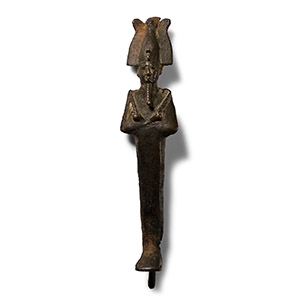
Egyptian Bronze Statuette of Osiris
Late Period, 664-332 B.C.Sold for (Inc. bp): £650
A slender standing figure of Osiris in iconic mummiform appearance, wearing the tall conical Atef crown with its flanking Ostrich plumes, and central uraeus, a long, internally-detailed divine beard, and holding the crook (heka) and flail (nekhakha) regalia; with tang under feet for attachment. 63 grams, 15 cm
Acquired on the German art market, 1989-1995. with The Museum Gallery, 19 Bury Place, London, WC1, UK, 1998-2003. Property of a London based academic, 2003-present.
Osiris is a deity who represents death and fertility and is commonly regarded as the quintessential god of rebirth. Though he was once a mortal ruler, as a deceased entity, his domain was the Underworld. Abydos was the primary centre of Osiris’ cult, where a renowned yearly celebration of the god was held. -
.jpg)
Egyptian Bronze Sistrum with Bes and Hathor
Roman Period, 30 B.C.-323 A.D.Sold for (Inc. bp): £14,950
The large liturgical rattle with a columnar handle composed of a bifacial figure of Bes standing on a lotus capital, flanked by seated sphinxes, his feathered crown supporting the bust of goddess Hathor wearing a broad collar and a curling wig, two rearing uraei emerging from the sides to support the base of the rattle, both wearing the pschent crown, above the cobras a standing figure of the goddess Hathor in cow form, wearing a tripartite wig and a sun disc between the horns; the rattle with a looped body with flared outer rims and set with three metal rods to accept metal discs, a pair of reclining lions to the base and the top with three felines surrounding a cockerel, and resting one of their front paws on the bird. 1.52 kg, 39.5 cm
German art market. European private collection, 1970s-early 2000s. Acquired from the above; thence by descent. Private collection, London, UK. Accompanied by an academic report by Dr Raffaele D’Amato. This lot has been checked against the Interpol Database of stolen works of art and is accompanied by search certificate number no.12348-225588.
The sistrum (seshesh in ancient Egyptian) was a rattle-like musical instrument, played exclusively by women in religious ceremonies. It was often decorated with the bust of the goddess Hathor to whom the sistrum was sacred. Their use continued into the Roman period in ceremonies associated with the cult of Isis. -
.jpg)
Egyptian Bronze Head of a Pharaoh with Inlaid Eyes
Third Intermediate Period, 21st-22nd Dynasty, circa 1069-900 B.C.Sold for (Inc. bp): £49,400
Hollow-formed mask with integral tripartite wig and mount for a uraeus; impassive facial detailing and applied gold cosmetic lines to eyes, eyebrows, and lateral chin straps of the braided 'false beard'; segment of the wesekh-collar visible between the lappets of the wig; some restoration; mounted on a custom-made stand within a padded wooden display case. 1.2 kg, 22.5 cm high including stand (3.27 kg total, 27 cm including case)
Old French family collection of Monsieur and Madame D., 1960s. Ex Rennes Enchères, Hôtel des Ventes, France, 11 March 2003, no.117 (front-cover) for 150,000.00 euros. Acquired from Mansour Gallery, London W1, UK, in 2013. From the collection of a Kensington gentleman. Private collection, UK. Accompanied by the original Rennes Enchères catalogue. Accompanied by a copy of French passport no.058205 dated 15 April 2003. Accompanied by a copy of Mansour Gallery’s invoice, 2013. Accompanied by previous typed and illustrated collection cataloguing pages. Accompanied by an academic report by Egyptologist Paul Whelan. This lot has been checked against the Interpol Database of stolen works of art and is accompanied by a search certificate number no.12372-225585. -
.jpg)
Egyptian Faience Offering Cup of Ramesses II
New Kingdom, 19th Dynasty, circa 1279-1213 B.C.Sold for (Inc. bp): £1,170
Blue faience cylindrical offering cup, gently tapering form with slightly flared foot and rim, a black painted rectangular frame containing a hieroglyphic inscription including cartouches containing the throne and birth names of Ramesses II and the dedication: skr-wsı͗r mry nb tꜢwy (wsr-mꜢꜤt-re stp-n-re) nb ḫꜤw (ı͗mn mry re-mssw), ‘Beloved of Sokar-Osiris, lord of the Two Lands (The justice of Re is powerful, Chosen of Re), lord of appearances (Beloved of Amun, Ramesses)’. 29.94 grams, 46 mm
Francesc Cambó i Batlle (1876-1947) a prominent Spanish politician, art patron and philanthropist. Gifted to his friend, the archaeologist Josep Gilbert i Buch. Acquired from Gilbert's family by the present owner's grandfather in the early 1980s. Private collection of a European noble.
Francesco Cambó i Batlle was a notable figure in early 20th century Spain, best known for his role in politics as a leader of the Catalan nationalist movement and as a patron of the arts. He was a key benefactor of the Museo del Prado and left a significant legacy through his art collections. His deep connection to the cultural and artistic life of Spain makes items from his collection particularly valuable and historically significant. -
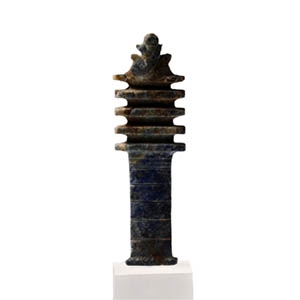
Egyptian Lapis Lazuli Amulet of a Djed Pillar
New Kingdom, 18th Dynasty, circa 1550-1295 B.C.Sold for (Inc. bp): £585
Carved as a square-section column with transverse ribs and a decorative finial, incised transverse lines to the body; mounted on a custom-made display stand. 4.84 grams, 49 mm (8.6 grams total, 64 mm including stand)
Ex R. Liechti (1934-2010) collection, Geneva, Switzerland. Private collection, Europe.
The djed pillar signifies the concepts of 'enduring' and 'stability' and was a common funerary amulet from the Old Kingdom onwards. It was first associated with the gods Ptah and Sokar but later became a symbol of Osiris, representing the god's backbone. In this context, the djed pillar appears in Chapter 155 of the Book of the Dead, concerned with the deceased's resurrection. R. Liechti was a distinguished collector of Egyptian antiquities, known for his discerning eye and passion for ancient artefacts. Active during the mid-20th century, Liechti's collection featured a wide range of objects that showcased the rich cultural heritage of ancient Egypt, from intricately carved statuettes to rare amulets and jewellery. His dedication to preserving and studying these relics earned him a respected reputation among scholars and collectors alike. Many pieces from his collection have since found their way into prominent museum collections and auction houses, further solidifying his legacy in the world of antiquities. -
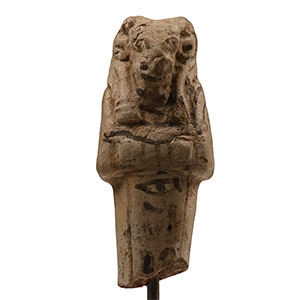
Egyptian Faience Bull-Headed Shabti from the Serapeum at Saqqara
New Kingdom, Ramesside Period, 1295-1069 B.C.Sold for (Inc. bp): £3,250
Pale faience figurine representing a bull-headed mummy adorned with a tripartite wig and human arms crossed over the chest with hands holding a pick and a hoe; only the lower legs and feet missing; the opening part of a central panel of hieroglyphic inscription reads: Wsir ͗ ḥp, 'the Osiris Apis'; mounted on a custom-made display stand. 152 grams total, 15 cm including stand
Probably found at the Serapeum at Saqqara in the 19th century. From the private collection of the late Mr M.S.C., Norfolk, UK, formed 1950s-1960s. Accompanied by an academic report by Egyptologist Paul Whelan.
While most shabtis served as substitutes or servants of the deceased and were placed in the tomb, some, like this example, were votive objects deposited in places of great sanctity. Virtually all known Apis shabtis come from excavations in the Serapeum catacombs led by Auguste Mariette from 1850 to 1853. They all belong to activity dating to the 19th and 20th Dynasties (circa 1295-1069 BC) and were unearthed in various chambers where they had been placed as votive offerings to honour the deified Apis bulls.

