-
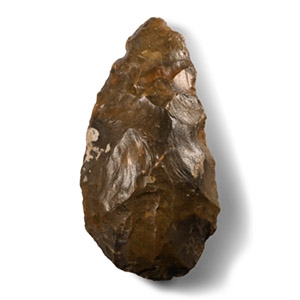
Large Stone Age Bifacial Flint 'Lancelot' Hand Axe
Lower Palaeolithic Period, circa 450,000-300,000 B.P.Sold for (Inc. bp): £468
A large and substantial handaxe with glossy mottled patina. 708 grams, 18 cm
Found in the Somme region of Northern France. From the collection of amateur archaeologist Mr M. Allais, formed in the mid-1900s. Acquired on the European art market. From the private collection of an East Anglian, UK, collector.
The 'Lancelot' form is well regarded as a typology of handaxes from the Lower Palaeolithic. -
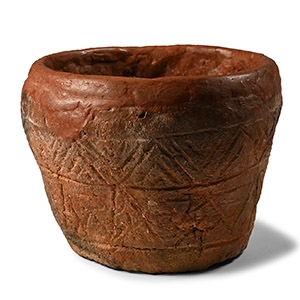
Stone Age 'Cranborne Chase' Terracotta Barrow Burial Vessel
Neolithic Period-Bronze Age, 3rd-2nd millennium B.C.Sold for (Inc. bp): £650
With two bands of incised geometric ornament to the outer face, carinated rim; inked inscription to underside 'Barrow / Cranborne Chase / [...] burial'. 740 grams, 13 cm
Found Cranborne Chase, UK. From a collection acquired on the UK art market from various auction houses and collections mostly before 2000. From an important Cambridgeshire estate; thence by descent. -
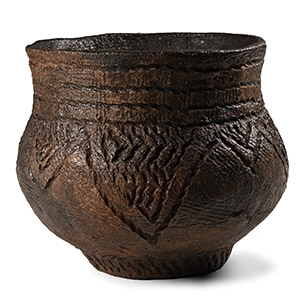
Stone Age Decorated Corded Ware Ceramic Vessel
Neolithic Period, early 3rd millennium B.C.Sold for (Inc. bp): £975
A squat pot with carinated profile, slightly everted rim, band of impressed linear ornament to the neck and chevrons to the shoulder. 760 grams, 16 cm wide
Acquired in the late 1950s. From the family collection of a South East London collector. -
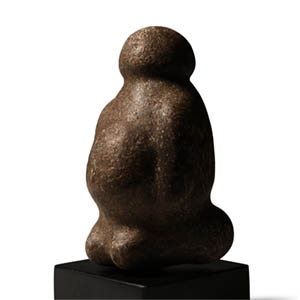
Large Stone Age Polished Kneeling Pregnant Goddess Idol
Neolithic Period, circa 6th-4th millennium B.C. or laterSold for (Inc. bp): £1,170
A carved and polished figurine with rounded head and broad shoulders, folded arms resting on each side of the protruding belly, legs folded beneath the body; mounted on a custom-made stand. 1.07 kg total, 15.3 cm high including stand
From a collection acquired on the UK art market from various auction houses and collections mostly before 2000. From an important Cambridgeshire estate; thence by descent.
Most scholars consider these as symbols of the fertility cult and as evidence of the existence of a matriarchal society as a form of organisation of the earliest human society. The people of the Stone Age may have considered figures such as this to represent women and mothers with their life-giving powers, or as depictions of the ancestors. -
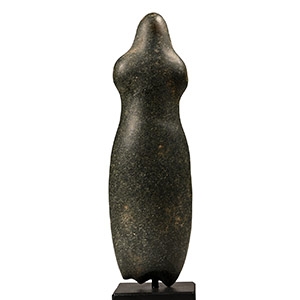
Large Stone Age Standing Goddess Idol
Neolithic Period, circa 6th-4th millennium B.C. or laterSold for (Inc. bp): £4,160
Tall with rounded profile, stub arms and head without facial detailing, vestigial legs; accompanied by a custom-made display stand. 1.04 kg total, 23 cm high including stand
From a collection acquired on the UK art market from various auction houses and collections mostly before 2000. From an important Cambridgeshire estate; thence by descent. Accompanied by an academic report by Dr Raffaele D’Amato. This lot has been checked against the Interpol Database of stolen works of art and is accompanied by search certificate number no.12352-223252.
Most scholars consider these as symbols of the fertility cult and as evidence of the existence of a matriarchal society as a form of organisation of the earliest human society. The people of the Stone Age may have considered figures such as this to represent women and mothers with their life-giving powers, or as depictions of the ancestors. -
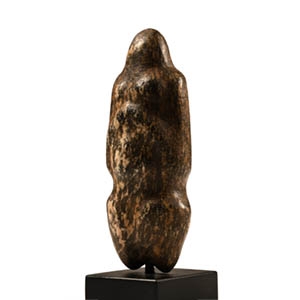
Stone Age Standing Pregnant Mother Goddess Idol
Neolithic Period, circa 6th-4th millennium B.C. or laterSold for (Inc. bp): £3,900
Modelled in the round as a figure with rudimentary head and limbs, emphasised belly and breasts supported on bent arms; mounted on a custom-made stand. 550 grams total, 15 cm including stand
From a collection acquired on the UK art market from various auction houses and collections mostly before 2000. From an important Cambridgeshire estate; thence by descent. Accompanied by an academic report by Dr Raffaele D’Amato. This lot has been checked against the Interpol Database of stolen works of art and is accompanied by search certificate number no.12333-224213.
Most scholars consider these as symbols of the fertility cult and as evidence of the existence of a matriarchal society as a form of organisation of the earliest human society. The people of the Stone Age may have considered figures such as this to represent women and mothers with their life-giving powers, or as depictions of the ancestors. -
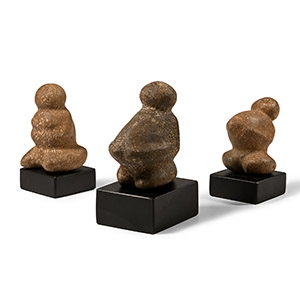
Stone Age Seated Mother Goddess Idol Collection
Neolithic Period, circa 6th-4th millennium B.C. or laterSold for (Inc. bp): £4,160
Group of three carved and polished figurines with rounded heads and broad shoulders, folded arms resting on each side, legs folded beneath the body; each mounted on a custom-made stand. 1.27 kg total, 8.7-11.5 cm including stand
From a collection acquired on the UK art market from various auction houses and collections mostly before 2000. From an important Cambridgeshire estate; thence by descent. Accompanied by an academic report by Dr Raffaele D’Amato. This lot has been checked against the Interpol Database of stolen works of art and is accompanied by search certificate number no.12351-223248.
Most scholars consider these as symbols of the fertility cult and as evidence of the existence of a matriarchal society as a form of organisation of the earliest human society. The people of the Stone Age may have considered figures such as this to represent women and mothers with their life-giving powers, or as depictions of the ancestors. -
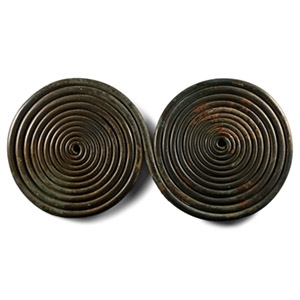
Large Bronze Age Spectacle Brooch
1st millennium B.C.Sold for (Inc. bp): £1,105
Formed as two large tightly-wound coils; similar verso with pin absent. 497 grams, 20.2 cm
Ex Surrey, UK, collection, 1980s. -
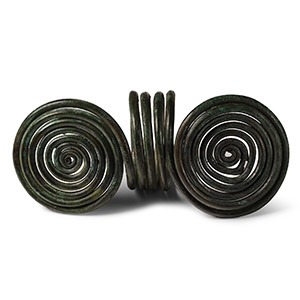
Bronze Age Double Spiral Ring
Central Europe, circa 11th-10th century B.C.Sold for (Inc. bp): £221
Formed from a single length of rod; median hoop of four coils developing at each end to a perpendicular coiled plaque. 28.29 grams, 67.66 mm overall, 19.54 mm internal diameter (approximate size British P, USA 7 1/2, Europe 16.23, Japan 15)
From a family collection mostly formed in the 1940s-1950s, thence by descent. -
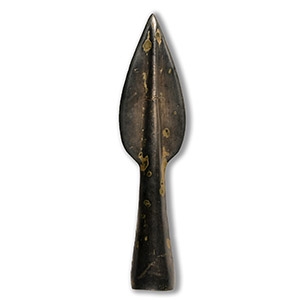
Bronze Age Socketted Spearhead
11th-10th century B.C.Sold for (Inc. bp): £234
Comprising a leaf-shaped blade with prominent midrib extending to a flaring socket; opposed lateral holes to accept attachment pegs. 64 grams, 13 cm
Acquired on the German art market, 2000. Private collection, Europe. -
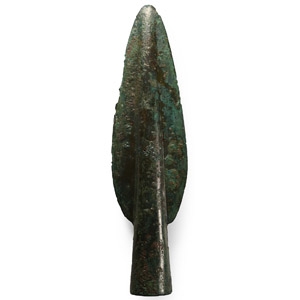
Bronze Age Socketted Spearhead
Late 2nd millennium B.C.Sold for (Inc. bp): £208
With flared socket developing to a midrib in a leaf-shaped blade; opposed lateral holes to accept attachment pegs. 130 grams, 16.5 cm
From the private collection of Kenneth Machin (1936-2020), Buckinghamshire, UK; with collection no.C2; his collection of antiquities and natural history was formed since 1948; thence by descent. -
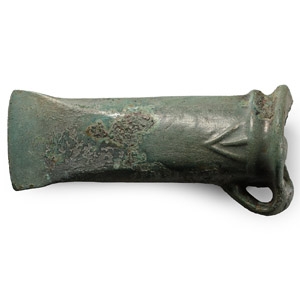
Bronze Age Decorated Looped and Socketted Axehead
Central Europe, 2nd-1st millennium B.C.Sold for (Inc. bp): £364
A cast looped and socketted axehead with straight edge, collar to mouth and lateral loop, raised V-shaped rib to each face. 364 grams, 12.1 cm
Ex German collection, 1990s.

