-
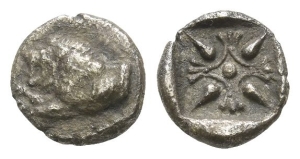
Western Asia Minor, uncertain mint AR Diobol. Circa 6th-5th century BC.
Sold for (Inc. bp): £195
Possibly Caria, uncertain mint or Ionia, Miletos. Forepart of roaring lion to left / Stellate pattern within incuse square. Unpublished in the standard references including HN Online. 0.98gr, 9mm.
Very Fine. Apparently unpublished and possibly unique.
From the collection of a London antiquarian, formed since the 1980s.
The fact that the present coin has the same reverse stellate pattern as the Diobols of Miletos (cf. SNG Kayhan I 462-75 and SNG Copenhagen 953) and some of the silver coins of the satraps of Caria (cf. HN Online 2926), leads us to attribute its origin to one of these two regions. -
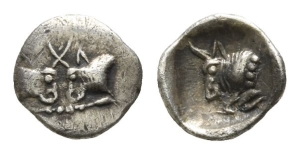
Caria, Uncertain mint 'D' AR Tetartemorion. Circa 450-400 BC.
Sold for (Inc. bp): £65
Foreparts of two confronted bulls, with horns intertwined / Forepart of bull to left within incuse square. HNO Online 73. 0.18gr, 7mm, 6h.
Extremely Fine. Unusually well struck for the type.
From the collection of a London antiquarian, formed since the 1980s. -
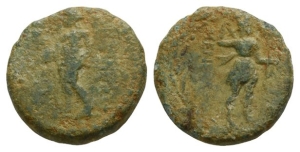
Caria, Iasos AE 17mm. Circa 250-190 BC.
Sold for (Inc. bp): £7
ΜΕΝΕΚΛΗΣ (Menekles), magistrate. Group C. Apollo Delphinios standing to left, holding bow and arrow, dolphin at feet; illegible inscription to right / MENE[ΚΛΗΣ], Artemis advancing to right, drawing arrow from quiver, to right [IA]; all within laurel wreath. Cf. Ashton, The Pre-Imperial Coinage of Iasos p.72, 2-3, pl.14, 216-7. 3.45gr, 17mm, 12h.
Near Very Fine. Very rare.
Ex 'V' gentleman's collection, Switzerland. From the property of a North London, UK, gentleman. -
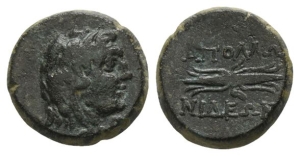
Lydia, Apollonis AE 15mm. Circa 200-1 BC.
Sold for (Inc. bp): £52
Head of Herakles to right, wearing lion skin headdress / AΠOΛΛΩ-NIΔEΩN, winged thunderbolt. GRPC Lydia 3; SNG Copenhagen 17; BMC 4; SNG München 33. 4.17gr, 15mm, 8h.
Good Very Fine.
Ex 'V' gentleman's collection, Switzerland. From the property of a North London, UK, gentleman. -
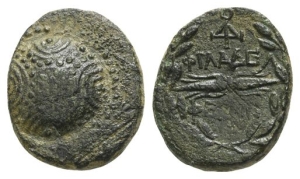
Lydia, Philadelphia AE 17mm. Circa 200-100 BC.
Sold for (Inc. bp): £26
Macedonian shield with star in the boss / ΦΙΛΑΔΕΛ-ΦΕΩΝ above and below thunderbolt; monogram above, all within wreath. GRPC Lydia 13; SNG Copenhagen 343-4. 3.72gr, 17mm.
Very Fine.
Ex 'V' gentleman's collection, Switzerland. From the property of a North London, UK, gentleman. -
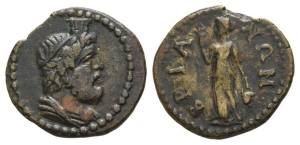
Phrygia, Bria or Briana AE 19mm. Time of the Severans, AD 193-235.
Sold for (Inc. bp): £13
Pseudo-autonomous issue. Draped bust of Serapis to right, wearing kalathos / BΡΙΑ-ΝΩΝ, Isis standing facing, head to left, holding sistrum with right hand and situla with left. Von Aulock, Phrygiens 225-37; SNG von Aulock 3520; BMC 1. 3.38gr, 19mm, 12h.
Near Very Fine. Edge chipped.
From the collection of a London antiquarian, formed since the 1980s. Ex Classical Numismatic Group, Electronic Auction 545, 30 August 2023, lot 411. -
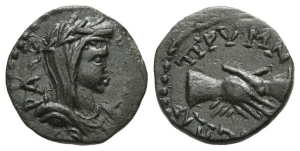
Phrygia, Prymnessos AE 19mm. Time of Gallienus, AD 253-268.
Sold for (Inc. bp): £52
Pseudo-autonomous issue. [IЄ]-PA [BOYΛH], laureate and draped bust of Boule to right / ΠΡΥΜΝ-[ΗCC]ЄΩN, clasped hands. RPC X Online Unassigned ID 63259; Von Aulock, Phrygien II 971-5. 4.36gr, 19mm, 9h.
Good Very Fine. Rare.
From the collection of a London antiquarian, formed since the 1980s. -
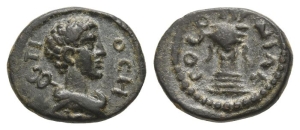
Pisidia, Antioch AE 16mm. Time of Marcus Aurelius, circa AD 161-180.
Sold for (Inc. bp): £39
Pseudo-autonomous issue. AN-TI-OCH, draped bust of Hermes to right, with head assimilated to portrait of youthful Commodus; caduceus over shoulder / COLO-NIAE, garlanded altar. RPC IV.3, 7376 (temporary). 2.06gr, 16mm, 6h.
Good Very Fine.
From the collection of a London antiquarian, formed since the 1980s. -
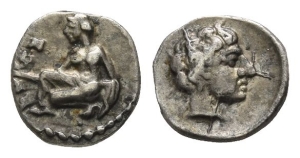
Cilicia, Tarsos AR Obol. Tiribazos, satrap of Lydia, 388-380 BC.
Sold for (Inc. bp): £59
Female kneeling to left, tossing astragaloi / Young male head to right. Göktürk 17; SNG BnF 239; SNG Levante 65. 0.63gr, 10mm, 3h.
Near Very Fine.
Property of a North London, UK, gentleman. -
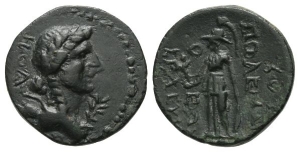
Cilicia, Seleukeia ad Kalykadnon AE 22mm. Circa 2nd-1st centuries BC.
Sold for (Inc. bp): £26
ΠΟΛΕΜΑΡΧΟΣ (Polemarchos), magistrate. Laureate and draped bust of Artemis (or Apollo) to right, with bow and quiver at shoulder; AΘH (retrograde) behind, palm branch before / Athena Nikephoros standing to left, holding shield; ΠΟΛΕΜΑΡ-ΧΟΥ downwards in two vertical lines to right, CΕΛΕΥΚ-ΕΩΝ downwards in two vertical lines to left. SNG Levante -; SNG Levante Supp. -; SNG BnF -; BMC Lycaonia 15. 6.83gr, 22mm, 12h.
Very Fine. Very rare.
From the collection of a London antiquarian, formed since the 1980s. -
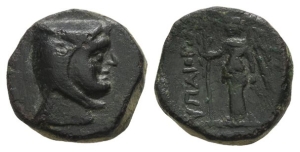
Kings of Cappadocia, Hypaioros AE 17mm. Circa 250-187 BC.
Sold for (Inc. bp): £2,340
Uncertain mint. Head to right, wearing bashlyk / ΥΠΑΙoΡo[...], Nike standing facing, head to left, holding long palm in extended right hand. Unrecorded ruler but cf. Roma Numismatics, E-81, 607 ('ΥΠΑΙ' legend on coin of Ariarathes) and HGC 9, 493b (similar reverse of issue of Antiochos III). 5.00gr, 17mm, 11h.
Good Very Fine. Unpublished and unique; of great historical and numismatic importance.
Ex 'V' gentleman's collection, Switzerland. From the property of a North London, UK, gentleman.
It is not rare when a coin can be the only evidence about the existence of a person or city from the past. On this particular coin, it is the inscription of YΠΑΙΟΡΟ that makes it difficult to attribute. No city or ruler is recorded with this name and the only ancillary evidence we have is its similarity to some other types. First of all, the style of the leather helmet (called bashlyk, common for the Cappadocian bronzes) and the lack of the royal title, refer us to the king of Cappadocia, Ariaramnes. The Roma's example is the only other example who bears the abbreviated legend YΠΑΙ but on a coin of Ariarathes. On the other hand, the reverse type and style of legend resemble the bronze coins of Antiochos III struck in Southern Coele-Syria (SC 1100a; HGC 9, 493b). It is not certain whether the name refers to a city or to a ruler. Bronze coins of Ariaramnes can have the name of the mint abbreviated (cf. Simonetta 9a&b), but it is considered unusual in this period to have a bronze coin with a full ethnic and the portrait of the ruler. It is very likely that we are dealing with the name of a Cappadocian ruler who was active for a short period in the second half of the 3rd to the first part of the 2nd century and participated in the recovery of the outlying provinces of the Seleucid Empire from Antiochos III. -

Seleukid Empire, Seleukos I Nikator AR Tetradrachm. Second satrapy and kingship, 312-281 BC.
Sold for (Inc. bp): £208
Babylon I mint. Struck circa 311-300 BC. In the name and types of Alexander III of Macedon. Head of Herakles to right, wearing lion skin headdress, paws tied beneath chin / ΒΑΣIΛΕΩΣ ΑΛΕΞΑΝΔΡΟΥ, Zeus seated to left on high-backed throne, right leg drawn back, his feet resting on a low foot rest, holding long sceptre in his left hand and, in his right, eagle standing to right with closed wings; in left field, [MI above bee]; monogram or MHTP in wreath beneath throne. SC 82.2b; Price 3754; HGC 9, 10f. 16.93gr, 26mm, 8h.
Near Very Fine.
Ex German art market, 2000s. Acquired from an EU collector living in London. From the collection of a Surrey, UK, gentleman.

