-
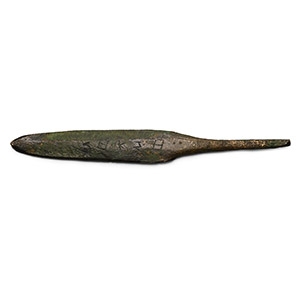
Phoenician Bronze Arrowhead with Inscriptions
Circa 12th-11th century B.C.Sold for (Inc. bp): £650
Slender leaf-shaped two-edged blade with broad neck and sturdy tang; impressed inscriptions to both faces. 14.2 grams, 10.6 cm
Acquired on the UK art market. Property of an Essex, UK, collector.
The arrowhead seems to carry a Proto-Aramaic or Phoenician inscription like many arrows found in the Levant and Israel. They are usually reporting proper names like ‘Suwar, retainer of Abday’. As far as the function of these arrowheads is concerned, we know that the name inscribed on them was the owner's because successive owner's names were incised on two palimpsest examples. The central rib of this arrow bears on both sides a ten letter inscription, which is relatively deep and firmly incised. The inscription should be read 'ḤŞ…BN…NY = ‘arrow of K…son of…ANAY’. -
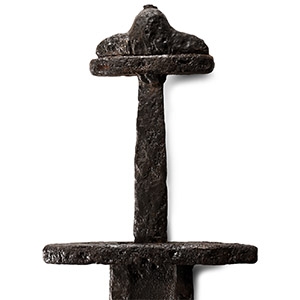
Viking Iron Sword with Three-Lobed Pommel
10th-11th century A.D.Sold for (Inc. bp): £3,510
Comprising a two-edged blade with broad fuller and rounded tip, narrow lower guard with rounded outer ends, broad tang, lobed pommel of Type U with cocked-hat profile and lower guard, traces of silvering. 848 grams, 92 cm
From the private collection of a London gentleman, from his grandfather's collection formed before the early 1970s. Accompanied by an academic report by Dr Raffaele D’Amato. This lot has been checked against the Interpol Database of stolen works of art and is accompanied by search certificate number no.12356-225922.
Petersen considered this type of Viking sword similar to the previous types R and S, but with differences in the pommel and cross-guard. The traces of silver ornaments on the guard and pommel are artistically consistent with archaeological examples of decorative work from the geographic region or estimated cultural point of origin, probably Eastern Scandinavia or the Baltic areas. -
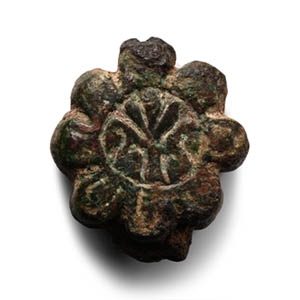
Medieval Enamelled Bronze Dagger Pommel
Circa 12th century A.D.Sold for (Inc. bp): £260
Formed as an octofoil with frond to one face, three-towered castle to the other. 22.2 grams, 26 mm
From the collection of a London antiquarian, formed since the 1980s. -
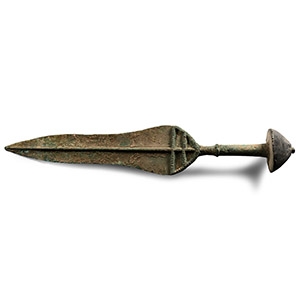
Western Asiatic Bronze Sword
Late 2nd-early 1st millennium B.C.Sold for (Inc. bp): £520
The hilt with mushroom-shaped pommel, round grip, crescentic guard with double horizontal bars, long sloping blade with rounded mid-ridge. 743 grams, 48 cm
Acquired 1980-2015. Ex Abelita family collection.
This category of swords has been classified by Khorasani as 'swords with a mushroom pommel' and are usually characterised by a solid-cast hilt with a penannular guard, a ribbed or variously decorated grip and the conical hollow-cast mushroom pommel. Usually the blade is multi-fullered and tapers to a sharp tip. Moorey considers them to be from the end of the 2nd millennium B.C. -
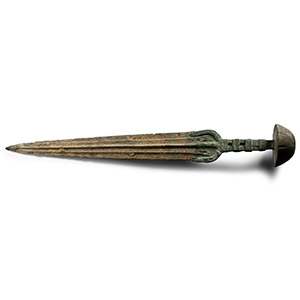
Luristan Bronze Sword with Mushroom Pommel
Late 2nd-early 1st millennium B.C.Sold for (Inc. bp): £780
The hilt with mushroom-shaped pommel, grip decorated with horizontal flat grooves, crescentic guard, long blade with ridged mid-grip. 790 grams, 59 cm
Acquired 1980-2015. Ex Abelita family collection.
This category of swords has been classified by Khorasani as 'swords with a mushroom pommel' and are usually characterised by a solid-cast hilt with a penannular guard, a ribbed or variously decorated grip and a conical hollow-cast mushroom pommel. Usually the blade is multi-fullered and tapers to a sharp tip. Moorey considers them to be from the end of the 2nd millennium B.C. Gorelik extends the dating to the 8th-7th century B.C. -
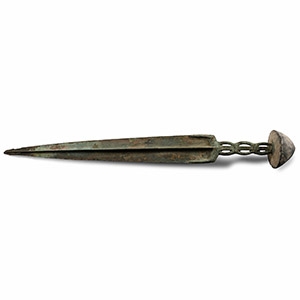
Amarlu Type Bronze Sword with Mushroom Pommel
Late 2nd millennium B.C.Sold for (Inc. bp): £520
With solid hilt having a penannular guard, an openwork grip and a conical cast mushroom pommel, the blade with pronounced mid-rib and tapering to a sharp point. 598 grams, 51.5 cm
Acquired 1980-2015. Ex Abelita family collection.
According to Moorey, such swords with mushroom pommels originated from North-Western Iran, as proved by Amarlu finds. He dates them to the end of the 2nd millennium B.C., more precisely to a period between 1400-1200 B.C. -
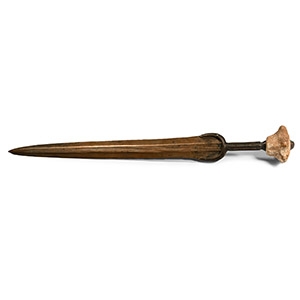
Luristan Bronze Sword with Decorated Stone Pommel
13th-7th century B.C.Sold for (Inc. bp): £715
With solid cast hilt with penannular guard and a horizontally ribbed grip; a massive star-shaped pommel and a multi-fullered blade tapering to a sharp tip; handle restored. 1.03 kg, 63.5 cm
Acquired 1980-2015. Ex Abelita family collection.
According to Moorey, such category of swords were distributed in the Northern Iran area, as proved by the Amarlu finds. Based on the example from the Ashmolean Museum, he dated them to the end of the 2nd millennium B.C., more precisely to a period between 1400-1200 B.C. The type was in use until the 7th century B.C. -
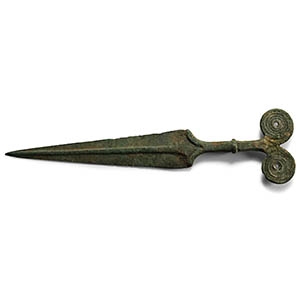
Western Asiatic Bronze Dagger
3rd-2nd millennium B.C.Sold for (Inc. bp): £650
With triangular blade and a square sectioned mid-rib ‘antenna’ guard with tubular grip and spiral ‘ears’. 240 grams, 34 cm
Acquired 1980-2015. Ex Abelita family collection. -
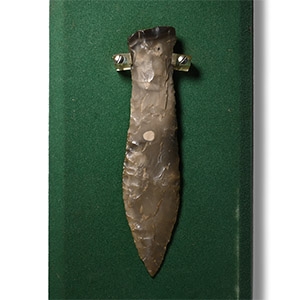
Stone Age Danish Handled Flint Dagger
Neolithic Period, 3rd millennium B.C.Sold for (Inc. bp): £3,120
In mottled grey flint, bifacially flaked with integral handle and lentoid-section blade; mounted on an old felted display stand. 68 grams, 14.7 cm (325 grams total, 35.6 cm including stand)
with Sotheby's, Bournemouth, UK, no.255. Private collection, Europe. -
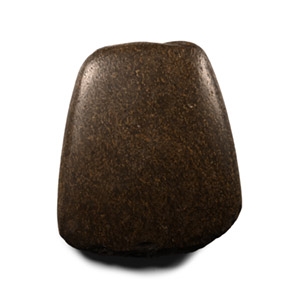
Stone Age 'Giant's Causeway' Polished Green Stone Hand Axe
Neolithic Period, circa 4th-3rd millennium B.C.Sold for (Inc. bp): £1,235
Lentoid in section and trapezoidal in plan; old inked find spot legend 'Giants Causeway / IRE 94'. 235 grams, 90 mm
Found Giant's Causeway, Northern Ireland, 1894. From the private collection of Kenneth Machin (1936-2020), Buckinghamshire, UK; with collection no.N161; his collection of antiquities and natural history was formed since 1948; thence by descent. -
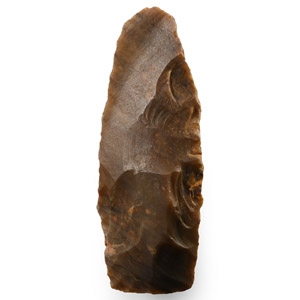
Stone Age British Bifacial Flint Axehead
Late Mesolithic Period, circa 8000-6000 B.P.Sold for (Inc. bp): £104
Triangular in section with rounded butt, straight cutting edge; beautiful example with fine knapping. 216 grams, 12.7 cm
Possibly found Lincolnshire, UK. Acquired Birmingham, UK, on 12th January 2003. From the private collection of Kenneth Machin (1936-2020), Buckinghamshire, UK; with collection no.M194; his collection of antiquities and natural history was formed since 1948; thence by descent. -
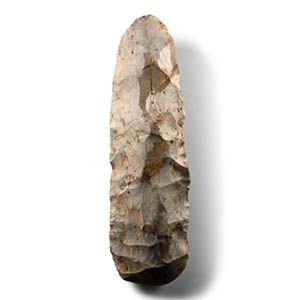
Large Stone Age Salisbury Knapped Flint Axehead
Neolithic Period, circa mid 3rd millennium B.C.Sold for (Inc. bp): £390
Cigar-shaped in profile and lntoid in section with small patch of cortex. 457 grams, 19.5 cm
Found Old Sarum, Salisbury, Wiltshire, UK. Acquired from Mr Edwards in November 2002. From the private collection of Kenneth Machin (1936-2020), Buckinghamshire, UK; with collection no.N143; his collection of antiquities and natural history was formed since 1948; thence by descent.

