-
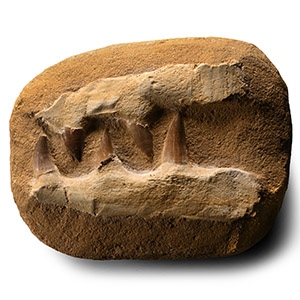
Composite Mosasaur 'Marine Dinosaur' Jaw Section
Cretaceous Period, circa 145-65 million years B.P.Sold for (Inc. bp): £52
Comprising five Mosasaur prognathodon set on a matrix simulating jaw bones on sandstone. 1.81 kg, 20 cm
From a Cambridgeshire, UK, collection. -
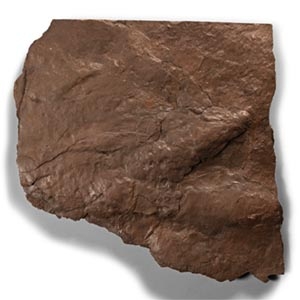
Fossil Dinosaur Footprint
Lower Jurassic Period, circa 200 million years B.P.Sold for (Inc. bp): £208
Flat irregular plaque of sedimentary rock with footprint. 509 grams, 17 cm
From a collection acquired on the UK art market from various auction houses and collections mostly before 2000. From an important Cambridgeshire estate; thence by descent. -
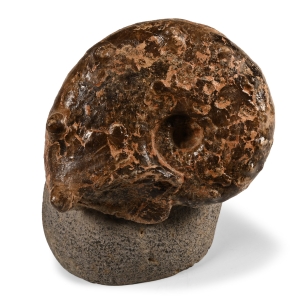
Fossil Mamite Ammonite on Stand
Cretaceous Period, circa 90 million years B.P.Sold for (Inc. bp): £20
The horned ammonite with regularly disposed spines to the outer shell, set on a domed stone stand. 937 grams total, 130 mm
From a Cambridgeshire, UK, collection. -
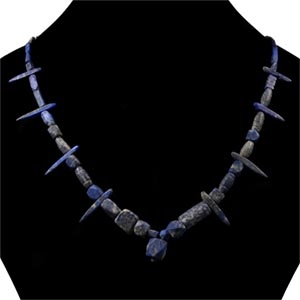
Lapis Lazuli Bead Necklace String
Sold for (Inc. bp): £26
Restrung to a Y-shape, composed of variously shaped graduated beads interspersed with long claw-like beads, central feature a facetted polygonal bead. 50 grams, 41.5 cm
Ex London art market. Property of a North London, UK, gentleman. -
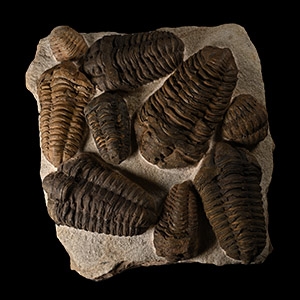
Fossil Flexicalymene Trilobite Cluster
Devonian Period, circa 417-354 million years B.P.Sold for (Inc. bp): £169
A mortality plate showing a cluster of Flexicalymene sp. trilobites. 2117 grams, 230 mm
From a Cambridgeshire, UK, collection. -
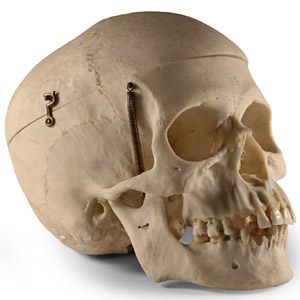
Medical Educational Skull
20th century A.D.Sold for (Inc. bp): £520
Human skull with upper cranium detached and contents removed; fasteners and locating pins, securing springs; some teeth absent. 579 grams, 20 cm wide
From a collection acquired on the UK art market from various auction houses and collections mostly before 2000. From an important Cambridgeshire estate; thence by descent.
This item is for collection only. -
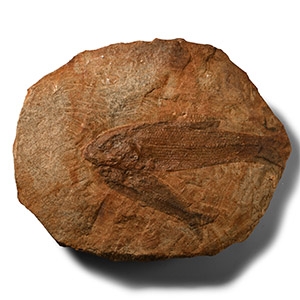
Twin Tharrhias Fossil Fish in Matrix from Brazil
Early Cretaceous Period, circa 112 million years B.P.Sold for (Inc. bp): £20
Showing two overlapping Tharrhias Araripis specimens on a rounded matrix, the larger showing good scale detail. 1.7 kg, 19.5 cm
From N.E. Brazil. From the private collection of Kenneth Machin (1936-2020), Buckinghamshire, UK; his collection of antiquities and natural history was formed since 1948; thence by descent. -
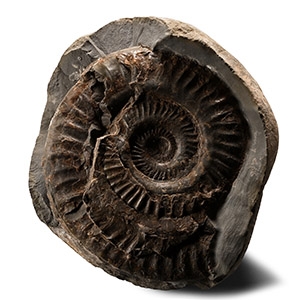
Fossil Ammonite in Nodule
Jurassic Period, Toarcian Stage, circa 180 million years B.P.Sold for (Inc. bp): £59
An opened nodule containing a large Hildites sp. fossil. 1.29 kg, 14 cm
From Yorkshire coast. From a Lincolnshire, UK, collection. -
.jpg)
Mocha Stone (Dendritic Limestone) Tile Group
Sold for (Inc. bp): £39
Superb examples exhibiting finely formed dendrites of manganese oxide. 342 grams total, 9.6-13 cm
From India. Ex Mineral Imports, London, UK. Gregory, Bottley & Lloyd (Gregory's). -
.jpg)
Polished Fossil Orthoceras Column
Devonian Period, circa 417-354 million years B.P.Sold for (Inc. bp): £13
The four polished 'bullets' showing variously sized Orthoceras sp. specimens. 1.56 grams, 19.8 cm
From a Cambridgeshire, UK, collection. Property of a Cambridgeshire, UK, gentleman. -
.jpg)
British Bison Bone Group
Pleistocene Period, circa 2.6 million-11,700 years B.P.Sold for (Inc. bp): £72
Comprising two rib sections, three vertebrae and two bones from the feet. 1.02 kg total, 7-40 cm
From a Norfolk, UK, collection. Property of a Cambridgeshire, UK, gentleman. -
.jpg)
Campo del Cielo Meteorite Necklace
Fell 6000-5000 years B.P.Sold for (Inc. bp): £208
Comprising a section of nickel-iron meteorite (IAB) set with a suspension loop and suspended from a cord necklace; supplied in a gift box. 27 grams total, meteorite: 30 mm
From a Lincolnshire, UK, collection. Property of a Cambridgeshire, UK, gentleman.
A crater field of roughly 26 craters was found in the vicinity of this crater, which is estimated to date to 4-5 thousand years BP. The age of the meteorite itself is thought to be c.4.5 billion years, formed as part of the development of this solar system. The largest two fragments, the 30.8 ton Gancedo and 28.8 ton El Chaco, are among the heaviest meteorite masses ever recovered on Earth. In 1576, the governor of a province in Northern Argentina commissioned the military to search for a large mass of iron, which it was believed the local people claimed had fallen from the sky and which they used for their weapon production. The expedition discovered a large mass of metal which was assumed to be an iron mine and brought back a few samples, which were described as being of unusual purity. Following the legends, in 1774 Don Bartolomé Francisco de Maguna rediscovered the iron mass. He himself did not believe that the stone had fallen from the sky and assumed that it had formed by a volcanic eruption. However, he sent the samples to the Royal Society of London. In 1990 it became protected by law.

