-
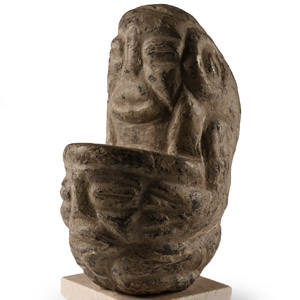
South East Asian Stone Funerary Idol
4th-3rd century B.C. or laterSold for (Inc. bp): £85
Carved in the round as a crouching figure clutching an offering bowl on his lap; mounted on a display stand. 650 grams total, 11.1 cm including stand
From a collection acquired on the UK art market from various auction houses and collections mostly before 2000. From an important Cambridgeshire estate; thence by descent. -
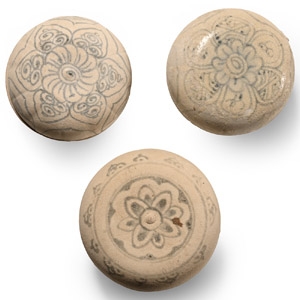
Hoi An Cargo Shipwreck Glazed Blue and White Lidded Box Collection
15th century A.D.Sold for (Inc. bp): £78
Comprising three powder boxes with painted rosette to the lid, tendrils to the sidewall. 210 grams total, 50-56 mm
Ex Butterfield and Butterfield auction with official Hoi An Hoard labels. Accompanied by an illustrated information sheet about the Hoi An shipwreck.
In the mid 15th century a freighting junk loaded with fine Vietnamese pottery sank in an area of the South China Sea called the 'Dragon’s Embrace.' This vessel is part of the shipwreck cargo recovered off the coast of Vietnam at Hoi An. The ceramics themselves were probably made in the area of Chu Dau. -
.jpg)
Chinese Qing Blue and White Headrest
Qing Dynasty, 1644–1912 A.D.Sold for (Inc. bp): £130
A tin-glazed ceramic headrest with blue floral motifs; hollow-formed with decorative piercings complementing the main design. 2.2 kg, 32 cm long
Fine condition.
Acquired 1970s. West Country, UK, collection. -
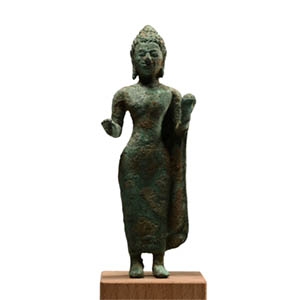
South East Asian Bronze Statuette of a Goddess
Circa 12th-13th century A.D. or laterSold for (Inc. bp): £169
Modelled in the round wearing a tight-fitting ankle-length robe draped over the left arm; tiered headdress and long-lobed ears; hand arms bent and hands raised palm-outwards; mounted on a custom-made stand. 399 grams total, 20 cm high including stand
From a family collection mostly formed in the 1940s-1950s, thence by descent. -
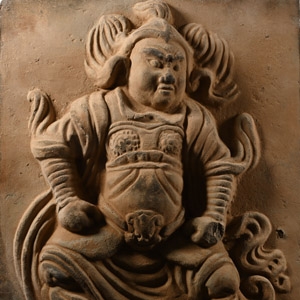
Chinese Song Terracotta Tile with Standing Warrior
Song Dynasty, 960-1279 A.D. or laterSold for (Inc. bp): £208
With high-relief image of a warrior standing with hands resting on his spread legs, wearing a helmet and armour with mask ornament to the abdomen over a flowing floor-length robe, riding boots placed firmly on a scrolled baseline. 6 kg, 35.5 cm
From a West Country, UK, collection, 1990s. -
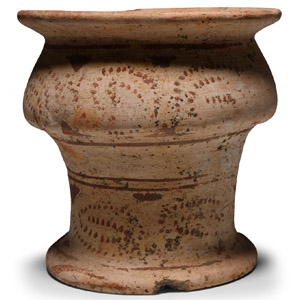
South East Asian Ban Chiang Period Painted Chalice
Middle Period, 900-300 B.C.Sold for (Inc. bp): £72
Squat carinated bowl with flared neck and rim atop a trumpet-shaped base, remains of painted interlocking spiral motifs; foot repaired. 879 grams, 16.5 cm high
From a collection acquired on the UK art market from various auction houses and collections mostly before 2000. From an important Cambridgeshire estate; thence by descent.
In Ban Chiang pottery the most common body shape is an ellipsoid form with a rounded bottom covered by a low outflaring pedestal base. The neck variations include a low straight-sided neck and a higher outflaring neck. Body-pedestal juncture and body-neck juncture may be either angular or curved. The same neck variations occur on a globular body, in addition to a composite concave-convex neck form not occurring on the ellipsoid bodies. Again, all examples have low outflaring pedestal bases. -
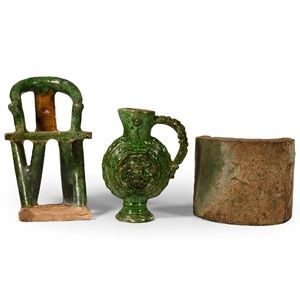
Chinese Green Glazed Terracotta Artefact Collection
Ming Dynasty, 1368-1644 A.D. or laterSold for (Inc. bp): £52
Comprising a model folding chair with back-rest and integral arms, flagon with high-relief detailing and flared base, low arched support. 1.89 kg total, 14-20 cm
From a family collection mostly formed in the 1940s-1950s, thence by descent. -
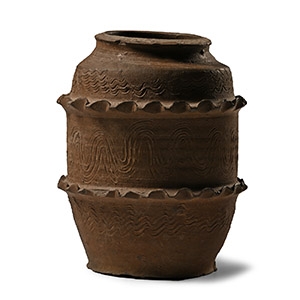
Chinese Decorated Ceramic Vessel
Qing Dynasty, 1644-1911 A.D.Sold for (Inc. bp): £20
Barrel-shaped with carinated rim, two raised bands of piecrust ornament and low-relief scale detailing. 380 grams, 14 cm
From a family collection mostly formed in the 1940s-1950s, thence by descent. -
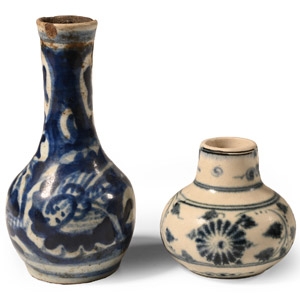
Chinese Blue and White Pottery Group
Circa 19th century A.D.Sold for (Inc. bp): £26
One with dense blue floral ornament, tall neck with slight flare; one squat with basal ring, rosettes and horizontal rig. 203 grams total, 5.7-11.2 cm
From a family collection mostly formed in the 1940s-1950s, thence by descent. -
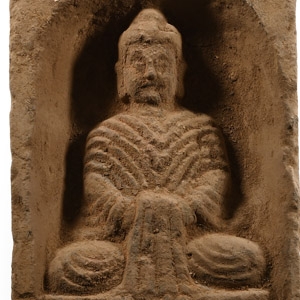
Chinese Wei Terracotta Buddha Brick
Northern Wei, 386-534 A.D. or laterSold for (Inc. bp): £195
Seated in a lotus pose on a low throne, his robe draped at the chest and legs. 3.16 kg, 28.5 cm
Ex Hong Kong collection, 1990s. From a London, UK, collection. -
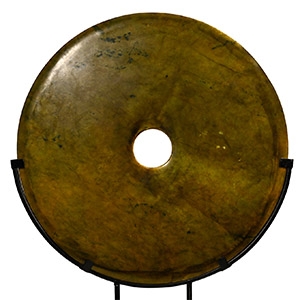
Colossal Chinese Green Serpentine Bi Disc
20th century A.D. or earlierSold for (Inc. bp): £6,500
A very large mottled green serpentine bi disc with central hole; rectangular in cross section, tapering towards the outer edge; mounted on a custom-made display stand. 12.9 kg total, 75.5 cm high including stand
Fine condition.
French collection, 1990s-early 2000s. From an important Paris gallery, France. Ex private Paris collection. -
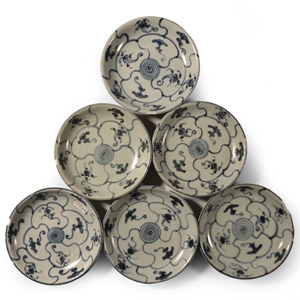
Tek Sing Treasure Shipwreck Glazed Blue and White Dish Set
Early 19th century A.D.Sold for (Inc. bp): £111
Each a shallow dish with tendril and flowers to the upper and lower faces, central spiral. 1.35 kg total, 15-15.7 cm
Ex Nagel Auction, with official Tek Sing Treasure labels to verso. Accompanied by an illustrated information sheet about the Tek Sing shipwreck.
The Tek Sing (True Star) wreck is one of the famous recovery stories of the 20th century. Sailing from the port of Xiamen (then known as Amoy) in February 1822 the vessel Tek Sing was bound for Jakarta, Indonesia laden with porcelain goods and 1600 Chinese emigrants. The captain decided to pass through the Gaspar Strait, between the Bangka-Belitung Islands, and ran aground on a reef. The vessel sank in about 100 feet of water. The next morning, February 7, an English East Indiaman captained by James Pearl, passing through the same waters, encountered debris and some survivors and managed to rescue about 190 of the latter.

