-
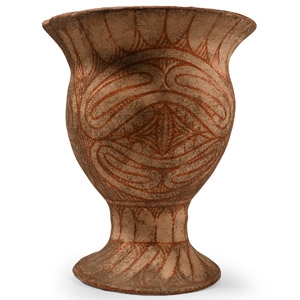
South East Asian Ban Chiang Period Painted Chalice
Middle Period, 900-300 B.C.Sold for (Inc. bp): £117
Red-on-buff chalice with everted rim, globular body and trumpet-shaped base; surface decorated with concentric bands, arches and floral motifs on a hatched field. 1.65 kg, 24.2 cm
From a collection acquired on the UK art market from various auction houses and collections mostly before 2000. From an important Cambridgeshire estate; thence by descent. -
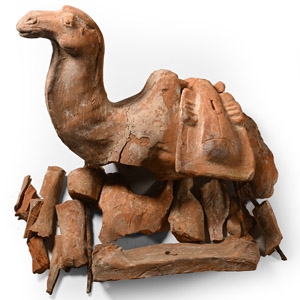
Chinese Tang Terracotta Camel Fragment Group
Tang Dynasty, 618-907 A.D. or laterSold for (Inc. bp): £91
Including fragments of the camel's body, saddle and other elements. 1.77 kg total, 1.2-26.5 cm
From a collection acquired on the UK art market from various auction houses and collections mostly before 2000. From an important Cambridgeshire estate; thence by descent. -
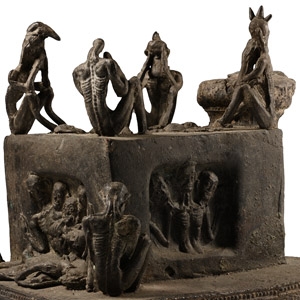
Large South East Asian Bronze Mortuary Vessel
20th century A.D.Sold for (Inc. bp): £221
Comprising a broad square base with pelleted rim and foliage in low relief supporting a cuboid block; to three faces, a shallow recess with cadavers and squatting figure with three heads, to fourth face an integral gourd with socketted rim above and central void; to the forward edge of the base a cadaver flanked by two crouching figures with hands raised to their mouths, modelled in the round; to the upper face, four partial cadavers radiating from the centre in low relief, with a sitting figure to each corner with hands raised to the face, wearing a zoomorphic headdress; some traces of gilding. 5.14 kg, 18.5 cm wide
From a collection acquired on the UK art market from various auction houses and collections mostly before 2000. From an important Cambridgeshire estate; thence by descent. -
.jpg)
Chinese Wei Female Court Figure
Wei Dynasty, 534-550 A.D. or laterSold for (Inc. bp): £494
An unglazed ceramic figure of a courtly lady wearing a floor-length robe with flared train to the rear, hands clasped to the midriff inside ribbed sleeves, close-fitting cap; traces of pigment to the collar, cap and elsewhere. 1.3 kg, 32cm
Finely modelled.
Ex West Country collection, Bath, Somerset, UK, 1970-2000s. -
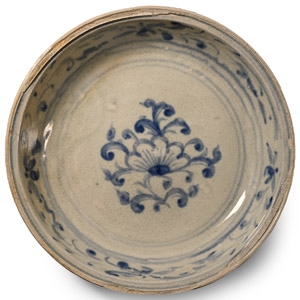
Large Hoi An Shipwreck Glazed Blue and White Bowl
15th century A.D.Sold for (Inc. bp): £117
With thick basal ring, stepped rim, band of tendrils enclosing a floral motif. 823 grams, 23.5 cm
Ex Butterfield and Butterfield auction with official Hoi An Hoard labels. Accompanied by an illustrated information sheet about the Hoi An shipwreck.
In the mid 15th century a freighting junk loaded with fine Vietnamese pottery sank in an area of the South China Sea called the 'Dragon’s Embrace.' This vessel is part of the shipwreck cargo recovered off the coast of Vietnam at Hoi An. The ceramics themselves were probably made in the area of Chu Dau. -
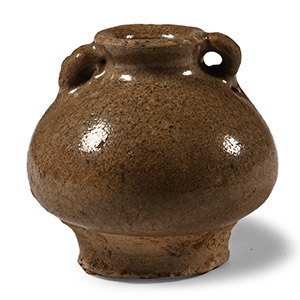
South East Asian Sawankhalok Glazed Jar
Thai, 14th-15th century A.D.Sold for (Inc. bp): £20
Squat in profile with flared base and mouth, small lateral loop handles; old dealer's label to base. 173 grams, 72 mm
From the private collection of Kenneth Machin (1936-2020), Buckinghamshire, UK; his collection of antiquities and natural history was formed since 1948; thence by descent. -
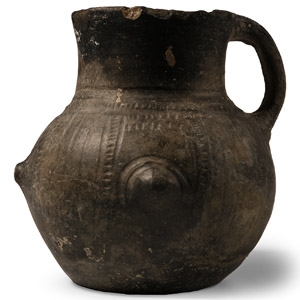
South East Asian Black Ware Jug with Bosses
Neolithic Period, 4th-3rd millennium B.C.Sold for (Inc. bp): £117
Comprising globular body, radiating bosses with low-relief segmentation and rouletting, slightly flared neck with loop handle. 759 grams, 16 cm
Acquired in the late 1940s. From an old central Asian collection. -
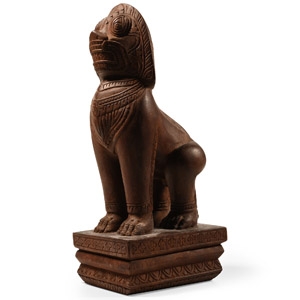
South East Asian Mahogany Guardian Lion
20th century A.D.Sold for (Inc. bp): £13
Carved in the round standing on a rectangular tiered base, with D-shaped mane framing the grimacing face. 990 grams, 26.5 cm
From a family collection mostly formed in the 1940s-1950s, thence by descent. -
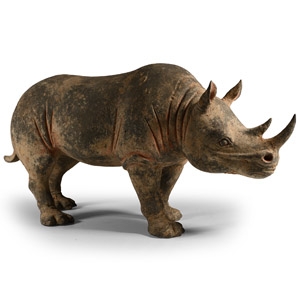
Chinese Tang Terracotta Rhinoceros
Tang Dynasty, 618-907 A.D.Sold for (Inc. bp): £28,600
Modelled in the round in an alert pose with raised head, flaring nostrils and pricked ears, the folds on the body indicated in red pigment. 5.35 kg, 51 cm wide
Ex Hong Kong collection, 1990s. From a London, UK, collection. Accompanied by thermoluminescence analysis report no.01C26042024 from Laboratory Kotalla. This lot has been checked against the Interpol Database of stolen works of art and is accompanied by a search certificate number no.12453-226134. -
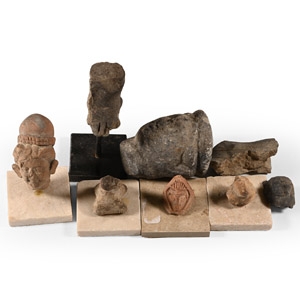
South East Asian Stone and Other Terracotta Artefact Group
1st millennium B.C. and laterSold for (Inc. bp): £39
Including head with cap, small dog and other types, some on a ceramic base. 647 grams total, 2.8-11 cm including stand
From a collection acquired on the UK art market from various auction houses and collections mostly before 2000. From an important Cambridgeshire estate; thence by descent. -
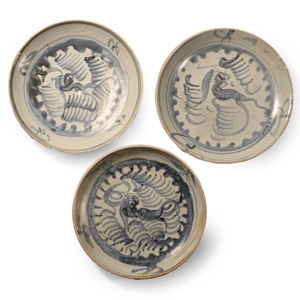
Tek Sing Treasure Shipwreck Glazed Blue and White Dish Group
Early 19th century A.D.Sold for (Inc. bp): £72
Each a broad flat dish with floral motif and fronds. 836 grams total, 17.3-18 cm
Ex Nagel Auction, with official Tek Sing Treasure labels to verso. Accompanied by an illustrated information sheet about the Tek Sing shipwreck.
The Tek Sing (True Star) wreck is one of the famous recovery stories of the 20th century. Sailing from the port of Xiamen (then known as Amoy) in February 1822 the vessel Tek Sing was bound for Jakarta, Indonesia laden with porcelain goods and 1600 Chinese emigrants. The captain decided to pass through the Gaspar Strait, between the Bangka-Belitung Islands, and ran aground on a reef. The vessel sank in about 100 feet of water. The next morning, February 7, an English East Indiaman captained by James Pearl, passing through the same waters, encountered debris and some survivors and managed to rescue about 190 of the latter. -
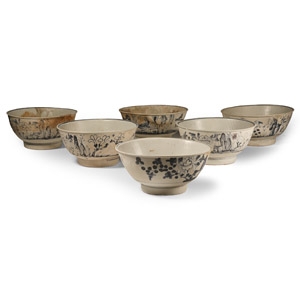
Large Tek Sing Treasure Shipwreck Glazed Blue and White Bowl Set
Early 19th century A.D.Sold for (Inc. bp): £156
Each a squat glazed footed bowl with painted floral motifs below the rim to the outer face, concentric rings to the inner face with rosette to the centre. 2.73 kg total, 16.2-16.8 cm
Ex Nagel Auction, with official Tek Sing Treasure labels to verso. Accompanied by an illustrated information sheet about the Tek Sing shipwreck.
The Tek Sing (True Star) wreck is one of the famous recovery stories of the 20th century. Sailing from the port of Xiamen (then known as Amoy) in February 1822 the vessel Tek Sing was bound for Jakarta, Indonesia laden with porcelain goods and 1600 Chinese emigrants. The captain decided to pass through the Gaspar Strait, between the Bangka-Belitung Islands, and ran aground on a reef. The vessel sank in about 100 feet of water. The next morning, February 7, an English East Indiaman captained by James Pearl, passing through the same waters, encountered debris and some survivors and managed to rescue about 190 of the latter.

