-
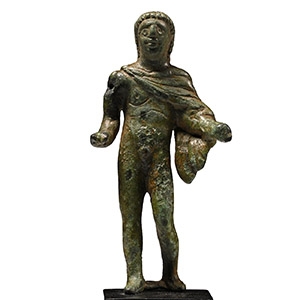
Roman Bronze Statuette of Hermes
2nd-3rd century A.D.Sold for (Inc. bp): £390
Standing nude with left leg bent, arms extended, mantle draped from the right shoulder, hair combed forward from the crown; mounted on a custom-made stand. 100 grams total, 10 cm including stand
From a collection acquired on the UK art market from various auction houses and collections mostly before 2000. From an important Cambridgeshire estate; thence by descent.
Despite the lack of specific attributes related to Hermes, the pose of the statue, with the right hand advanced to hold the sacculus, the cloak thrown over the right shoulder and then folded over the left would lean towards an interpretation of the statuette as an ex voto related to the god of thieves. The statuette seems to originate from a Gallo-Roman workshop. A similar drapery on the chest is also found on a Mercury/Hermes in the Museum of Besancon. -
.jpg)
A Fine Life-Sized Eastern Roman Bust of a Wealthy Lady
2nd-3rd century A.D.Sold for (Inc. bp): £28,600
Finely carved in hard white limestone; the facial features framed by swept-back locks of wavy hair enclosed by a loosely draped palla headdress held onto a low turban by a segmented diadem with high-relief ornament, with drop earrings at the sides; a necklace of graduated beads at the throat, soft fabric stola covering the chest and shoulders; the arched brows above large almond-shaped eyes with carefully worked pupils, small pert mouth with full lips, smooth cheeks and brow; unworked to the reverse; mounted on a custom-made stand. 29.95 kg, 50 cm including stand
From a private UK collection, since at least 1971. Acquired from Rupert Wace Ancient Art Limited, Old Bond Street, London W1, UK, in 2001. From the private collection of Mr M.R. Davis, Bristol, UK. Accompanied by a copy of a stamped and signed Art Loss Register declaration dated 1st March 2001. Accompanied by a copy of a conservation report by restorer David Singleton dated 26th June 2001. Accompanied by a copy of the 23th February 2001 invoice (£34,000); a copy of the illustrated listing with reference number C230; plus communications regarding acquisition. Accompanied by an academic report by Dr Raffaele D’Amato. This lot has been checked against the Interpol Database of stolen works of art and is accompanied by search certificate no.12339-224541.
The sculpture is a good example of 2nd-3rd century A.D. Palmyrene female funerary portrait types. The amount of jewellery displayed in these portraits could be a direct reflection of the wealth of the family, and certainly reflected the jewellery possessed by the owner of the grave. -
.jpg)
Eastern Roman Head of a Priest
Palmyra, circa 3rd century A.D.Sold for (Inc. bp): £6,500
Carved in the half-round wearing flat-topped priest's cap with laurel wreath detailing and medallion, naïve facial features with exaggerated lentoid eyes and soft modelled cheeks and mouth; mounted on a custom-made stand. 7.5 kg total, 26.5 cm including stand
Previously in the private collection of Mr Pierre Bart (1889-1964), an official of the French Mandate in Syria and Lebanon (1919-1936), and delegate to the Lebanese government until 1946. Thence by descent in 1964 to his daughter Lucienne Amirault who brought the inherited collection with her to France from Beirut on 11th October 1976. Accompanied by inventory list from 11 October 1976. Accompanied by a copy of a previous six page catalogue document. Accompanied by a copy of a signed Art Loss Register declaration no.S00218486. Accompanied by French cultural passport no.233598. This lot has been checked against the Interpol Database of stolen works of art and is accompanied by a search certificate number no.12399-225440. -
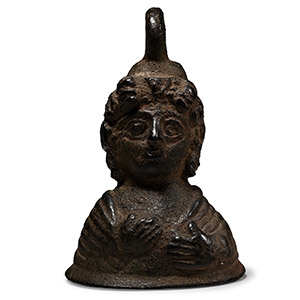
Byzantine Bronze Steelyard Weight of an Empress
5th-6th century A.D.Sold for (Inc. bp): £1,820
Filled with lead and formed as the upper body of an empress wearing a pleated palla, her hair arranged in loose curls around the face, suspension loop to the head. 630 grams, 94 mm
Private collection, Europe. Acquired by the current owner in 1999. Accompanied by a copy of an Art Loss Register certificate no.S00038155.
The choice of the image of the empress for an official weight may have been to display fairness and equality before the law in commercial matters, as well as to bolster the authority of the imperial family. -
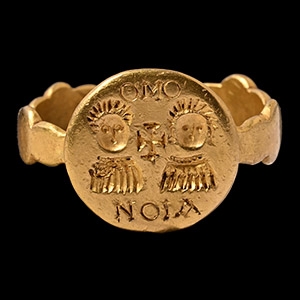
Byzantine Gold Marriage Ring with Busts
6th-8th century A.D.Sold for (Inc. bp): £4,420
With hoop formed as a band of quatrefoils, applied discoid bezel with facing busts flanking a cross potent, legend 'OMO / NOIA' (harmony). 6.47 grams, 21.52 mm overall, 19.27 mm internal diameter (approximate size British O, USA 7, Europe 14.98, Japan 14)
Acquired on the London art market in the late 1980s-1990s. From the family collection of an East London, UK, gentleman. This lot has been checked against the Interpol Database of stolen works of art and is accompanied by a search certificate no.12350-222584
The marriage ring is one of the typologies on which figural decorations are frequently found. Generally marriage rings are engraved with a representation of the husband and wife, sometimes accompanied by Christ, and usually engraved with wishes for 'harmony, health and the grace of God'. Rings of this type had been used since the late 4th century A.D. and remained extremely popular in Byzantium in the 6th and 7th century. -
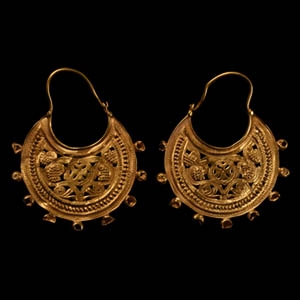
Byzantine Gold Earrings with Crosses
Circa 6th-8th century A.D.Sold for (Inc. bp): £1,170
Each a crescent plaque with integral wire loop and fastener, applied radiating granules to the rim, the field an openwork panel of tendrils and grapes surrounding an equal-arm cross. 10.80 grams total, 59-60 mm
Formerly in North American collection, 1990s. From the collection of a London, UK, gentleman. -
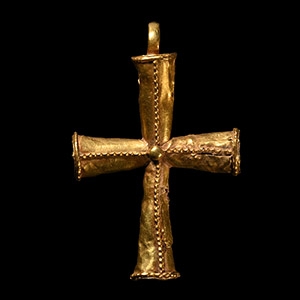
Byzantine Gold Cross Pendant
5th-6th century A.D.Sold for (Inc. bp): £3,315
Hollow-formed sheet gold cruciform pendant with filigree ropework to the end of each expanding tubular arm, band of beading to the upper face of each arm and central pellet; bale to the upper end. 3.67 grams, 40 mm
Acquired in the mid 1980s-1990s. From the family collection of Mr S.A., Switzerland, thence by descent. Private collection since the late 1990s. This lot has been checked against the Interpol Database of stolen works of art and is accompanied by a search certificate number no.12114-218167. -
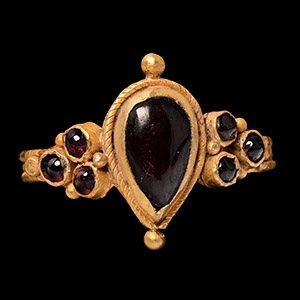
Byzantine Gold Ring with Cabochon Garnets
6th-8th century A.D.Sold for (Inc. bp): £1,690
With gusset to the hoop, each triangular shoulder with three cells containing garnet cabochons, bezel a piriform cell with granules and inset garnet cabochon. 4.04 grams, 23.53 mm overall, 18.52 mm internal diameter (approximate size British Q 1/2, USA 8 1/4, Europe 18.12, Japan 17)
Acquired on the London art market in the late 1980s-1990s. From the family collection of an East London, UK, gentleman. -
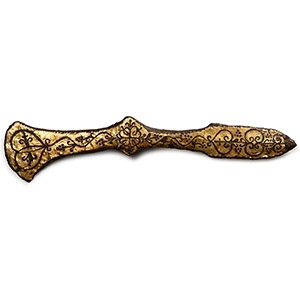
Byzantine Gold Inlaid Ceremonial Axe Head
Circa 9th-12th century A.D.Sold for (Inc. bp): £11,700
A miniature tzikourion comprising a crescentic blade with long neck, flared socket and leaf-shaped blade to the rear; gilt surface with reserved florid and tendril detailing, stylised cross to the flared socket. 28.88 grams, 10.9 cm
Private collection formed in Europe in the 1980s. Westminster collection, central London, UK. Accompanied by an academic report by Dr Raffaele D’Amato. This lot has been checked against the Interpol Database of stolen works of art and is accompanied by search certificate no. no.12340-225024.
It is possible that this axe was used as a status symbol for officers or their family. The axe was known to be a symbol of the Varangian Guard who protected the emperor. -
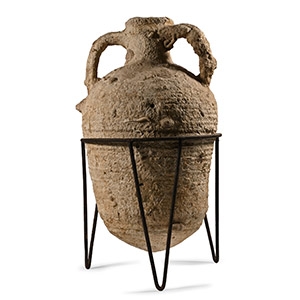
Byzantine Shipwreck Terracotta Wine Amphora
5th-7th century A.D.Sold for (Inc. bp): £468
With tapering ribbed sidewall and conical foot, domed shoulder, carinated mouth with two lateral strap handles; marine encrustation; with tripod display stand. 8.15 kg total, 56 cm high including stand
From a family collection mostly formed in the 1940s-1950s, thence by descent. -
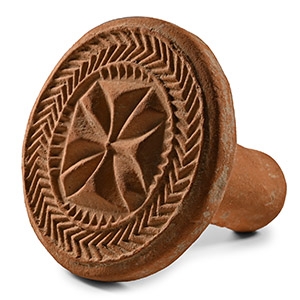
Byzantine Terracotta Bread Stamp
10th-11th century A.D.Sold for (Inc. bp): £1,300
Discoid in plan with integral stub handle; central Maltese cross within a herringbone ring. 319 grams, 95 mm
From the collection of Sir Daniel Donohue [1919-2014] and the Countess Bernardine [1904-1968], Los Angeles, USA; the collection was assembled in the 1950-1960s, but before March 1968. with Bonhams, London, 13 April 2011, no.310 [Part]. Acquired on the English art market, 2011. Private collection, Europe. Accompanied by copies of the relevant Bonhams catalogue pages. -
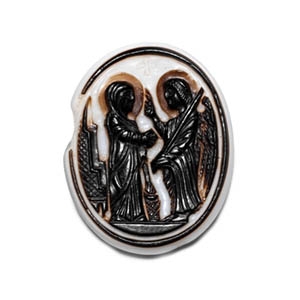
Byzantine Cameo with Virgin Mary and Archangel Gabriel
6th century A.D.Sold for (Inc. bp): £5,720
Ellipsoid in plan with reserved image of the Annunciation and a frond. 2.3 grams, 25 mm
Formerly in the collection of Michael Dennis O'Hara, 1970. From the private collection of the late Alison Barker, a retired barrister, formed 1970-1990. Ex North American collection. Accompanied by an academic report by Dr Raffaele D'Amato. This lot has been checked against the Interpol Database of stolen works of art and is accompanied by search certificate no.12401-226381.
The cameo represents the well known episode of the Gospel of Saint Luke (1.26.38), where the Archangel Gabriel brings Virgin Mary the news of her pregnancy.

